Snorkeling Guides
DreamDiver's snorkeling guides cover 15 places, from Hanauma Bay and the Kona manta night snorkel in Hawaii to Cozumel, Aruba, Bali, Nusa Penida, the Great Barrier Reef and Iceland's Silfra fissure. Each guide marks every spot as a shore or boat entry and lists the official rules, entry fees and tour prices.
Popular snorkeling trips
Trips run by local operators, booked on Viator or GetYourGuide.
 ViatorHanauma BayHanauma Bay Guided Snorkeling Tour with TransportationView on Viator (opens in a new tab)
 GetYourGuideHanauma BayHonolulu: Hanauma Bay Snorkeling TourView on GetYourGuide (opens in a new tab)
 ViatorOahuWaikiki Turtle Canyon Snorkel Adventure on OahuView on Viator (opens in a new tab)
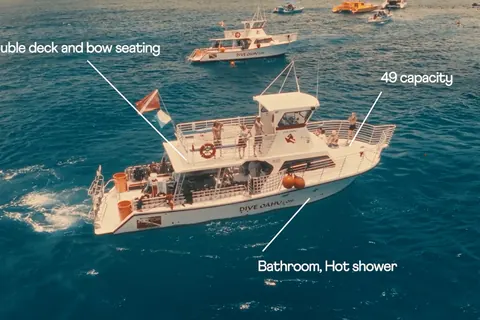 GetYourGuideOahuOahu: Honolulu Turtle Canyon Snorkeling TourView on GetYourGuide (opens in a new tab)
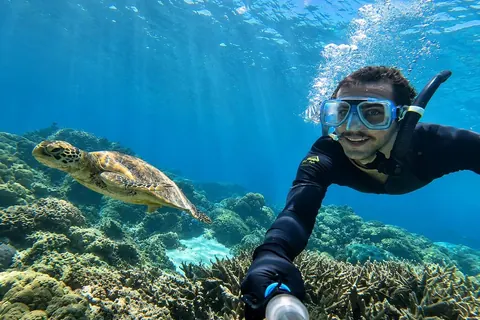 ViatorMauiTurtle Town Signature Snorkel: With Photo and VideoView on Viator (opens in a new tab)
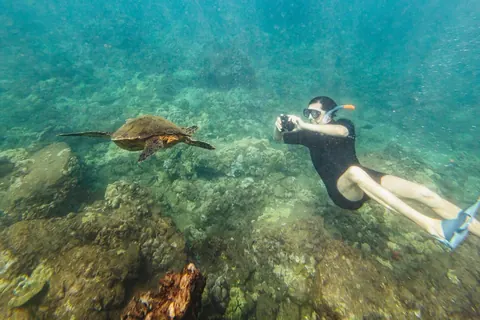 GetYourGuideMauiSouth Maui: Molokini & Turtle Town Snorkeling Tour with MealView on GetYourGuide (opens in a new tab)
Ratings from GetYourGuide travellers.
Which snorkeling spots does DreamDiver cover?
DreamDiver covers 15 snorkeling destinations with 91 spots between them: Hanauma Bay, Oahu, Maui and Kona in Hawaii; Cozumel, Cancun, the Florida Keys, Key West, Puerto Rico, Aruba and Turks and Caicos; Bali and Nusa Penida; the Great Barrier Reef; and Silfra in Iceland.
Each guide marks every spot as a shore or boat entry, gives its level and currents, and lists the park rules and entry fees you need to know.
- Hanauma BayHow to snorkel Hanauma Bay on Oahu: booking two days ahead, the US$25 entry and mandatory video, opening days, the safest reef zones and the currents to avoid.
- OahuWhere to snorkel on Oahu beyond Hanauma Bay: Shark's Cove and Three Tables in summer, Kuilima Cove, Waikīkī, Ko Olina and Turtle Canyon boat trips from US$60.
- MauiWhere to snorkel on Maui: Molokini Crater by tour boat, Honolua Bay in summer, Black Rock, Kapalua and Turtle Town, with cruise prices and the state rules.
- KonaSnorkeling in Kona on Hawaii's Big Island: the manta ray night snorkel from about US$149, the Captain Cook Monument, Two Step, Kahaluʻu and the rules to know.
- Great Barrier ReefSnorkeling in the Great Barrier Reef: Green Island, Fitzroy Island, Michaelmas Cay and an outer-reef pontoon, official rules, stinger season and tour prices.
- Key WestSnorkeling in Key West: Sand Key, Rock Key and the Sambos by boat, Looe Key in the Lower Keys, Dry Tortugas ferry with its US$15 park fee and sanctuary rules.
- Florida KeysSnorkeling the Florida Keys reef by boat: Christ of the Deep at Key Largo Dry Rocks, Molasses, Alligator Reef, Sombrero Key and Looe Key, with prices and rules.
- CozumelWhere to snorkel in Cozumel: Chankanaab park and Sky Reef from the beach, Paradise Reef, Palancar and Colombia shallows by boat, and the MXN 225 daily park fee.
- Cancun & Riviera MayaSnorkeling around Cancun and the Riviera Maya: MUSA statues, Isla Mujeres reefs, Puerto Morelos, Akumal's turtles on guided tours, Gran Cenote and park fees.
- Puerto RicoWhere to snorkel in Puerto Rico: Escambrón in San Juan, Culebra's Cayo Luis Peña and Tamarindo, Vieques, Fajardo and La Parguera, with tour prices and rules.
- ArubaSnorkel Aruba from the beach at Arashi, Boca Catalina, Malmok, Mangel Halto and Baby Beach, or sail to the Antilla wreck: sail prices, currents and rules.
- Turks and CaicosSnorkel Turks and Caicos from the beach at Bight Reef and Smith's Reef on Providenciales, or by boat to Leeward and Half Moon Bay: currents, rules and prices.
- BaliWhere to snorkel in Bali: Jemeluk Bay in Amed, the Liberty wreck at Tulamben, Menjangan and Padang Bai, with trip prices, the tourist levy and best months.
- Nusa PenidaSnorkel with reef mantas at Manta Bay and Manta Point, then Crystal Bay, Gamat Bay and Toyapakeh: Nusa Penida's spots, sea conditions, fees and manta rules.
- SilfraSnorkel Silfra in Iceland's Þingvellir National Park: the four sections of the fissure, dry suit rules, the ISK 1,500 park fee and guided tour prices.
Can you snorkel from the shore, or do you need a boat tour?
Aruba, Hanauma Bay, Silfra, Maui and Oahu are snorkeled almost entirely from the shore, while the Florida Keys reefs, Nusa Penida, most reefs off Key West and the outer Great Barrier Reef need a boat.
On the Great Barrier Reef, Green Island and Fitzroy Island have beach entries once you are on the island; Michaelmas Cay, Low Isles, the outer-reef pontoon and the Agincourt Reefs are boat trips. Off Key West, Sand Key, Rock Key, the Sambo reefs and Looe Key are boat sites, while Fort Jefferson on Garden Key in the Dry Tortugas is snorkeled from the beach after a ferry ride.
In Cozumel, Chankanaab and the Sky Reef beach club are beach entries and Paradise Reef and the Palancar and Colombia shallows are boat stops. In Kona the manta night snorkel is a boat trip, while Kahaluʻu Beach Park and Two Step are entered from shore.
| Destination | Shore spots | Boat spots | Guided trip (typical price, range) |
|---|---|---|---|
| Hanauma Bay | 5 | 0 | No boat needed |
| Oahu | 6 | 1 | USD 80 (USD 60–139.95), Turtle Canyon trip from Waikīkī |
| Maui | 5 | 1 | USD 249 (USD 180–269), Molokini cruise |
| Kona | 4 | 3 | USD 149 (USD 139–175), manta ray night snorkel |
| Great Barrier Reef | 2 | 4 | AUD 289 (AUD 275–394), outer-reef day trip |
| Key West | 1 | 4 | USD 67.50 (USD 50–79), Florida Keys reef trip |
| Florida Keys | 0 | 7 | USD 67.50 (USD 50–79), reef trip with gear |
| Cozumel | 2 | 4 | Not in our price list |
| Cancun & Riviera Maya | 3 | 4 | USD 55 (USD 45–59), guided reef trip with gear |
| Puerto Rico | 4 | 3 | USD 105 (USD 70–113), reef trip or catamaran sail |
| Aruba | 6 | 1 | USD 85 (USD 69–107), snorkel sail with gear |
| Turks and Caicos | 3 | 3 | USD 125 (USD 125–135), shared half-day boat trip |
| Bali | 2 | 3 | IDR 350,000 (IDR 320,000–600,000), trip from Amed or Tulamben |
| Nusa Penida | 0 | 5 | Not in our price list |
| Silfra | 5 | 0 | ISK 14,699 (ISK 13,592–16,857), guided dry suit tour |
How much does it cost to snorkel at these spots?
Many of these spots cost nothing to enter, among them Aruba's marine park, the Turks and Caicos beach reefs and Kealakekua Bay in Kona, while Hanauma Bay charges non-residents aged 13 and over USD 25 plus a 2.35% online fee and Mexico's reef parks charge MXN 125.32–225.56 per person per day.
- Hanauma Bay: parking is USD 3 per non-resident vehicle, cash on site. Hawaii residents with ID, U.S. military and children 12 and under enter free.
- Kona and Oahu: permitted commercial ocean tours collect an Ocean Stewardship User Fee of USD 1 per passenger. At Two Step, Puʻuhonua o Hōnaunau's USD 20 vehicle fee applies only if you also visit the park.
- Maui: Mākena State Park charges non-residents USD 5 per person and USD 10 per vehicle for parking.
- Great Barrier Reef: the Environmental Management Charge of AUD 8.50 a day is included in tour prices; it is AUD 4.25 for trips under three hours, and the full-day rate rises to AUD 9.00 on 1 April 2027.
- Key West: the Dry Tortugas entrance fee of USD 15 applies from age 16, is valid for 7 days and is included in ferry tickets.
- Florida Keys: John Pennekamp Coral Reef State Park in Key Largo charges USD 8 per vehicle with 2–8 people plus a USD 0.50 county surcharge per person, USD 4 for a single-occupant vehicle and USD 2.50 on foot or by bike.
- Cozumel: the Arrecifes de Cozumel National Park fee is MXN 225.56 per person per day, paid as MXN 225, and Chankanaab park entry is MXN 589 for adults.
- Cancun: the Isla Mujeres–Punta Cancún–Punta Nizuc and Puerto Morelos national parks each charge MXN 125.32 per person per day, paid as MXN 125.
- Bali and Nusa Penida: international visitors pay the Bali tourist levy of IDR 150,000, which is not a marine-park fee; at Nusa Penida a marine-park charge is reported at IDR 100,000 per person per day, so check the amount on arrival.
- Silfra: Þingvellir National Park charges ISK 1,500 per person for each snorkel, usually included in tour prices, and ISK 1,000 a day to park a car.
Do you need to book Hanauma Bay in advance?
Yes, non-residents book Hanauma Bay online two days ahead, from 7 a.m. Hawaii time, although about a quarter of entries are kept for walk-ins.
- The bay is open Wednesday to Sunday, with entry from 6:45 a.m. to 1:30 p.m.; it is closed every Monday and Tuesday and on December 25 and January 1.
- Every visitor watches the educational video in the theater on each visit, even a repeat one.
- Payment is online, non-refundable and non-transferable.
- The beach is cleared at 3:30 p.m. and everyone has to leave by 4 p.m.
Where can you snorkel with manta rays?
You can snorkel with manta rays at night off Kona, where boats take you to Manta Village or Manta Heaven for about USD 149 per adult, and by day at Nusa Penida's Manta Bay and Manta Point, where reef mantas come in every month.
Neither is guaranteed. Off Kona, sightings are frequent but vary with plankton and surf. At Nusa Penida, Manta Point is open to swell, so boats go only when the sea allows, and encounters tend to peak from April to June. From Bali's east coast, Padang Bai centers sell full-day snorkel trips across the Badung Strait to Manta Point.
What rules apply when you snorkel these reefs?
Every one of these places has official rules, and most come down to the same thing: do not touch, stand on or take coral and marine life, and do not feed fish; some add their own, such as the dive flag in the Florida Keys sanctuary, life jackets in Cancun's marine parks and a guide for every group in Silfra.
- Hawaii: Hanauma Bay, Molokini, Honolua–Mokulēʻia Bay, Pūpūkea, Waikīkī, Kealakekua Bay and Old Kona Airport are Marine Life Conservation Districts: no taking or injuring marine life. Molokini islet is a seabird sanctuary, so landing on it is prohibited, and anywhere in Hawaii you stay 50 yards (46 m) from spinner dolphins.
- Florida Keys and Key West: in Sanctuary Preservation Areas such as Sand Key, Rock Key and Looe Key, do not touch or stand on coral, and tie up to mooring buoys instead of anchoring. At the Dry Tortugas, day-use buoys may be used for up to 2 hours.
- Great Barrier Reef: Michaelmas Cay is a seabird Restricted Access Area, so stay inside the roped visitor zone. The reefs around Michaelmas and Upolu cays are a no-take Green Zone, fishing is not allowed around Green Island, and Woody Island in the Low Isles group closes from September to March for nesting pigeons.
- Cancun and the Riviera Maya: in Akumal Bay you may swim with the sea turtles only on a guided tour with an authorized guide, in groups of up to 6, inside two marked circuits between 9:00 and 17:00.
- Cozumel: at Chankanaab you may look at and photograph the coral but never touch it, and you stay out of the sea while the red flag flies.
- Aruba: in protected areas you may not feed, disturb or collect any plant or animal, and sunscreens containing oxybenzone have been banned since 2019.
- Silfra: every snorkel is registered with Þingvellir National Park and its fee paid, nobody goes in alone, only people who can swim may snorkel, and a guide may take at most six snorkelers.
Which snorkeling spots suit beginners?
Beginner-rated spots with mild currents include Hanauma Bay's inner reef flat, Kahaluʻu Beach Park in Kona, Kuilima Cove and the Waikīkī reef on Oahu, Arashi Beach and Baby Beach in Aruba, Escambrón Beach in San Juan, Jemeluk Bay in Amed, Chankanaab in Cozumel and the Reef Magic pontoon off Cairns.
Places to treat with care:
- Hanauma Bay's cable channel, where rip currents can be strong on ebb tides, and the outer left side of the bay near the Molokaʻi Express current. Witches' Brew and the Toilet Bowl are best avoided in rough water.
- Oahu's North Shore in winter, when the Pūpūkea reserve becomes dangerous, and Electric Beach, with strong currents and a rocky, exposed entry.
- Molokini in the afternoon, when the currents pick up, and Honolua Bay in winter, when high surf is common.
- Mangel Halto in Aruba and Smith's Reef in Turks and Caicos, where currents can build or run along the beach.
- Toyapakeh at Nusa Penida, a drift in a strong current, and Manta Point when the swell is up.
- Fitzroy Island away from Welcome Bay and Nudey Beach, where currents can be dangerous.
Current ratings for the Great Barrier Reef spots are a rough guide, not measured values, so ask the crew about the day's conditions before you get in.
Where can you snorkel with turtles?
Turtles are a feature at Makena Landing on Maui, known as Turtle Town, at Kahaluʻu Beach Park in Kona, on Turtle Canyon off Waikīkī, in Akumal Bay south of Cancun, at Smith's Reef in Turks and Caicos and at Green Island off Cairns, where they are often seen at the surface.
They are also often around Crystal Bay at Nusa Penida, on Hanauma Bay's outer reef and on the Culebra and Vieques beach reefs in Puerto Rico. Give turtles room and let them surface. In Akumal Bay you may swim with them only on a guided tour, and in Hawaii's Marine Life Conservation Districts, such as Hanauma Bay, injuring marine life is prohibited.
How warm is the water for snorkeling at each spot?
Monthly sea averages at these spots range from 23.4 °C (74 °F) on the Great Barrier Reef in August to 29.9 °C (86 °F) in the Florida Keys in the same month, while Silfra in Iceland is fresh water that the national park gives as 2–4 °C (36–39 °F).
On the Great Barrier Reef the warm months are also stinger season: box jellyfish and irukandji can occur all year but are most likely from November to May, when a full-body stinger or lycra suit is advised. In Silfra the tours put you in a dry suit with a hood and gloves. The sea figures are long-term monthly averages at the surface.
| Destination | Coolest month | Warmest month |
|---|---|---|
| Hanauma Bay | Feb–Mar: 23.9 °C (75 °F) | Sep: 26.7 °C (80 °F) |
| Oahu | Feb–Mar: 24.0 °C (75 °F) | Sep: 26.8 °C (80 °F) |
| Maui | Feb–Mar: 24.3 °C (76 °F) | Sep: 26.9 °C (80 °F) |
| Kona | Feb–Mar: 24.7 °C (76 °F) | Sep: 27.2 °C (81 °F) |
| Great Barrier Reef | Aug: 23.4 °C (74 °F) | Feb: 28.7 °C (84 °F) |
| Key West | Feb: 23.8 °C (75 °F) | Aug: 29.8 °C (86 °F) |
| Florida Keys | Jan–Feb: 23.8 °C (75 °F) | Aug: 29.9 °C (86 °F) |
| Cozumel | Feb: 26.5 °C (80 °F) | Sep: 29.4 °C (85 °F) |
| Cancun & Riviera Maya | Feb–Mar: 26.4 °C (80 °F) | Sep: 29.2 °C (85 °F) |
| Puerto Rico | Feb–Mar: 26.2 °C (79 °F) | Sep–Oct: 28.9 °C (84 °F) |
| Aruba | Feb: 26.0 °C (79 °F) | Sep–Oct: 28.6 °C (83 °F) |
| Turks and Caicos | Feb: 25.4 °C (78 °F) | Sep: 29.1 °C (84 °F) |
| Bali | Aug: 26.7 °C (80 °F) | Apr: 28.9 °C (84 °F) |
| Nusa Penida | Aug: 26.7 °C (80 °F) | Apr: 28.9 °C (84 °F) |
| Silfra (fresh water) | 2–4 °C (36–39 °F) | 2–4 °C (36–39 °F) |
Frequently asked questions
How much does a snorkeling tour cost?
It depends on how far the boat goes. A Florida Keys reef trip usually costs about USD 67.50, a Turtle Canyon trip off Waikīkī USD 80, the Kona manta night snorkel USD 149, a Molokini cruise on Maui USD 249 and an outer-reef day on the Great Barrier Reef AUD 289. Hanauma Bay, the Aruba beaches and Bight Reef in Turks and Caicos need no tour at all.
Do you need a stinger suit to snorkel the Great Barrier Reef?
From November to May, yes: box jellyfish and irukandji can occur all year off tropical Queensland but are most likely in those months, and the Great Barrier Reef Marine Park Authority advises wearing a full-body stinger or lycra suit then. Ask your reef trip operator whether suits are provided before you book, so you are not caught without one.
Can you snorkel at Hanauma Bay without a reservation?
Sometimes. Non-residents are expected to book a time slot online two days ahead, from 7 a.m. Hawaii time, but about a quarter of entries are kept for walk-ins on open days, Wednesday to Sunday. Walk-in places are limited, so a booking is the safer plan. Hawaii residents with ID, U.S. military and children 12 and under enter free.
What is a good snorkeling spot for complete beginners?
Hanauma Bay's inner reef flat is a gentle start: shallow, up to about 3 m (10 ft), entered from the beach and inside a Marine Life Conservation District. Arashi Beach in Aruba and Kahaluʻu Beach Park in Kona are other easy shore entries. Stay away from channels and points with currents, such as Hanauma Bay's cable channel on an ebb tide.
How cold is the water in Silfra?
Very cold: Þingvellir National Park gives Silfra's water temperature as 2–4 °C (36–39 °F), and it is fresh water, not sea water. Tours put you in a dry suit with a hood, gloves and neoprene boots or socks, so little more than your face touches the water. A guided snorkel costs about ISK 13,600–16,900 with all the gear.


