Dive guide · Mexico
Scuba Diving in Cancun and the Riviera Maya
Cancun and the Riviera Maya pair Caribbean reef diving, from the MUSA sculptures and Isla Mujeres to Akumal's turtles, with jungle cenotes such as Angelita and The Pit. December to May falls outside hurricane season, with water at 26.4–27.8 °C (80–82 °F). A two-tank reef dive costs about US$127.
Key facts
- Best months
- December to May
- Water temperature
- 26.4–29.2 °C (80–85 °F)Monthly average, coolest to warmest month
- Level
- Beginner to advanced
- Open Water course
- US$489Typical price, checked
- Two-tank boat dive
- US$127Typical price, checked
- Discover Scuba (try dive)
- US$154.50Typical price, checked
- Snorkel tour
- US$55Typical price, checked
- Airports
- Cancún International Airport (CUN), Tulum International Airport (TQO)
- Park fee
- Costa Occidental de Isla Mujeres, Punta Cancun y Punta Nizuc National Park (Cancun and Isla Mujeres reefs, MUSA), per person per day: MX$125.32
- Park fee
- Arrecife de Puerto Morelos National Park, per person per day: MX$125.32
- Park fee
- Caribe Mexicano Biosphere Reserve, per person per day: MX$125.32
- Park fee
- Tiburon Ballena Biosphere Reserve (whale-shark area off northern Quintana Roo), per person per day: MX$225.56
- Park fee
- Optional annual pass for all federal protected areas except Revillagigedo and Isla Guadalupe: MX$3,759.29
- Nearest chamber
- SSS Recompression Chamber Playa del Carmen, Playa del Carmen
Book a dive trip in Cancun & Riviera Maya
Trips run by local operators, booked on Viator or GetYourGuide.
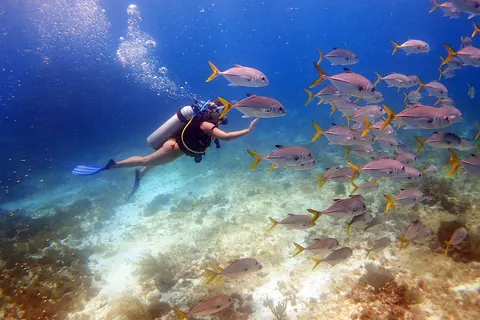 ViatorDiving in the Mexican Caribbean for Beginners 2 Tanks 2 DivesView on Viator (opens in a new tab)
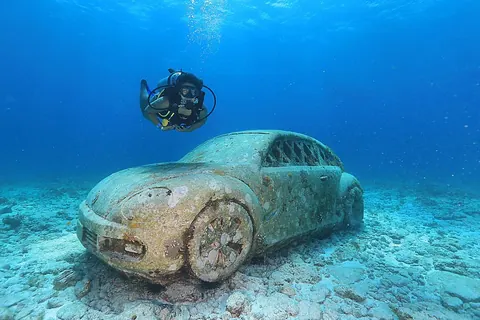 GetYourGuideCancun: Scuba Diving for Beginners at MUSA Underwater Museum & ReefView on GetYourGuide (opens in a new tab)
 Viator2 Tanks Scuba Diving for Beginners in Cancun: MUSA Museum & ReefView on Viator (opens in a new tab)
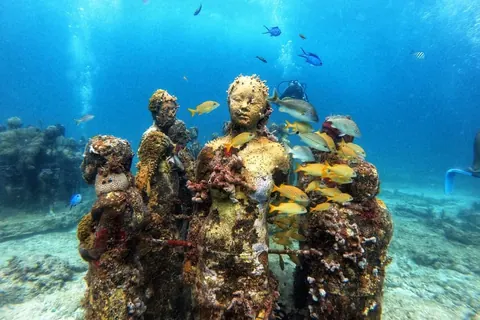 GetYourGuideCancun: MUSA Underwater Museum & Reef Discover Scuba DivingView on GetYourGuide (opens in a new tab)
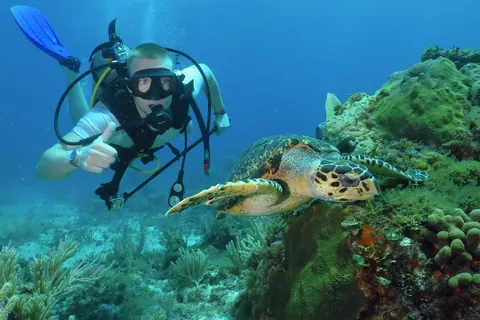 ViatorScuba Diving Under Water Museum and Reef for beginnersView on Viator (opens in a new tab)
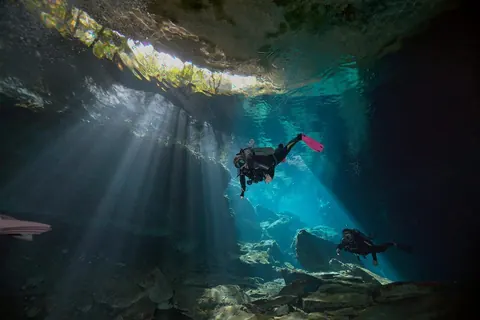 GetYourGuidePrivate Cenote Diving from Playa del Carmen and TulumView on GetYourGuide (opens in a new tab)
All Cancun & Riviera Maya trips on Viator (opens in a new tab)
Ratings from GetYourGuide travellers.
When is the best time to dive Cancun and the Riviera Maya?
The best time to dive Cancun and the Riviera Maya is December to May, outside the June–November hurricane season, when the sea runs at 26.4–27.8 °C (80–82 °F); summer adds whale sharks reached from Isla Mujeres, and winter brings bull sharks to Playa del Carmen.
Most Atlantic storms that reach this coast do so between mid-August and mid-October, so those are the weeks to avoid if your dates are fixed. They are also the warmest weeks, at 29.1 °C (84 °F) in August and 29.2 °C (85 °F) in September. February and March are the coolest months at 26.4 °C (80 °F), and the sea changes by less than 3 °C (5 °F) over the whole year.
Two shark seasons
- Bull sharks, November to March: they gather off Playa del Carmen in winter, and centers run dives for advanced divers (details below).
- Whale sharks, mid-May to mid-September: the summer highlight, reached by boat from Isla Mujeres (details below).
| Month | Average water temperature | Season |
|---|---|---|
| January | 26.5 °C (80 °F) | Best month to dive |
| February | 26.4 °C (80 °F) | Best month to dive |
| March | 26.4 °C (80 °F) | Best month to dive |
| April | 27 °C (81 °F) | Best month to dive |
| May | 27.8 °C (82 °F) | Best month to dive |
| June | 28.4 °C (83 °F) | Outside the best months |
| July | 28.7 °C (84 °F) | Outside the best months |
| August | 29.1 °C (84 °F) | Outside the best months |
| September | 29.2 °C (85 °F) | Outside the best months |
| October | 28.8 °C (84 °F) | Outside the best months |
| November | 28 °C (82 °F) | Outside the best months |
| December | 27.1 °C (81 °F) | Best month to dive |
In season in: January · February · March · April · May · December
What is diving around Cancun and Isla Mujeres like?
Diving around Cancun and Isla Mujeres is mostly shallow boat diving inside a national park, at the MUSA sculptures and the Manchones reef in about 10–12 m (33–39 ft) of water, with deeper sites such as the C-58 wreck at about 24–30 m (79–98 ft).
MUSA, the underwater museum of art, set its sculptures on sand near the reefs to draw snorkelers and divers away from the natural coral. The Punta Nizuc gallery is mostly a snorkel stop; the Manchones gallery off south-west Isla Mujeres lies beside patch reefs that average about 10 m (33 ft), a better depth for divers. Hurricanes have damaged the Manchones reef, so do not expect pristine coral there.
Other boat sites off Isla Mujeres include Punta Sur at about 17 m (56 ft) and the Ultra Freeze wreck at about 29 m (95 ft). Carey Dive Center on Isla Mujeres charges US$130 for two tanks, and Solo Buceo sells a Discover Scuba dive at MUSA for US$149 with gear and fees. The whole area belongs to the Costa Occidental de Isla Mujeres, Punta Cancún y Punta Nizuc National Park, which charges a daily fee (see park fees).
Can you dive with bull sharks in Playa del Carmen?
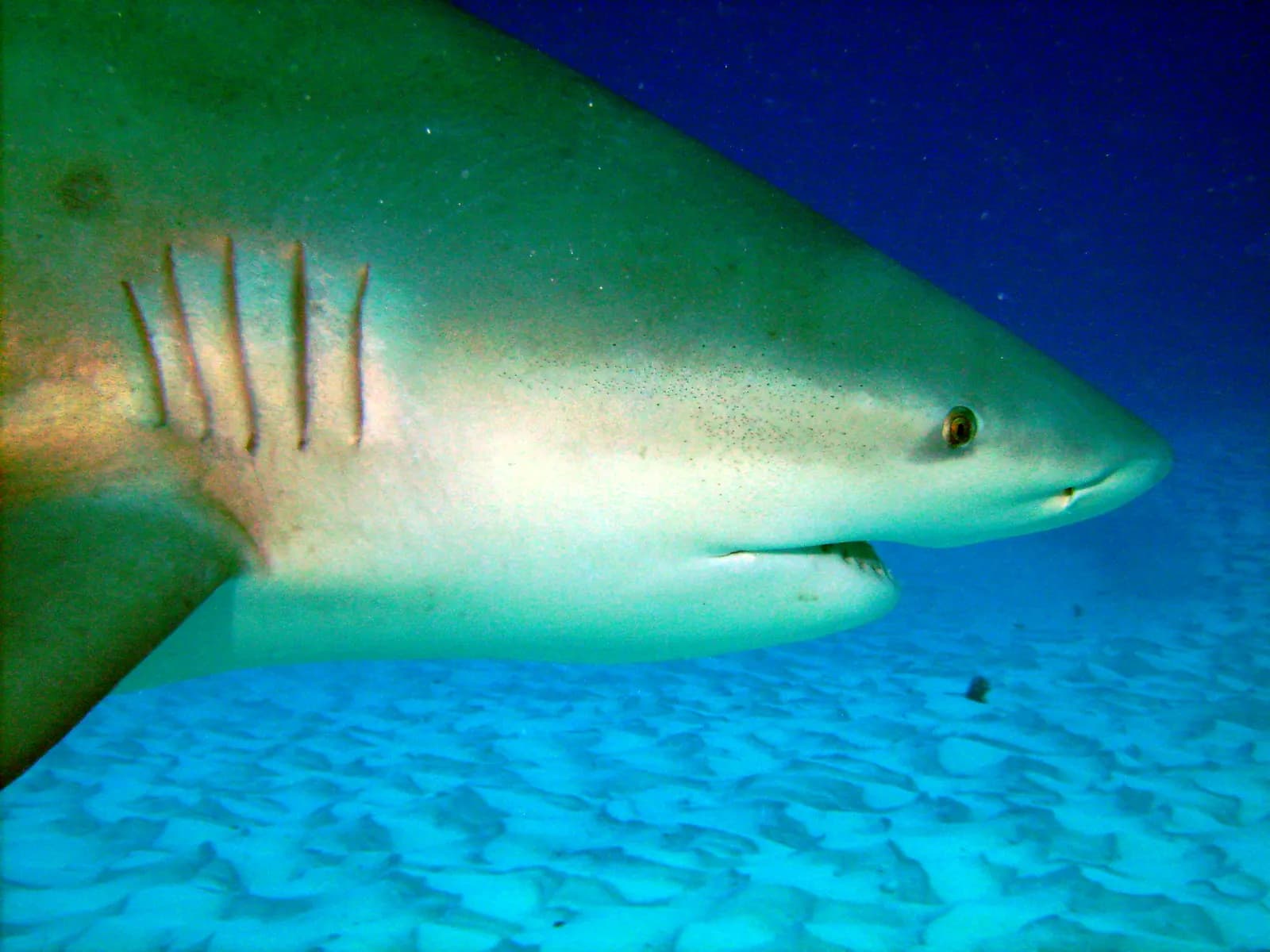
Yes: bull sharks gather off Playa del Carmen from November to March, and Riviera Maya centers run dives to see them for advanced divers only.
Ask how a center runs the dive before you book. Some operators bait the sharks to bring them close, while Koox Diving says it does not feed them; if you would rather not support shark feeding, choose a center that does not bait. Koox charges US$249 from Playa del Carmen and US$294 from Tulum or Cancun.
The sharks are wild animals, so no center can promise an encounter. Agree the depth and the plan with your guide on the boat, and stay with the group.
What is diving in Akumal like?
Akumal, on the coast between Playa del Carmen and Tulum, has boat-dived reefs at 12–30 m (39–98 ft), and at Gonzalo's Reef hawksbill, green and loggerhead turtles feed among the reef fingers.
- Las Redes (12–18 m, 39–59 ft): named after a big commercial fishing net that its first explorers found draped over the reef.
- Dick's Reef (12–15 m, 39–49 ft): the most varied topography in Akumal, with coral structures rising about 6 m (20 ft) off the bottom.
- Motorcycle Reef (15–18 m, 49–59 ft): a coral-covered motorcycle lies in the sand at the shallow end.
- Trigger Fish (18–30 m, 59–98 ft) and Xa-Ak (18–27 m, 59–89 ft): deeper reef fingers and widely spaced coral patches on white sand.
In Akumal Bay itself, the turtles that graze the seagrass may be visited only on a guided snorkel tour, in groups of up to six inside two marked circuits. Our Cancun snorkeling guide has the bay's rules.
What is cenote diving like at Angelita and The Pit?
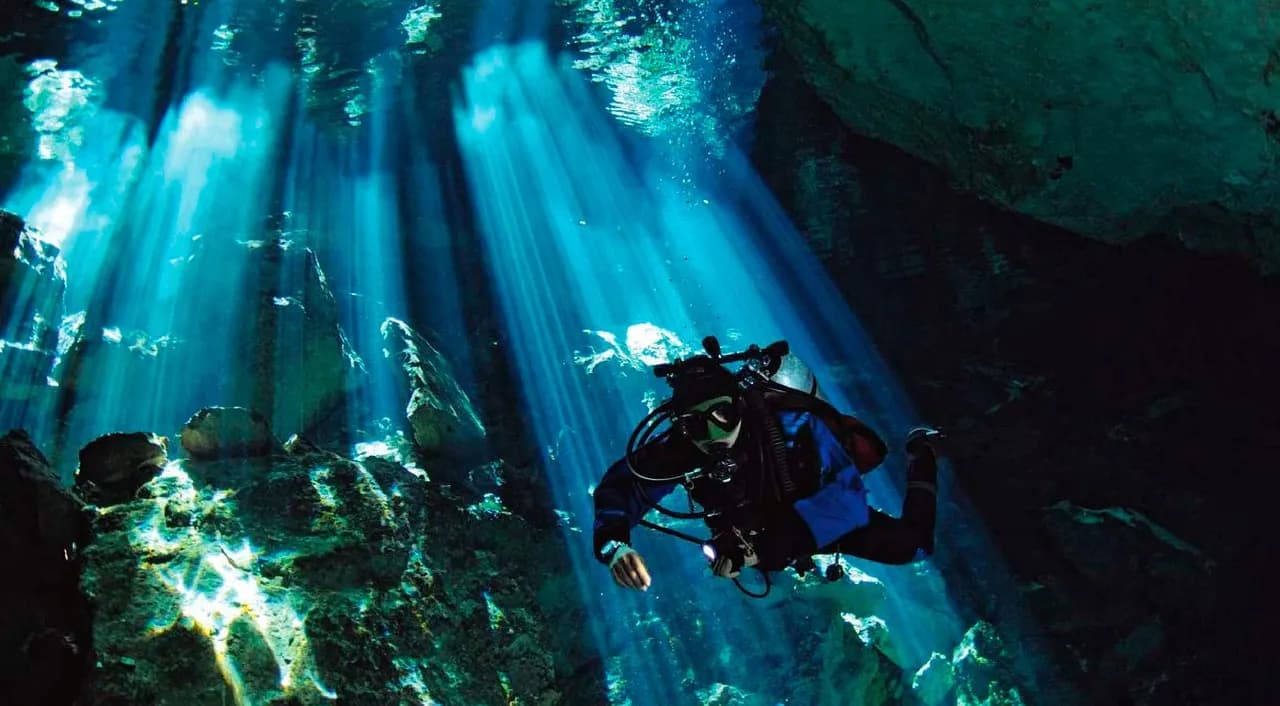
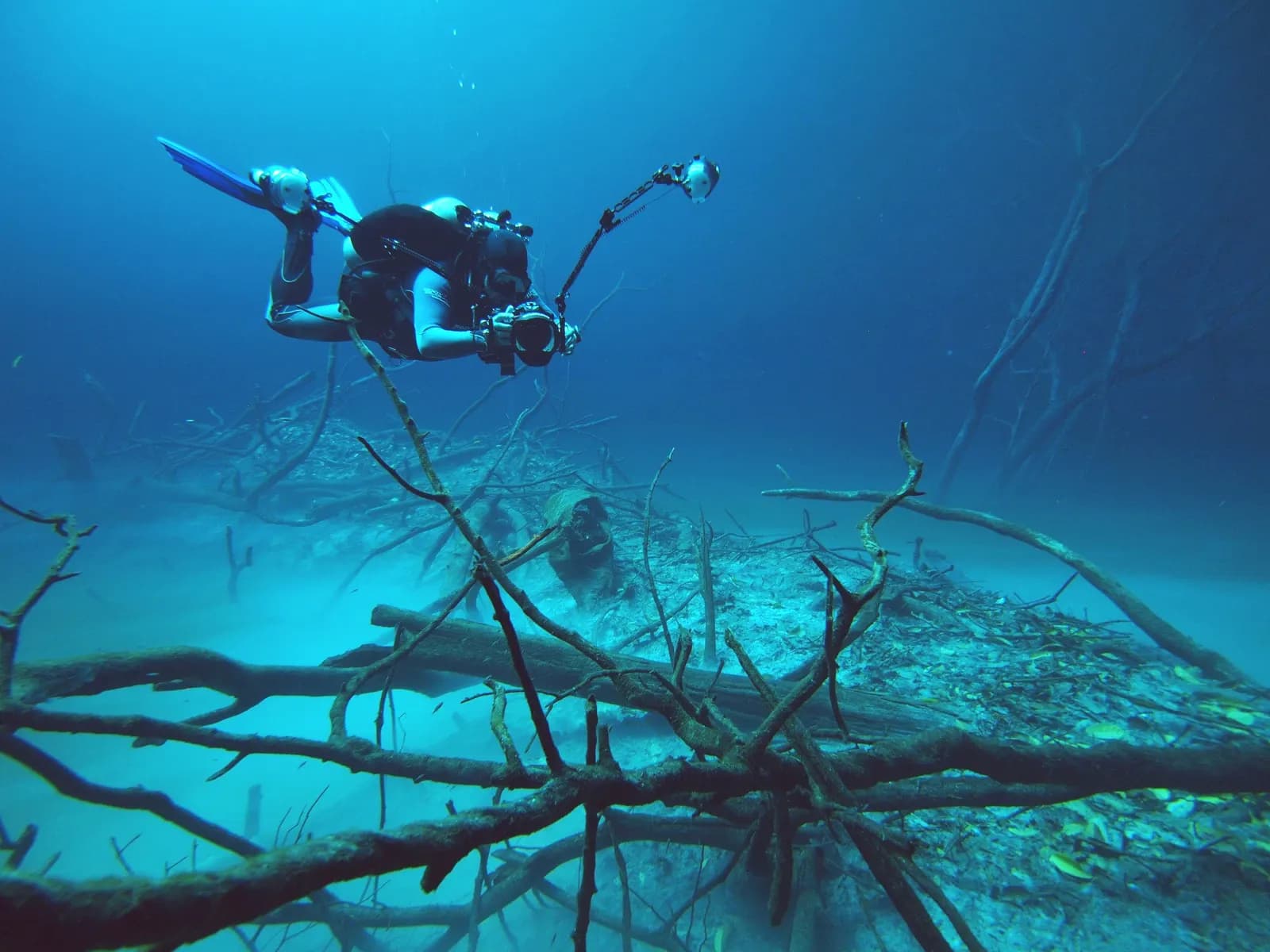
Cenote diving in the Riviera Maya means descending through clear fresh water in jungle sinkholes: at Cenote Angelita and The Pit you sink through a halocline to a hydrogen-sulphide cloud at about 25–30 m (82–98 ft), and guided dives stop at 30–35 m (98–115 ft).
- Cenote Angelita: a ladder entry into fresh water lying over salt water, with dead trees poking up through the cloud; guided dives go to 35 m (115 ft).
- The Pit (El Pit): a deep sinkhole in the Dos Ojos system that you enter with a jump, then sink through shafts of sunlight to the cloud; dives go to about 30 m (98 ft).
Both are advanced dives: Akumal Dive Shop asks for Deep or Advanced Open Water certification and at least 30 logged dives. A two-cenote trip costs US$210 at Scuba Cancun and US$239–249 at Koox Diving. Each cenote charges its own entrance fee, and some add a camera fee: expect to pay the cenote fee on top unless your price says it is included, and ask your center.
When can you swim with whale sharks from Cancun?
Whale-shark trips from Cancun and Isla Mujeres run in summer: the Tiburón Ballena Biosphere Reserve off northern Quintana Roo allows watching and swimming with the sharks only from 15 May to 17 September, and Isla Mujeres centers sell trips from June to mid-September.
Carey Dive Center on Isla Mujeres charges US$155 for its whale-shark tour. The reserve's federal fee is higher than in the reef parks, MXN 225.56 per person per day in 2026, and the tour operator normally collects it. Early and late in the season, ask the center how recent trips have gone before you pay: the sharks are wild, and a sighting is never certain.
Which Riviera Maya dive sites suit your level?
Three of the eight Riviera Maya sites in our table, Las Redes, Dick's Reef and Motorcycle Reef in Akumal, are beginner reefs no deeper than 18 m (59 ft), while the cenotes Angelita and The Pit are advanced.
Gonzalo's Reef, Trigger Fish and Xa-Ak sit in between, intermediate dives at 18–30 m (59–98 ft). The cenotes show 0 m as their shallowest depth because you enter at the surface. For Cancun and Isla Mujeres sites, use the depths given above.
| Dive site | Depth | Level | Entry | Highlights |
|---|---|---|---|---|
| Las Redes (Akumal) | 12–18 m (39–59 ft) | Beginner | Boat | Akumal reef named after a big commercial fishing net its first explorers found draped over it |
| Dick's Reef (Akumal) | 12–15 m (39–49 ft) | Beginner | Boat | The most varied topography in Akumal, with coral structures rising about 6 m off the bottom |
| Motorcycle Reef (Akumal) | 15–18 m (49–59 ft) | Beginner | Boat | A coral-covered motorcycle lies in the sand at the shallow end, surrounded by feeding fish |
| Gonzalo's Reef (Akumal) | 18–24 m (59–79 ft) | Intermediate | Boat | Large reef fingers a few minutes off the Akumal shop, where hawksbill, green and loggerhead turtles feed |
| Trigger Fish (Akumal) | 18–30 m (59–98 ft) | Intermediate | Boat | Deeper favourite of local divers: widely spaced coral patches on white sand |
| Xa-Ak (Akumal) | 18–27 m (59–89 ft) | Intermediate | Boat | Reef fingers rising up to 9 m off the floor, about 15 minutes north of Akumal by boat |
| Cenote Angelita | 0–35 m (0–115 ft) | Advanced | Shore | Jungle cenote entered by ladder: fresh water over salt water and a hydrogen-sulphide cloud at about 25-30 m with dead trees poking through; guided dives stop at 35 m |
| The Pit (El Pit) | 0–30 m (0–98 ft) | Advanced | Shore | Deep sinkhole of the Dos Ojos system: jump in and sink through the halocline to a sulphide cloud lit by shafts of sunlight; guided dives go to about 30 m |
How much does diving in Cancun and the Riviera Maya cost?
A two-tank reef dive around Cancun and the Riviera Maya costs US$110–184, typically about US$127, and a Discover Scuba dive US$135–244 (prices checked November 2026).
- Two-tank reef dive with gear: Scuba Cancun US$110 (wetsuit US$10 and the park fee extra), Solo Buceo US$124 (conservation and dock fees included), Carey Dive Center on Isla Mujeres US$130, Koox Diving US$184 in groups of four from Cancun, Playa del Carmen or Tulum.
- Cenotes: two cenote dives cost US$210 at Scuba Cancun and US$239–249 at Koox Diving, plus the cenote entrance fee where it is not included.
- Discover Scuba: Scuba Cancun US$135 for a pool session and two reef dives, Solo Buceo US$149 at MUSA, Carey Dive Center US$160 on Isla Mujeres, Koox Diving US$244 for one cenote and one ocean dive.
- Snorkel boat trip with gear: US$45–59, typically about US$55.
Some Riviera Maya shops quote in pesos rather than dollars. For a price in your currency, ask local dive centers for a quote.
Prices checked
| Item | Typical price | Range |
|---|---|---|
| Open Water course | US$489 | US$450–US$684 |
| Two-tank boat dive | US$127 | US$110–US$184 |
| Discover Scuba (try dive) | US$154.50 | US$135–US$244 |
| Snorkel tour | US$55 | US$45–US$59 |
Prices change; confirm with the center before you book.
Which park fees do divers pay around Cancun and the Riviera Maya?
Divers around Cancun and the Riviera Maya pay a federal fee of MXN 125.32 per person per day (collected as MXN 125) in the Isla Mujeres–Punta Cancún–Punta Nizuc and Puerto Morelos national parks and the Caribe Mexicano Biosphere Reserve, and MXN 225.56 in the Tiburón Ballena whale-shark reserve.
The amounts are set by article 198 of Mexico's Federal Duties Law for 2026. When you go out with a center, paying the fee is the center's job, so it is either built into your price or added to the bill: Solo Buceo includes conservation fees, while Scuba Cancun charges the park fee on top.
You pay nothing if you are under 12, a person with a disability, a senior with an INAPAM card or a pensioner; Mexican nationals and foreign residents pay half. An annual pass for all federal protected areas except Revillagigedo and Isla Guadalupe costs MXN 3,759.29, which only pays off after about 30 days in the MXN 125 parks. Cenote entrance fees are separate, since each cenote sets its own. Fees are revised every year, so check the current amount if you travel later.
How much is an Open Water course in Cancun and the Riviera Maya?
An Open Water course around Cancun and the Riviera Maya costs US$450–684, typically about US$489, with theory by manual or eLearning, rental gear and four open-water dives; several Riviera Maya centers quote MXN 9,800–9,900 instead.
Courses run from Cancun, Isla Mujeres, Playa del Carmen and Tulum, and the training dives are in the sea. Keep the cenotes for after you qualify: Angelita and The Pit need advanced training and logged dives, although Koox Diving's US$244 try dive includes one cenote. If you prefer a particular agency, such as PADI, SSI or RAID, ask the center which it teaches, and choose by instructor and group size. See how the region compares in our Open Water price index.
Where is the nearest recompression chamber to Cancun and the Riviera Maya?
The nearest confirmed recompression chamber for Cancun and the Riviera Maya is the SSS Recompression Chamber in Playa del Carmen, a multiplace chamber operating since 1995; the other chamber on this coast is the Costamed Hyperbaric Center on Cozumel.
The Playa del Carmen chamber does not publish its opening hours, so confirm it is staffed before you dive, and ask your center how an injured diver gets there from Cancun or Isla Mujeres. The cenote dives at Angelita and The Pit reach 30–35 m (98–115 ft): plan them within your certification and gas.
Carry dive insurance that covers chamber treatment and evacuation, and contact DAN or a dive doctor about any symptoms after diving. Planning a day across the water as well? See our Cozumel diving guide and Cozumel snorkeling guide.
Dive centers in Cancun & Riviera Maya
Loading dive centers…
Frequently asked questions
Is Cancun good for beginner divers?
Yes. The MUSA sculptures and the Manchones reef off Isla Mujeres lie in about 10–12 m (33–39 ft) of water, and Akumal's Las Redes, Dick's Reef and Motorcycle Reef are rated beginner at 12–18 m (39–59 ft). A Discover Scuba dive costs US$135–244 around Cancun and the Riviera Maya. Leave the cenotes Angelita and The Pit until you hold advanced training.
Do you need to be certified to dive in a cenote?
For Angelita and The Pit, yes: Akumal Dive Shop asks for Deep or Advanced Open Water certification and at least 30 logged dives, because both reach 30–35 m (98–115 ft). Without certification you can still try a cenote: Koox Diving's US$244 Discover Scuba includes one cenote dive and one ocean dive with an instructor. Expect the cenote entrance fee on top.
What is the water temperature in Cancun?
The sea off Cancun averages 26.4 °C (80 °F) in February and March, the coolest months, and 29.2 °C (85 °F) in September, the warmest. In the December–May season it stays between 26.4 and 27.8 °C (80–82 °F), and it varies by less than 3 °C (5 °F) across the year. The cenotes are a different, freshwater world, so ask your center what suit to bring for them.
How much is the marine park fee in Cancun?
The national park around Cancun, Isla Mujeres and MUSA charges MXN 125.32 per person per day in 2026, collected as MXN 125, and so does the Puerto Morelos reef park. The whale-shark reserve charges MXN 225.56. Centers usually collect the fee, either included in the trip price or added on top, so ask which before you pay.
Can you see whale sharks from Cancun in winter?
No. Swimming with whale sharks in the Tiburón Ballena Biosphere Reserve is allowed only from 15 May to 17 September, and Isla Mujeres centers run their trips from June to mid-September. In winter the big-animal dive on this coast is the bull-shark dive off Playa del Carmen, from November to March, for advanced divers.
Should I dive Cancun or Cozumel?
Cozumel is the place for drift dives along walls, with two-tank boat trips at US$105–128. Cancun and the Riviera Maya trade the walls for variety: shallow reefs and MUSA, Akumal's turtles, cenotes such as Angelita and The Pit, and seasonal bull and whale sharks, with two-tank reef dives at US$110–184. Both can be reached through Cancún International Airport (CUN), so one trip can cover the two.
Which airport is best for diving Cancun and the Riviera Maya?
Cancún International Airport (CUN) suits Cancun, Isla Mujeres, Puerto Morelos and Playa del Carmen. For Tulum, Akumal and the cenotes south of Playa, Tulum International Airport (TQO) is the other option. Before you fly home, leave a dive-free gap after your last dive in line with DAN's flying-after-diving guidance.


