Dive guide · Curaçao
Scuba Diving in Curaçao
Curaçao, just west of Bonaire, has more than 38 dive sites you can reach from the beach and many more by boat, from a shallow tugboat wreck to the Watamula wall. Diving runs all year in water of 26.4–28.8 °C (80–84 °F), and a morning two-tank boat trip costs about US$130–150.
Key facts
- Best months
- All year
- Water temperature
- 26.4–28.8 °C (80–84 °F)Monthly average, coolest to warmest month
- Level
- Beginner to advanced
- Two-tank boat dive
- US$190Typical price, checked
- Open Water course
- US$515Typical price, checked
- Discover Scuba (try dive)
- US$117.50Typical price, checked
- Airport
- Curaçao International Airport (CUR)
- Nearest chamber
- Decompression Chamber & Wound Care, Curaçao Medical Center (CMC), Willemstad
Book a dive trip in Curaçao
Trips run by local operators, booked on Viator or GetYourGuide.
 ViatorDiscover Scuba Dive in CuracaoView on Viator (opens in a new tab)
 GetYourGuideCuraçao: Private Introductory Dive with Photos and VideoView on GetYourGuide (opens in a new tab)
 ViatorGuided Shore Dive for Certified Divers with Scubaçao (2 tank)View on Viator (opens in a new tab)
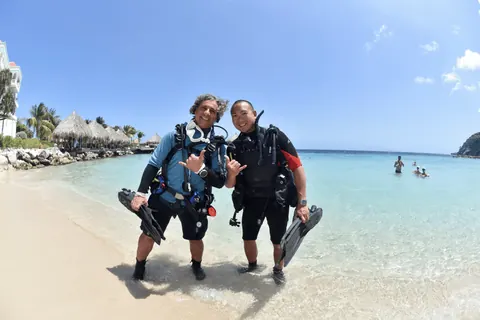 GetYourGuideCuraçao: PADI Discover Scuba Diving at Blue Bay BeachView on GetYourGuide (opens in a new tab)
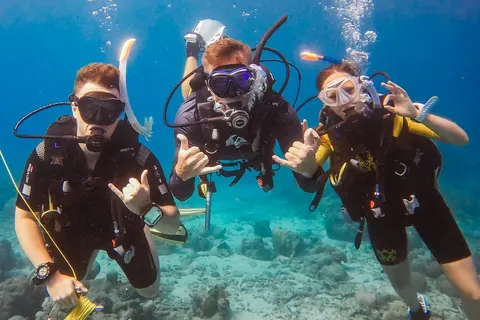 ViatorPersonalized Discover Scuba Dive Experience in CuraçaoView on Viator (opens in a new tab)
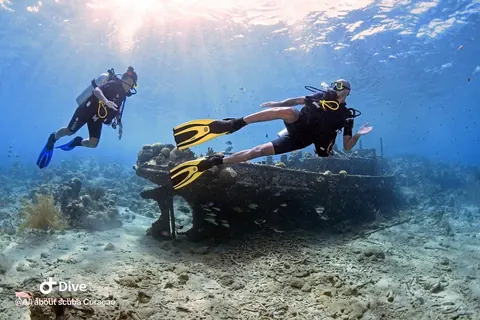 GetYourGuideCuracao: Scuba Diving Experience with InstructorView on GetYourGuide (opens in a new tab)
All Curaçao trips on Viator (opens in a new tab)
Ratings from GetYourGuide travellers.
When is the best time to dive in Curaçao?
Curaçao is a year-round dive island: the sea averages 26.4 °C (80 °F) in February and March, climbs to 28.8 °C (84 °F) in October, and tropical storms rarely come close.
Rain is light, about 500–600 mm (20–24 in) a year. Most of it falls in the October–January rainy season, often in the early morning or evening, so a wet-season trip still leaves the middle of the day for diving. February to May is the dry season, and visibility tends to be best from December to April.
Curaçao sits on the southern fringe of the Atlantic hurricane region. The season officially lasts from June to November and is busiest between mid-August and mid-October, yet a tropical cyclone passes within 100 nautical miles (185 km) of the island only about once every 11 years, and none has ever made a direct landfall.
Coral spawning
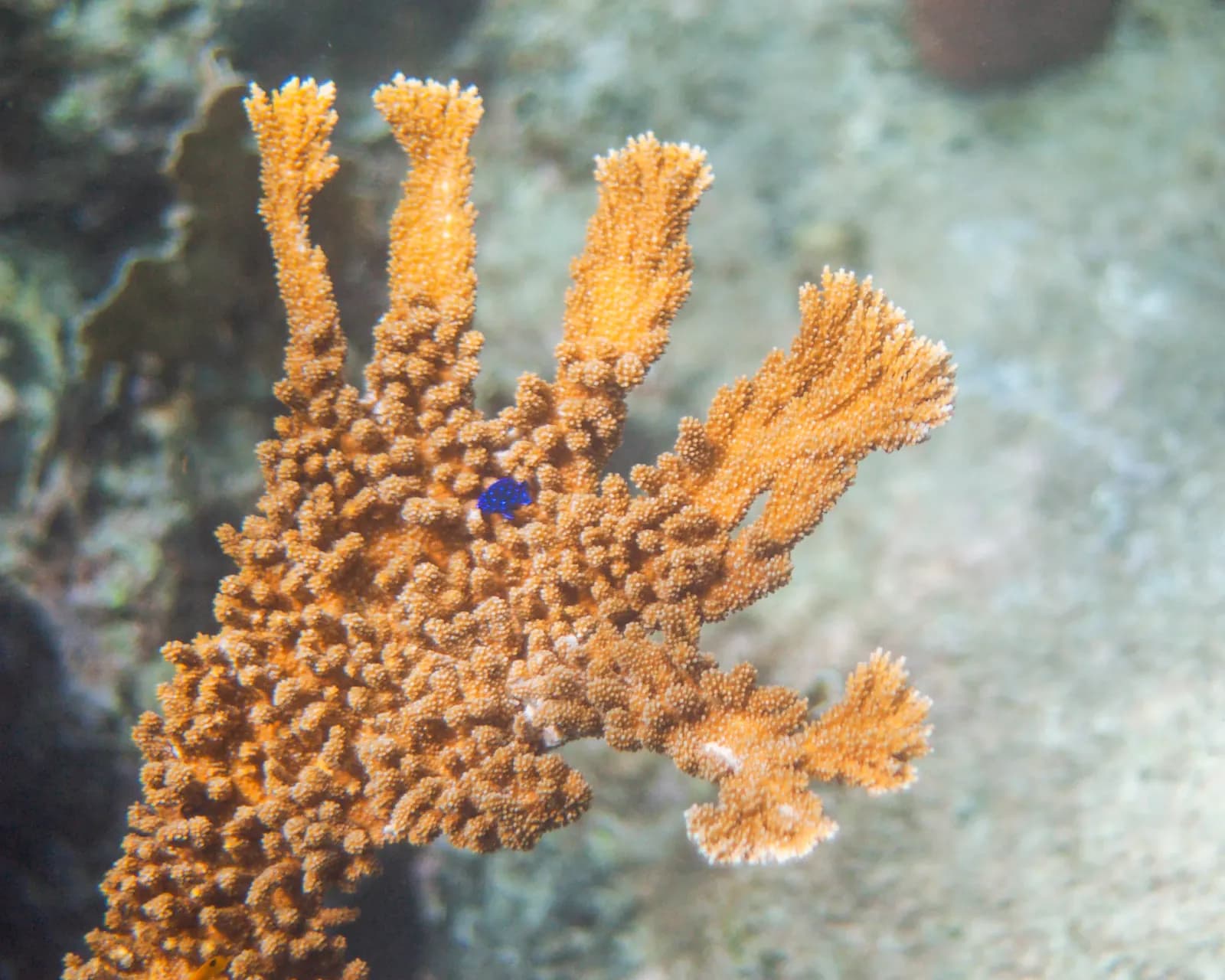
The island's reef-building corals, including star, brain, pillar and elkhorn corals, release their spawn on a handful of predictable nights a few days after the late-summer and autumn full moons, mainly from August to October. Pillar coral has been recorded spawning two to five nights after the August and September full moons at Sea Aquarium and Water Factory, and grooved brain coral spawns earlier, from April to June. The CARMABI research station publishes a prediction calendar every year. Nothing is guaranteed, though: after the 2024 heat, spawning largely failed across much of the Caribbean.
| Month | Average water temperature | Season |
|---|---|---|
| January | 26.7 °C (80 °F) | Best month to dive |
| February | 26.4 °C (80 °F) | Best month to dive |
| March | 26.4 °C (80 °F) | Best month to dive |
| April | 26.7 °C (80 °F) | Best month to dive |
| May | 27.3 °C (81 °F) | Best month to dive |
| June | 27.6 °C (82 °F) | Best month to dive |
| July | 27.7 °C (82 °F) | Best month to dive |
| August | 28.3 °C (83 °F) | Best month to dive |
| September | 28.7 °C (84 °F) | Best month to dive |
| October | 28.8 °C (84 °F) | Best month to dive |
| November | 28.5 °C (83 °F) | Best month to dive |
| December | 27.6 °C (82 °F) | Best month to dive |
In season in: January · February · March · April · May · June · July · August · September · October · November · December
How does shore diving work in Curaçao?
Curaçao has more than 38 dive sites you can reach from the beach, so many divers buy shore tanks and dive with a buddy; Go West sells a day of unlimited shore tanks for US$38 and six days for US$204.
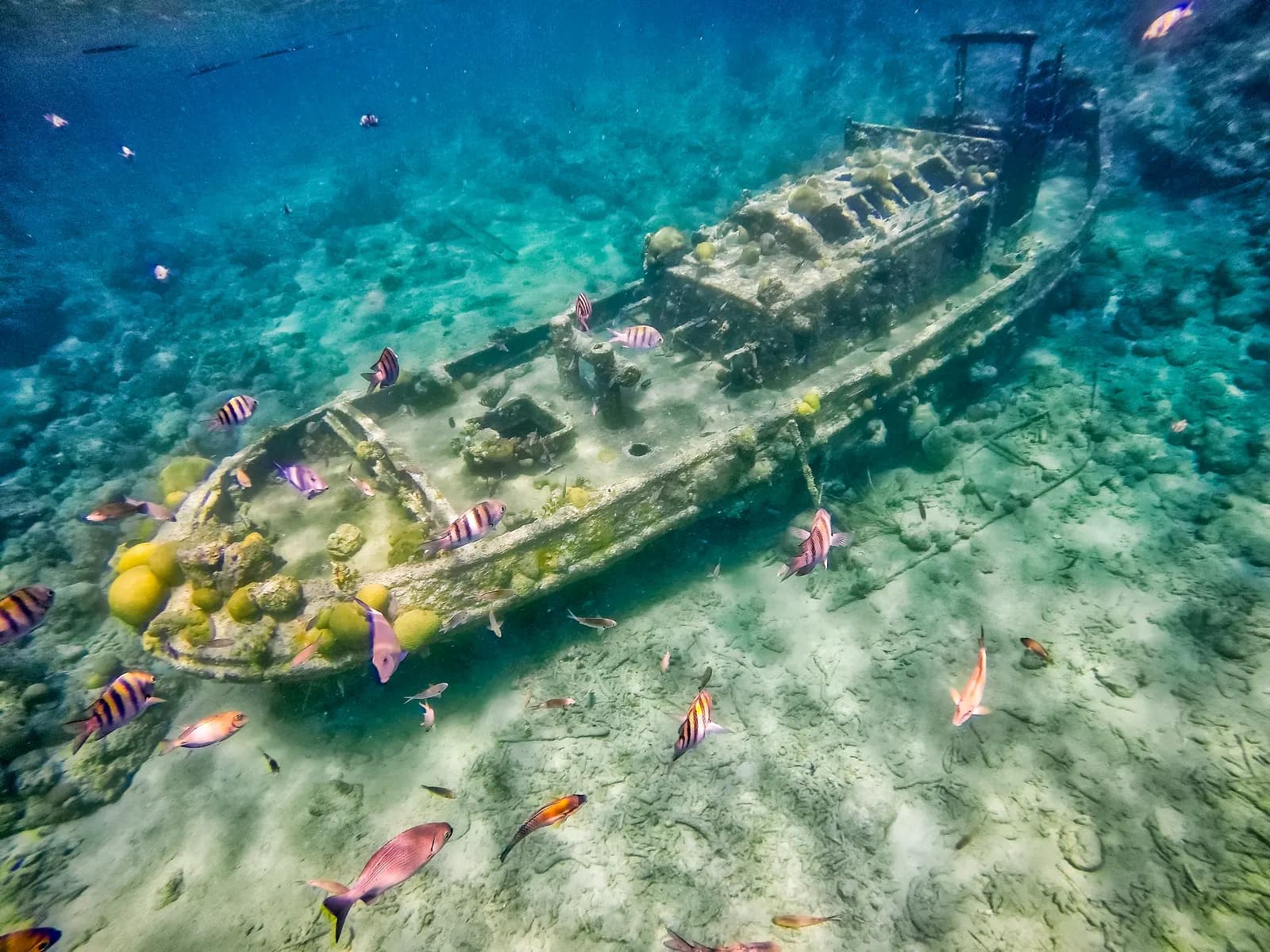
Two easy shore dives for a first day are Tugboat Beach in Caracas Bay, where a small coral-covered tug lies at 5–12 m (16–39 ft), and Playa Porto Mari, a double reef from 5 m (16 ft) where sea turtles are often seen. Alice in Wonderland at Playa Kalki, on the west end, starts deeper at 15 m (49 ft) and suits divers with some experience.
If you would rather not plan your own dives, Scubacao runs a guided two-tank shore dive for US$115 with your own gear. Fun Diving packages ten shore dives with tank and weights for US$500.
Some of the island's best-known sites are not shore dives at all: Sponge Forest can only be reached by boat, and Mushroom Forest and the Watamula wall are dived from boats too.
| Center | What you get | Price |
|---|---|---|
| Go West Diving | Unlimited shore tanks, 1 day | 38 |
| Go West Diving | Unlimited shore tanks, 6 days | 204 |
| Fun Diving | 10 shore dives with tank and weights | 500 |
| Scubacao | Guided shore dive, 2 tanks, own gear | 115 |
What are the best dive sites in Curaçao?
The seven Curaçao sites in the table run from the beginner Tugboat wreck in Caracas Bay at 5–12 m (16–39 ft) to Watamula, an advanced wall at the island's north-west tip that reaches 40 m (131 ft).
- Mushroom Forest (12–18 m, 39–59 ft): a field of mushroom-shaped star corals with turtles, morays, grouper and lobster; the Blue Room sea cave is close by.
- Sponge Forest (11–26 m, 36–85 ft): a slope crowded with elephant-ear, stove-pipe, barrel and vase sponges, and big fish among them.
- Superior Producer (18–30 m, 59–98 ft): a cargo ship sitting upright west of Willemstad's harbor, hung with gorgonians and visited by tarpon, barracuda and jacks.
- Watamula (20–40 m, 66–131 ft): hard corals, barrel sponges and rays on a wall where the current can run strong.
Curaçao has over 70 named dive sites, so treat the table as a starting point. Klein Curaçao, a small islet reached by boat, is not in it yet.
| Dive site | Depth | Level | Entry | Highlights |
|---|---|---|---|---|
| Tugboat (Caracas Bay) | 5–12 m (16–39 ft) | Beginner | Shore | Small coral-covered tug wreck in shallow water off Tugboat Beach; seahorses, octopus and spiny lobster |
| Playa Porto Mari | 5–25 m (16–82 ft) | Beginner | Shore | Double reef system reached from the beach; sea turtles are often seen |
| Alice in Wonderland (Playa Kalki) | 15–28 m (49–92 ft) | Intermediate | Shore | West-end reef of mushroom-shaped coral heads with plenty of fish |
| Mushroom Forest | 12–18 m (39–59 ft) | Intermediate | Boat | Field of mushroom-shaped star corals with turtles, morays, grouper and lobster; the Blue Room sea cave is nearby |
| Sponge Forest | 11–26 m (36–85 ft) | Intermediate | Boat | Slope covered in elephant-ear, stove-pipe, barrel and vase sponges with large fish; boat access only |
| Superior Producer wreck | 18–30 m (59–98 ft) | Advanced | Boat | Cargo ship resting upright west of Willemstad's harbour; gorgonians, tarpon, barracuda and jacks |
| Watamula | 20–40 m (66–131 ft) | Advanced | Boat | Wall at the island's north-west tip with hard corals, barrel sponges and rays; currents can be strong |
Is there a marine park fee for diving in Curaçao?
Curaçao has no published dive fee: CARMABI, which manages the Curaçao Marine Park along the southern coast, lists none, and the dive centers' prices on this page do not add one.
The marine park is a strip of reef about 20 km (12 mi) long and 100 m (330 ft) wide, open all year. No fee today is not a promise for the future, so ask your center when you book whether anything new applies.
Neighboring Bonaire works differently: there every visitor aged 13 and over pays a US$40 Nature Fee before diving.
How much does diving in Curaçao cost?
A standard morning two-tank boat trip in Curaçao costs about US$130–150, and longer east-end trips cost US$215–220 with your own gear (prices checked November 2026).
- Two-tank boat dive: Go West US$130 including taxes, Ocean Encounters from US$150, Coral Divers from US$190. Scubacao's Eastpoint trip is US$215 and Fun Diving's half-day East Coast catamaran US$220, both with your own gear. Rental gear is extra unless a center says otherwise.
- Discover Scuba: US$105–150, typically about US$117.50, for one dive with gear. Fun Diving charges US$105, Scubacao US$115 and Go West US$120; Ocean Encounters' version, from US$150, adds a classroom session and confined-water practice before a guided shore dive.
- Shore diving: the cheapest way to dive here, from US$38 a day for unlimited tanks (see the shore-diving table above).
For a price on your dates and group size, ask local dive centers.
Prices checked
| Item | Typical price | Range |
|---|---|---|
| Two-tank boat dive | US$190 | US$130–US$220 |
| Open Water course | US$515 | US$425–US$575 |
| Discover Scuba (try dive) | US$117.50 | US$105–US$150 |
Prices change; confirm with the center before you book.
How much is an Open Water course in Curaçao?
An Open Water course in Curaçao costs US$425–575, typically about US$515, but the two cheapest prices leave out the eLearning, which adds about US$200.
- Go West, US$425 and Ocean Encounters, US$475: course with gear; PADI eLearning extra, about US$200.
- Fun Diving, US$515: the price does not say whether the theory is included.
- Coral Divers, US$525 and Scubacao, US$575: eLearning included.
With the eLearning added, Go West and Ocean Encounters come to roughly US$625–675, above the all-in prices at Coral Divers and Scubacao. Most of these centers sell PADI courses; if you would rather train with SSI, RAID or CMAS, ask before you book. Our Open Water price index shows how Curaçao compares with other places.
Is there a recompression chamber in Curaçao?
Yes: the Curaçao Medical Center in Willemstad has a 10-person hyperbaric chamber that treats decompression sickness and arterial gas embolism, but it publishes no opening hours, so ask your center how it reaches the chamber out of hours.
Keep the hospital's number with your dive kit, and let DAN or your insurer coordinate if you ever need treatment. The deep boat dives, Watamula at up to 40 m (131 ft) and the Superior Producer at 30 m (98 ft), are where careful planning matters most, and Watamula's current is a reason to dive it with a guide who knows the site.
Make sure your dive insurance covers chamber treatment and, in case the island chamber is unavailable, evacuation. For any symptoms after a dive, call DAN or see a dive doctor.
Dive centers in Curaçao
Loading dive centers…
Frequently asked questions
Is Curaçao good for beginner divers?
Yes. The water stays at 26.4–28.8 °C (80–84 °F) all year, and two of the seven Curaçao sites in our table are beginner shore dives: the Tugboat in Caracas Bay at 5–12 m (16–39 ft) and Playa Porto Mari from 5 m (16 ft). A Discover Scuba dive costs US$105–150 with gear. Leave Watamula and the Superior Producer wreck until you have more experience.
What is the water temperature in Curaçao?
Curaçao's sea averages 26.4 °C (80 °F) in February and March, the coolest months, and 28.8 °C (84 °F) in October, the warmest. From December to April, when visibility tends to be best, it sits at 26.4–27.6 °C (80–82 °F). The whole year spans less than 2.5 °C (4.5 °F), so the month you pick changes the weather more than the water.
Is Curaçao or Bonaire better for diving?
Both are year-round shore-diving islands with similar water, so it comes down to style and budget. Bonaire charges visitors aged 13 and over a US$40 Nature Fee; Curaçao publishes no dive fee. Curaçao adds boat-only sites such as Sponge Forest and the Watamula wall, plus the Superior Producer wreck. A two-tank boat trip starts at about US$125 on Bonaire and US$130 on Curaçao.
Does Curaçao get hurricanes?
Rarely. Curaçao lies south of the main Atlantic storm track: a tropical cyclone comes within 100 nautical miles (185 km) only about once every 11 years, and none has made a direct landfall. The official season still runs from June to November, peaking from mid-August to mid-October, so late-summer travelers should keep a spare day and check their cover for weather delays.
When do corals spawn in Curaçao?
Mostly from August to October, on set nights a few days after the full moon. Pillar coral, for example, spawns two to five nights after the August and September full moons, while grooved brain coral spawns from April to June. CARMABI publishes a yearly prediction calendar, but spawning is never certain: after the 2024 heat it largely failed across much of the Caribbean, so treat it as a bonus.
What is the best wreck dive in Curaçao?
It depends on your level. The Tugboat in Caracas Bay is a small coral-covered tug in 5–12 m (16–39 ft) of water, reached from the beach and home to seahorses, octopus and spiny lobster. The Superior Producer, an upright cargo ship west of Willemstad's harbor at 18–30 m (59–98 ft), is an advanced boat dive with tarpon, barracuda and jacks.


