Dive guide · Indonesia
Scuba Diving in Nusa Penida
Nusa Penida, with Lembongan and Ceningan across the Badung Strait from Bali, is where divers go for reef mantas, present all year, and oceanic sunfish, mostly July to November. Expect drift dives in strong currents. Two boat dives cost IDR 1.6–2.0 million on the islands, typically IDR 1.85 million (prices checked November 2026).
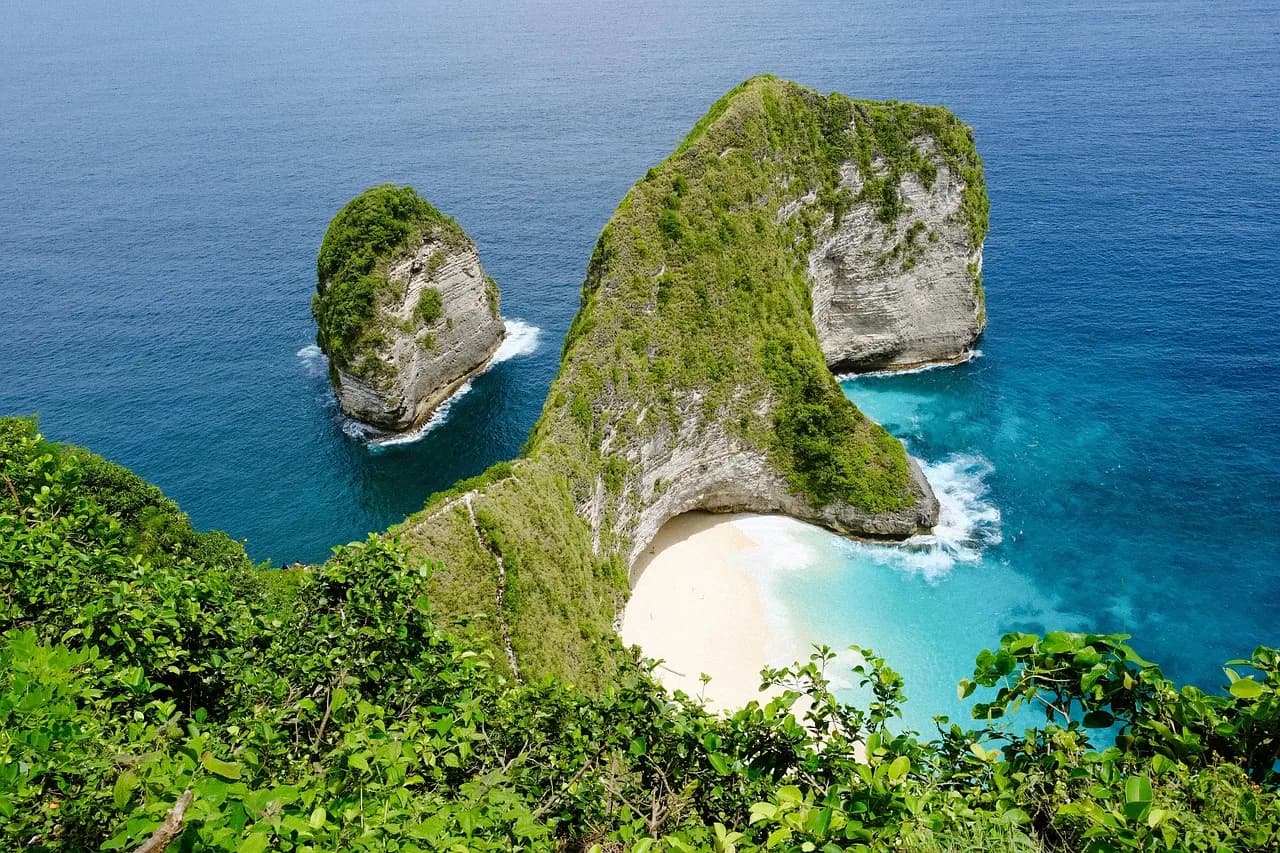
Key facts
- Best months
- April to November
- Water temperature
- 26.7–28.9 °C (80–84 °F)Monthly average, coolest to warmest month
- Level
- Intermediate to advanced
- Two-tank boat dive
- IDR 1,850,000Typical price, checked
- Open Water course
- IDR 6,825,000Typical price, checked
- Discover Scuba (try dive)
- IDR 2,200,000Typical price, checked
- Airport
- I Gusti Ngurah Rai International Airport (DPS)
- Park fee
- Nusa Penida marine protected area retribution for diving and snorkeling, foreign visitor, per person per day: IDR 100,000
- Park fee
- Bali levy for international tourists, per person (paid online or on arrival): IDR 150,000
- Nearest chamber
- Hyperbaric & Diving Medicine Centre, Kasih Ibu Hospital Saba, Saba, Gianyar
Book a dive trip in Nusa Penida
Trips run by local operators, booked on Viator or GetYourGuide.
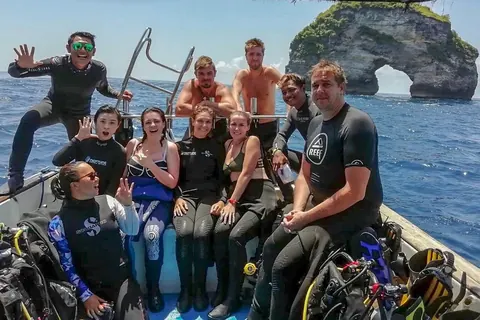 ViatorScuba Diving in Nusa Penida - Manta PointView on Viator (opens in a new tab)
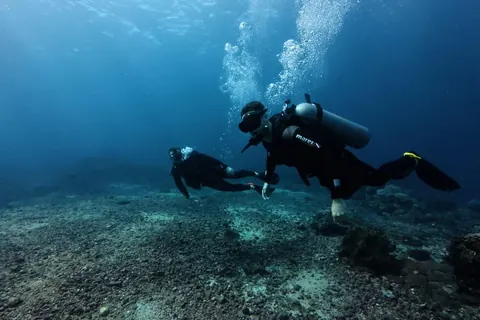 GetYourGuideNusa Penida: Scuba Diving or Snorkeling with Manta RaysView on GetYourGuide (opens in a new tab)
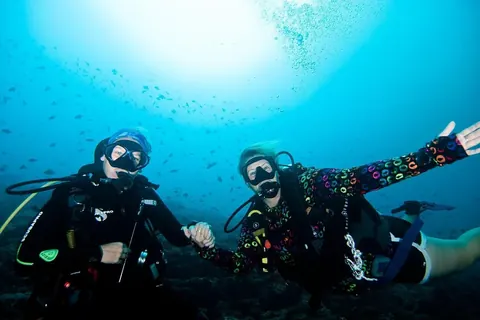 ViatorNusa Penida Try Scuba Diving Program - for Non-Certified DiversView on Viator (opens in a new tab)
 GetYourGuideNusa Penida: Beginner Scuba Diving with 2 Ocean DivesView on GetYourGuide (opens in a new tab)
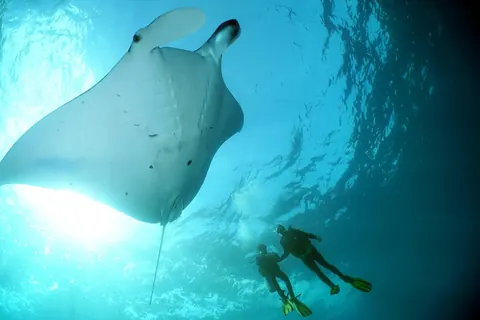 ViatorScuba Diving Nusa Penida Manta Point 3 dives for certified diversView on Viator (opens in a new tab)
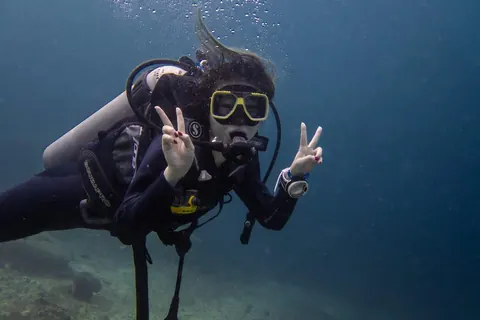 GetYourGuideBali: Nusa Penida Try Scuba Diving Day Trip with Pool and 2 DivesView on GetYourGuide (opens in a new tab)
All Nusa Penida trips on Viator (opens in a new tab)
Ratings from GetYourGuide travellers.
When is the best time to dive Nusa Penida?
Nusa Penida can be dived all year, but April to June is the peak for mantas at Manta Point and July to November is sunfish season, which brings the coolest water: about 26.7 °C (80 °F) at the surface in August.
Encounters with the island's reef mantas at Manta Point roughly double in May. The north-west monsoon of December and January can make the exposed sites hard to reach by boat.
Sunfish arrive with a seasonal pulse of cold water from the deep, and most sightings fall between July and November, give or take a few weeks at either end.
Water temperature
The sea surface averages 26.7 °C (80 °F) in August, the coolest month, and 28.9 °C (84 °F) in April, the warmest. In sunfish season the water below a thermocline can be noticeably colder than that average, so ask your center which wetsuit thickness it recommends before you book.
| Month | Average water temperature | Season |
|---|---|---|
| January | 28.7 °C (84 °F) | Outside the best months |
| February | 28.6 °C (83 °F) | Outside the best months |
| March | 28.7 °C (84 °F) | Outside the best months |
| April | 28.9 °C (84 °F) | Best month to dive |
| May | 28.5 °C (83 °F) | Best month to dive |
| June | 27.9 °C (82 °F) | Best month to dive |
| July | 27 °C (81 °F) | Best month to dive |
| August | 26.7 °C (80 °F) | Best month to dive |
| September | 26.9 °C (80 °F) | Best month to dive |
| October | 27.6 °C (82 °F) | Best month to dive |
| November | 28.5 °C (83 °F) | Best month to dive |
| December | 28.7 °C (84 °F) | Outside the best months |
In season in: April · May · June · July · August · September · October · November
Where do you dive with manta rays at Nusa Penida?
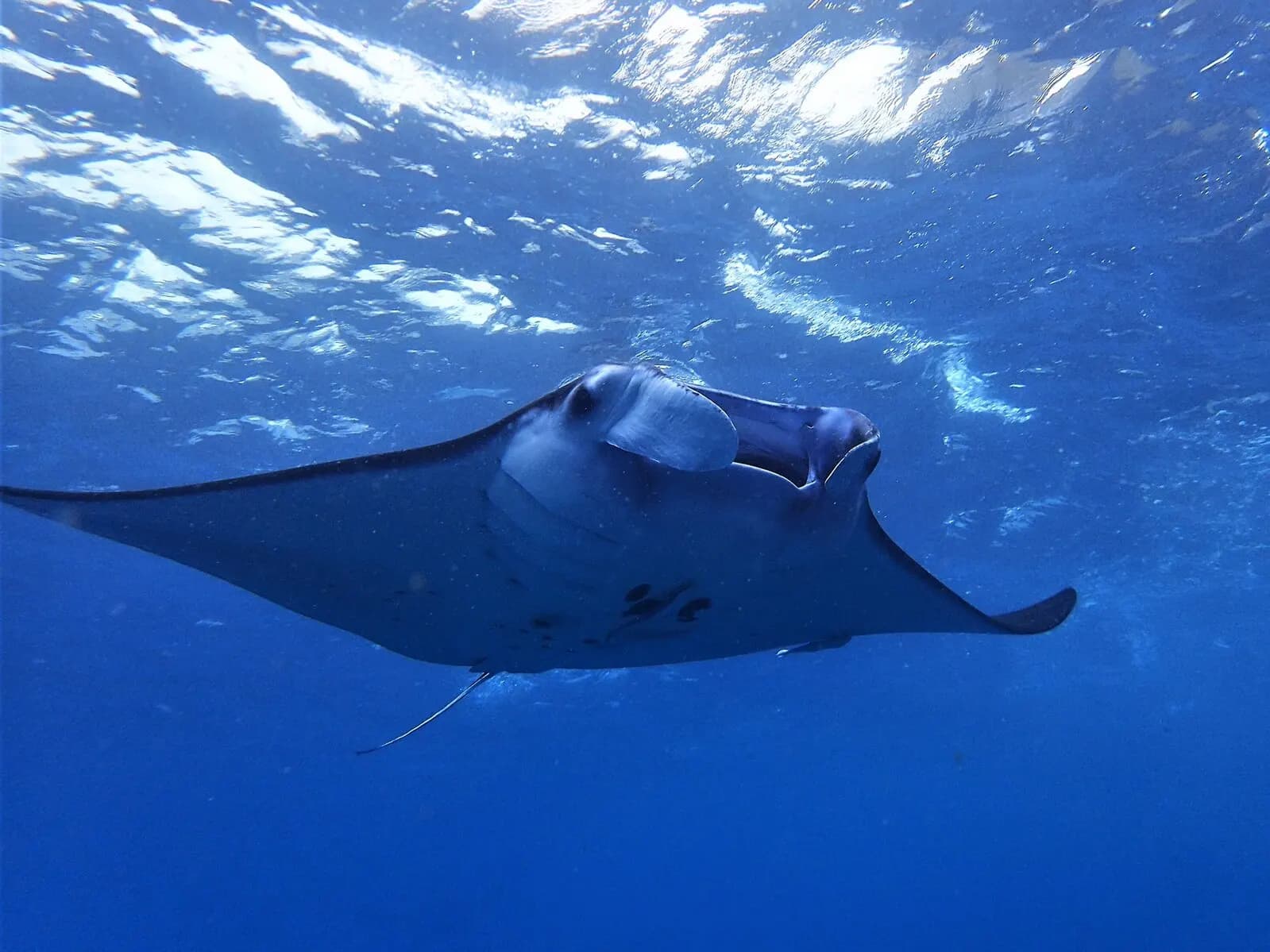
Manta Point, under the cliffs of Nusa Penida's south coast, is the main manta dive: reef mantas visit its cleaning stations at 5–15 m (16–49 ft) in every month, and most centers charge a supplement of IDR 150,000–200,000 to go there.
The site is exposed to ocean swell, so surge around the cleaning stations is common on rough days. Stay low and still, a little away from the cleaning station itself, and let the mantas come to you; chasing them only drives them off. Manta Bay, a second cleaning station used by the same population, is on some centers' menus too; ask for its depth when you book.
Because the mantas are resident, a week on the island gives several chances even outside the April to June peak.
When and where can you see mola mola at Nusa Penida?
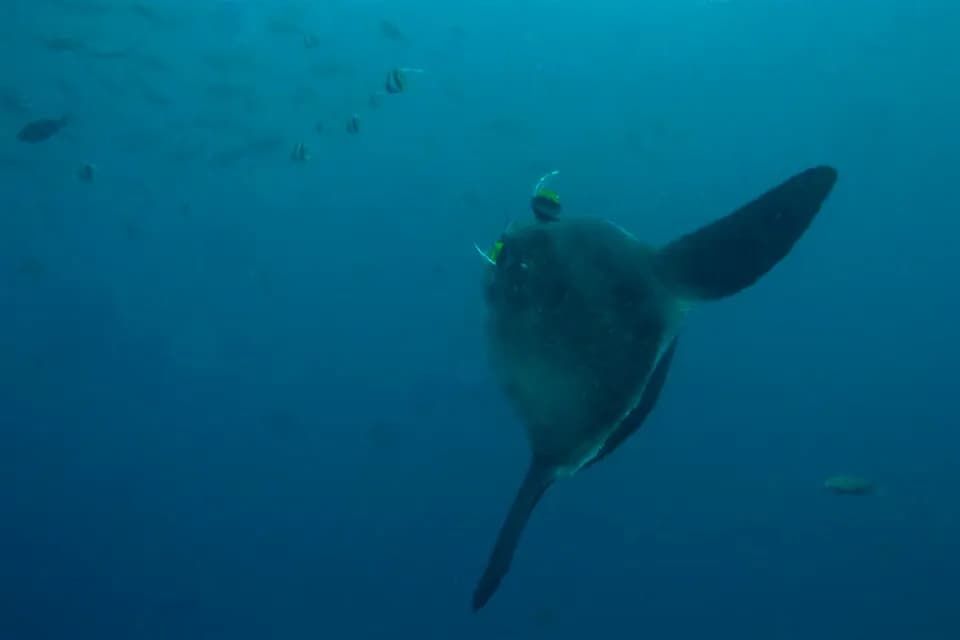
Oceanic sunfish (mola) appear at Nusa Penida mainly from July to November, most famously at Crystal Bay (5–40 m, 16–131 ft) and on the current-swept terraces of Blue Corner off Lembongan (15–30 m, 49–98 ft).
Researchers now tell individual Nusa Penida sunfish apart from photographs, despite their habit of changing color quickly. You may see the species called Mola alexandrini or by an older name; on this page they are simply oceanic sunfish.
- Crystal Bay: a sheltered bay with coral slopes and a cave, and the classic sunfish site in season.
- Blue Corner: terraces swept by strong current, with eagle rays, marble rays and sunfish in season. Centers take experienced divers only.
The July to November window is a pattern of sightings, not a fixed migration, so no center can promise one. Keep your distance, do not touch or crowd the fish, and follow your guide's depth limit: the cold water and down-slope views tempt divers deeper than planned.
What other dive sites are there around Nusa Penida and Lembongan?
Beyond Manta Point and Crystal Bay, Nusa Penida's main dives are the north-coast drifts at SD, Sental and Toyapakeh and the reef wall at Gamat Bay, at 5–40 m (16–131 ft), with turtles, giant map pufferfish, table corals and big fish schools.
Toyapakeh sits at the mouth of the channel between Penida and Ceningan, with coral pillars, sea fans and big schools of fish. SD is a popular drift for turtles and giant map pufferfish, Sental glides over hard corals, sponges and table corals, and Gamat Bay has a wall at the edge of the bay with table corals in the shallows.
Every Penida site in the table is rated intermediate except Blue Corner, which is advanced, and the area as a whole suits experienced divers only, because of strong currents and fast-changing local conditions. Dive with a guide who knows the tides, carry a surface marker buoy, and accept the guide's call when a site is too rough.
| Dive site | Depth | Level | Entry | Highlights |
|---|---|---|---|---|
| Manta Point | 5–15 m (16–49 ft) | Intermediate | Boat | Reef manta cleaning stations under the south-coast cliffs; swell and surge on exposed days |
| Crystal Bay | 5–40 m (16–131 ft) | Intermediate | Boat | Coral slopes and a cave in a sheltered bay; the classic sunfish site in season |
| Toyapakeh | 5–40 m (16–131 ft) | Intermediate | Boat | Coral pillars and sea fans at the mouth of the Penida-Ceningan channel, big fish schools |
| Gamat Bay | 15–30 m (49–98 ft) | Intermediate | Boat | Reef wall at the edge of the bay with table corals in the shallows |
| Blue Corner, Nusa Lembongan | 15–30 m (49–98 ft) | Advanced | Boat | Current-swept terraces for eagle rays, marble rays and sunfish in season; experienced divers only |
| Sental | 15–30 m (49–98 ft) | Intermediate | Boat | North-coast drift over hard corals, sponges and table corals |
| SD | 15–30 m (49–98 ft) | Intermediate | Boat | Popular north-coast drift with turtles and giant map pufferfish |
How much does diving at Nusa Penida cost?
Two boat dives at Nusa Penida cost IDR 1.6–2.0 million, typically IDR 1.85 million, an Open Water course IDR 5.1–6.93 million and a Discover Scuba with two ocean dives IDR 2.2–2.6 million (prices checked 22 November 2026).
Read the small print before you compare:
- Equipment: included at Emperor, World Diving and Big Fish; Two Fish charges IDR 150,000 a day.
- Season: Two Fish's two-dive price is its high-season rate (1 July to 30 November); the low-season rate is IDR 1,825,000.
- Manta Point: most centers add IDR 150,000–200,000.
- Tax: World Diving adds 10 % Klungkung regency tax.
- Open Water: Big Fish's IDR 5.1 million excludes PADI eLearning; Emperor includes equipment and course materials.
- Try dives: one-dive versions cost less, such as IDR 1.3 million at World Diving.
Day trips from Sanur include the car and the crossing, so they cost more per dive than diving from the islands. For current prices, ask Nusa Penida dive centers.
Prices checked
| Item | Typical price | Range |
|---|---|---|
| Two-tank boat dive | IDR 1,850,000 | IDR 1,600,000–IDR 2,000,000 |
| Open Water course | IDR 6,825,000 | IDR 5,100,000–IDR 6,930,000 |
| Discover Scuba (try dive) | IDR 2,200,000 | IDR 2,200,000–IDR 2,600,000 |
Prices change; confirm with the center before you book.
What fees do divers pay at Nusa Penida?
Foreign divers and snorkelers in the Nusa Penida marine protected area are reported to pay a retribution of IDR 100,000 per person per day, on top of Bali's IDR 150,000 tourist levy; confirm the park charge on arrival, because it is not officially confirmed.
The daily charge for diving, snorkeling and swimming in the protected area was reported to start in July 2023, but at least one dive center still describes it as proposed, so ask whether your center collects it with the dive price. The Bali levy is a separate provincial tourism charge, paid online or on arrival in Bali, and it is not a marine-park fee. Add the Manta Point supplement and, at some centers, regency tax, and a day of diving costs noticeably more than the headline price.
Should you stay on Nusa Penida or Lembongan, or visit from Bali?
Staying on Nusa Lembongan or Nusa Penida gives you more dives and earlier starts at Manta Point and Crystal Bay than a day trip from Bali, which crosses from Sanur harbor by fast boat in about 45 minutes and returns by mid-afternoon.
Emperor Divers, World Diving and Big Fish Diving are based on Lembongan; Two Fish runs its center on Nusa Penida itself, on the beach near the main village of Sampalan. Two Fish's own Sanur center tells guests that staying on the island beats day-tripping when mantas or sunfish are the main goal, because island-based boats reach sites that day trips cannot.
From the mainland, the crossing leaves from Sanur, about 60 minutes by car from Bali's airport (DPS). Mainland options such as the Liberty wreck at Tulamben are covered in our Bali diving guide.
Is there a recompression chamber on Nusa Penida?
No: the nearest chamber listed for Nusa Penida divers is the Hyperbaric and Diving Medicine Centre at Kasih Ibu Hospital Saba in Gianyar, on mainland Bali, so any treatment starts with a boat crossing of the Badung Strait.
In Denpasar, the RSUP Prof Ngoerah hospital runs a hyperbaric clinic with weekday outpatient hours.
That sea crossing, together with strong currents and cold water at depth, is the reason to check your insurance before you go: it should cover chamber treatment and emergency transport from the islands. Our dive insurance guide explains what to check. Plan conservative profiles on deep sunfish dives, and if you feel unwell after diving, tell your guide and call DAN or your insurer's emergency line.
Dive centers in Nusa Penida
Loading dive centers…
Frequently asked questions
Is Nusa Penida good for beginner divers?
Nusa Penida is better as a second trip than a first. Centers here do teach Open Water courses, at IDR 5.1–6.93 million, and run try dives, but the famous sites have strong currents and the area as a whole suits experienced divers. If you are newly certified, log a few easy dives first, tell the center your experience honestly and let it pick sheltered sites.
How deep is Manta Point in Nusa Penida?
Manta Point is a shallow dive of 5–15 m (16–49 ft), with the cleaning stations close to the cliffs of the south coast. The depth is easy, but swell and surge on exposed days make it a dive for confident divers with good buoyancy. Most centers charge an extra IDR 150,000–200,000 for the trip, and sea conditions decide whether the boat can go on a given day.
Can you see mantas at Nusa Penida in December?
Yes, reef mantas use the Nusa Penida cleaning stations in every month of the year. December is still a less reliable month, because the north-west monsoon of December and January can limit boat access to exposed sites such as Manta Point. Encounters peak from April to June, and May is usually the strongest month of all.
How much is the Nusa Penida marine park fee?
The marine protected area retribution is reported at IDR 100,000 per foreign visitor per day for diving, snorkeling or swimming, a charge first reported in 2023. It is not officially confirmed and at least one center still calls it proposed, so check the amount on arrival and ask your dive center whether it collects it. Budget for Bali's separate IDR 150,000 tourist levy too.
How cold is the water at Nusa Penida?
Surface water at Nusa Penida averages 26.7 °C (80 °F) in August and 28.9 °C (84 °F) in April. During sunfish season, roughly July to November, cold upwelling can make the water at depth cooler than the surface average. Bring or rent a thicker wetsuit for those months and ask your center what its guides wear.
How do you get to Nusa Penida from Bali?
Fly into Bali's I Gusti Ngurah Rai International Airport (DPS), drive about 60 minutes to Sanur, then take a fast boat across the Badung Strait, which takes about 45 minutes. Ask your island center about harbor pickups; day trips from Sanur collect divers from their hotels around 7:00–7:30 in the morning and return by mid-afternoon. Allow a spare day before your flight home in case the sea is rough.


