Diving region
Scuba Diving in Australia and the Pacific
Australia and the Pacific split into two seasons: the Great Barrier Reef, Fiji, Okinawa and Hawaii are best from about May to October, and Palau is calmest from December to March. Go to Palau for sharks in current, Fiji for soft corals, Kona or Ishigaki for mantas, and the Great Barrier Reef for easy outer-reef days.
Dive trips in Australia and the Pacific
Trips run by local operators, booked on Viator or GetYourGuide.
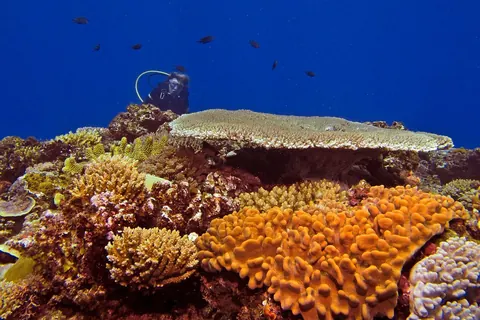 ViatorFijiCertified Scuba Diving with Whitetip Marine Adventures teamView on Viator (opens in a new tab)
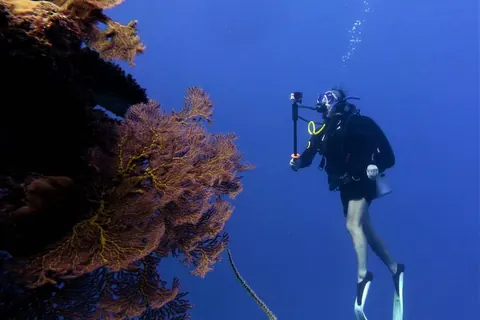 GetYourGuideFijiDenarau: Mamanuca Islands 2-Tank Guided Scuba Diving TripView on GetYourGuide (opens in a new tab)
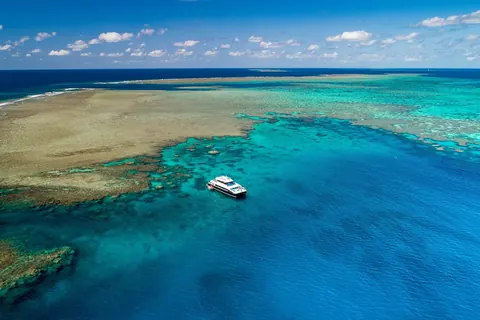 ViatorGreat Barrier ReefCalypso Outer Great Barrier Reef Cruise from Port DouglasView on Viator (opens in a new tab)
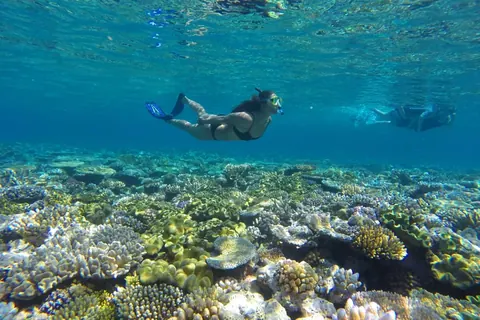 GetYourGuideGreat Barrier ReefPort Douglas: Outer Barrier Reef Snorkel and Dive OptionsView on GetYourGuide (opens in a new tab)
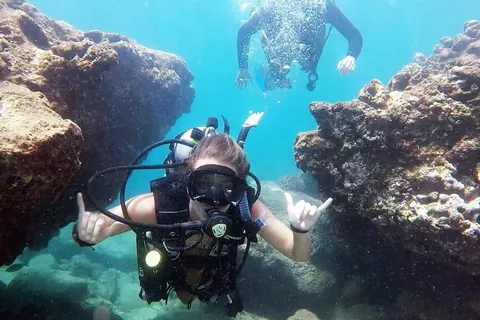 ViatorHawaiiBeginner Scuba No Certification/Swimming Needed + Free VideosView on Viator (opens in a new tab)
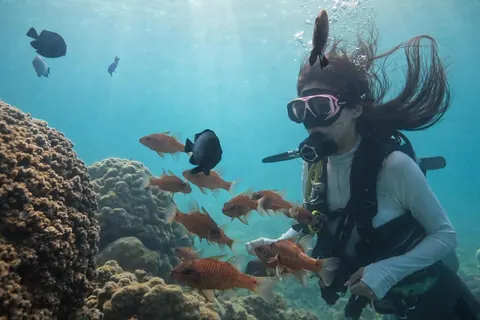 GetYourGuideHawaiiHonolulu: Beginner Scuba Diving Tour with VideosView on GetYourGuide (opens in a new tab)
Ratings from GetYourGuide travellers.
Where should you dive in Australia and the Pacific?
In Australia and the Pacific, go to Palau for reef sharks on current-swept corners such as Blue Corner, to Fiji for soft-coral walls and the Beqa Lagoon shark dive, to Kona on Hawaii's Big Island or Ishigaki in Okinawa for mantas, and to the Great Barrier Reef for easy outer-reef days and the SS Yongala wreck.
Five guides cover the region, and the table compares their seasons, water and prices. They lie far apart, so each usually makes a trip of its own.
- Fiji: dive areas spread over many islands, with the staged shark feed in Beqa Lagoon, the soft-coral walls of Taveuni's Somosomo Strait and Naiqoro Passage on Kadavu's Great Astrolabe Reef.
- Great Barrier Reef: outer-reef walls and bommies on day boats from Cairns, Port Douglas and Townsville, plus the SS Yongala wreck. Our Cairns & Port Douglas guide covers the northern reefs one by one.
- Hawaii: wrecks off Waikiki and the Waianae coast on Oahu, the manta night dive off Kona, and Molokini Crater off Maui.
- Okinawa: Japan's southernmost prefecture, with the Kerama Islands west of Naha, manta points off Ishigaki and sites around Okinawa Island itself.
- Palau: a small island nation in the western Pacific with current corners such as Blue Corner, manta cleaning stations in German Channel and the Iro Maru, a coral-covered WWII wreck 143 m (469 ft) long.
| Place | Best months | Water | Two-tank boat dive | Open Water course |
|---|---|---|---|---|
| Fiji | May to October | 25.3–28.7 °C (78–84 °F) | FJD 400 | FJD 1,380 |
| Great Barrier Reef | May to October | 23.4–28.7 °C (74–84 °F) | A$417 | A$1,177.50 |
| Hawaii | May to October | 24.4–27 °C (76–81 °F) | US$209 | US$879 |
| Okinawa | May to October | 21.7–28.9 °C (71–84 °F) | JP¥21,000 | JP¥99,000 |
| Palau | December to March | 28.1–29.5 °C (83–85 °F) | US$209 | US$680 |
Water: average temperature of the coolest and the warmest month. Prices: typical prices; each guide says when they were checked.
When is the best time to dive in Australia and the Pacific?
May to October is the main season for the Great Barrier Reef, Fiji, Okinawa and Hawaii, while Palau is best from December to March, so a northern-winter trip to Australia and the Pacific points to Palau and a mid-year trip to the rest.
- Great Barrier Reef: May to October is the drier high season in North Queensland, and the water off Townsville cools to 23.4 °C (74 °F) in August. Marine stingers are most likely from November to May, when a full-body stinger suit is recommended.
- Fiji: May to October falls outside the November to April cyclone season, whose risk is highest from about January to March. The sea cools to 25.3 °C (78 °F) in August and September.
- Okinawa: May to October is when Ishigaki's Kabira manta points are open, and July to September is the top season in the Kerama Islands. Typhoons approach mostly from July to October, so plan spare days.
- Hawaii: boats run all year off Kona and Oahu's south and west shores, but May to October brings the calmest seas and the only diving season on Oahu's North Shore.
- Palau: December to March usually brings the calmest seas and the least rain. July to October is wetter and can be choppier, though diving runs all year.
Palau's water is the warmest and steadiest, at 28.1–29.5 °C (83–85 °F). Okinawa has the widest swing, from 21.7 °C (71 °F) in February to 28.9 °C (84 °F) in August.
Where can you see sharks, mantas and whales in Australia and the Pacific?
In Australia and the Pacific, Palau's Blue Corner and Fiji's Beqa Lagoon are the classic shark dives, Kona's night dive at Garden Eel Cove and Palau's German Channel are the best-known manta sites, and dwarf minke whales visit the northern Great Barrier Reef in June and July.
- Sharks: at Blue Corner (15–40 m, 49–131 ft) divers hook into the reef to watch sharks, Napoleon wrasse and turtles in the current. The Beqa Lagoon dive is a staged feed where bull, lemon, silvertip and reef sharks come in, watched from stations at 30, 10 and 4 m (98, 33 and 13 ft). Palau's Turtle Cove adds grey reef, whitetip and leopard sharks.
- Mantas: Kona's mantas feed in the beams of dive lights at about 10 m (33 ft) and are seen often but not on every trip, with no fixed season. German Channel in Palau is busiest from about December to March. Off Ishigaki, Kabira Manta Point is dived from about May to October, and mantas feed near Kuroshima in winter.
- Whales: humpbacks winter around Hawaii from about November to April and around Okinawa's Kerama Islands from January to March, when divers sometimes hear their song underwater. Dwarf minke whales gather on the northern Great Barrier Reef, mostly in June and July.
- Coral spawning: corals across the Great Barrier Reef spawn a few nights after the full moons of October to December.
How much does diving in Australia and the Pacific cost?
A two-dive boat day in Australia and the Pacific usually costs about US$209 in both Palau and Hawaii, AUD 417 on the Great Barrier Reef, FJD 400 in Fiji and JPY 21,000 in Okinawa (prices checked November 2026).
The ranges, and what they leave out:
- Great Barrier Reef: AUD 375–499 for a day trip with two certified dives. The official Environmental Management Charge of AUD 8.50 a day is collected in the ticket and rises to AUD 9.00 on 1 April 2027.
- Palau: US$160–253 for a boat day with lunch, plus the US$100 Pristine Paradise Environmental Fee already in international air tickets and a Koror State Rock Islands permit of US$50, valid for 5 days.
- Hawaii: US$174–259 for a two-tank boat dive on Oahu or off Kona, with rental gear extra at most shops.
- Fiji: FJD 295–475 for a two-tank day; for its shark dive, Beqa Adventure Divers adds a Shark Reef levy of FJD 25 per diving day.
- Okinawa: JPY 15,000–27,500 for two boat dives, and Zamami village in the Kerama Islands charges a JPY 100 environmental tax per trip.
Open Water courses vary just as much, from US$500–723 in Palau to AUD 945–1,458 on the Great Barrier Reef. In Hawaii the US$575–1,130 course fee leaves out the eLearning, which centers list at about US$236–251.
Which Pacific dive destinations suit beginners, and which need experience?
The Great Barrier Reef is the easiest place to start in Australia and the Pacific, with beginner-rated walls at Flynn and Milln reefs (5–25 m, 16–82 ft) and introductory dives sold on reef day trips for AUD 295–499, while Palau's Blue Corner, Fiji's Naiqoro Passage and Okinawa's Yonara Channel are dives for experienced divers.
- Hawaii: Kaʻawaloa Cove in Kealakekua Bay, which is almost always calm, and Three Tables on Oahu's North Shore in summer are rated beginner; the Sea Tiger and Mahi wrecks are advanced.
- Okinawa: the Kerama Islands suit certified divers better than complete beginners, while Sukuji and the Osaki and Nagura reefs off Ishigaki are rated beginner.
- Palau: Open Water courses run 3–4 days for US$500–723 with equipment, but the signature dives come with current, and Siaes Corner is a vertical wall where you should plan your depth before you descend.
- Fiji: current is part of most Taveuni dives, and the Great White Wall is timed for slack tide in the Somosomo Strait.
- Great Barrier Reef: the SS Yongala, a 109 m (358 ft) wreck at 14–28 m (46–92 ft), needs Advanced Open Water certification and 10 logged dives with the operator that runs it.
How do you get to the dive areas of Australia and the Pacific?
Each Australia and Pacific destination has its own gateway: Cairns (CNS) or Townsville (TSV) for the Great Barrier Reef, Koror (ROR) for Palau, Nadi (NAN) for Fiji, Honolulu (HNL), Kona (KOA) or Kahului (OGG) for Hawaii, and Naha (OKA) or Ishigaki (ISG) for Okinawa.
- Great Barrier Reef: the outer reefs are a long ride from Cairns and Port Douglas, so most diving is on full-day boat trips. For the Whitsundays, fly into Proserpine (PPP) or Hamilton Island (HTI).
- Fiji: Beqa, Taveuni, Kadavu and the Mamanuca and Yasawa groups each have their own dive centers, mostly at island resorts, so choose the island for the diving you want. Suva (SUV) is the second international airport.
- Hawaii: Kona is on the Big Island, Molokini is off Maui, and Oahu's wrecks are a short ride from Honolulu; each island needs its own flight.
- Okinawa: the Kerama Islands are a boat ride west of Naha, while Ishigaki has its own airport far to the south-west.
Where are the recompression chambers in Australia and the Pacific?
The Townsville Hyperbaric Medicine Unit serves Great Barrier Reef divers with a 24-hour emergency service, Palau's chamber is at Belau National Hospital in Koror, Hawaii's is the University of Hawaiʻi Hyperbaric Treatment Center in Honolulu, Okinawa's is at University of the Ryukyus Hospital in Ginowan, and Fiji has chambers in Nadi and Suva.
- Hawaii: divers hurt off Kona or Maui are flown to Oahu; check the Honolulu center's status before your trip.
- Okinawa: patients from outside the hospital need a referral, which your dive center or the 119 emergency service arranges.
- Fiji: the Nadi chamber at Pacific Specialist Healthcare opened at the end of 2024, and the Colonial War Memorial Hospital chamber in Suva is nearer to Beqa Lagoon; confirm with your dive center that the nearer one is staffed.
- Great Barrier Reef: Townsville is Queensland's only public hyperbaric facility outside Brisbane, so divers hurt off Cairns are transferred there.
Carry dive insurance that covers evacuation and chamber treatment, especially for Fiji's outer islands, and put fitness-to-dive questions to a dive doctor or DAN.
Frequently asked questions
What is the best time of year to dive in the Pacific?
It depends on the island group. The Great Barrier Reef, Fiji, Okinawa and Hawaii are at their best from about May to October, when the reef is drier, Fiji is outside cyclone season and Okinawa's manta points are open. Palau is the exception, calmest from December to March, which is also when its German Channel mantas are most numerous.
Is the Great Barrier Reef good for beginner divers?
Yes. Flynn and Milln reefs off Cairns are beginner-rated walls at 5–25 m (16–82 ft), boats sell an introductory dive on a reef day for AUD 295–499, and a PADI Open Water course that combines pool sessions with outer-reef day trips costs AUD 945–1,458. From November to May, wear the full-body stinger suit that is recommended for divers and snorkelers.
Where can you dive with manta rays in the Pacific?
Kona on Hawaii's Big Island runs a manta night dive at Garden Eel Cove, where mantas feed in dive lights at about 10 m (33 ft) in any month, though sightings are never guaranteed. Palau's German Channel has manta cleaning stations, busiest from about December to March, and Ishigaki in Okinawa has Kabira Manta Point from about May to October and Kuroshima in winter.
Do you pay park fees to dive in Palau and on the Great Barrier Reef?
Yes, in both. Palau charges a US$100 environmental fee, the PPEF, already included in international air tickets, plus a Koror State Rock Islands permit of US$50 valid for 5 days, or US$100 with Jellyfish Lake. On the Great Barrier Reef, the Environmental Management Charge is AUD 8.50 per full day, collected in your boat ticket, rising to AUD 9.00 from 1 April 2027.
How warm is the water for diving in the Pacific?
Palau is the warmest and steadiest, at 28.1–29.5 °C (83–85 °F) all year. Fiji ranges from 25.3 °C (78 °F) to 28.7 °C (84 °F), Hawaii from 24.4 °C (76 °F) to 27 °C (81 °F), and the Great Barrier Reef from 23.4 °C (74 °F) in August to 28.7 °C (84 °F) in February. Okinawa drops to 21.7 °C (71 °F) in February, so plan a thicker suit for winter dives there.


