Dive guide · Fiji
Scuba Diving in Fiji
Fiji's diving is spread across many islands: the staged shark dive in Beqa Lagoon, the soft-coral walls of Taveuni's Somosomo Strait and the Great Astrolabe Reef off Kadavu. May to October, outside the cyclone season, is the best time, with water at 25.3–27.3 °C (78–81 °F). A two-tank boat dive costs about FJD 400.
Key facts
- Best months
- May to October
- Water temperature
- 25.3–28.7 °C (78–84 °F)Monthly average, coolest to warmest month
- Level
- Intermediate to advanced
- Open Water course
- FJD 1,380Typical price, checked
- Two-tank boat dive
- FJD 400Typical price, checked
- Discover Scuba (try dive)
- FJD 340Typical price, checked
- Airports
- Nadi International Airport (NAN), Nausori International Airport (Suva) (SUV)
- Nearest chamber
- Hyperbaric chamber, Pacific Specialist Healthcare (PSH) hospital, Legalega, Nadi
Book a dive trip in Fiji
Trips run by local operators, booked on Viator or GetYourGuide.
 ViatorCertified Scuba Diving with Whitetip Marine Adventures teamView on Viator (opens in a new tab)
 GetYourGuideDenarau: Mamanuca Islands 2-Tank Guided Scuba Diving TripView on GetYourGuide (opens in a new tab)
 Viator2 Tank (1 Day) Guided Diving for Certified Divers - Denarau MarinaView on Viator (opens in a new tab)
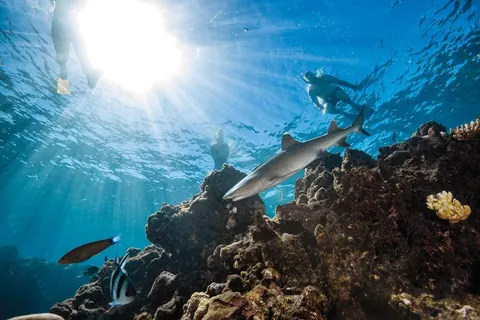 GetYourGuideFiji: Snorkel with Sharks and LunchView on GetYourGuide (opens in a new tab)
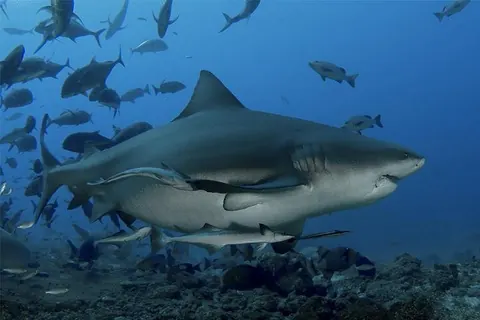 ViatorShark Encounter Two-Tank Dive at Beqa LagoonView on Viator (opens in a new tab)
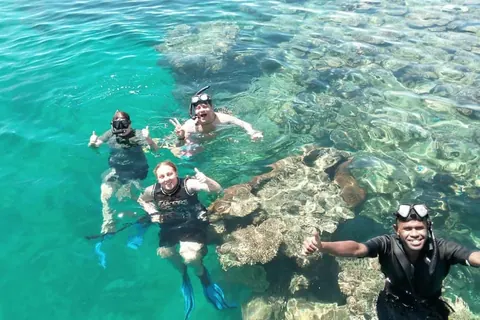 GetYourGuideNadi: Mamanuca Islands Snorkel, Turtle & Iguana SanctuaryView on GetYourGuide (opens in a new tab)
All Fiji trips on Viator (opens in a new tab)
Ratings from GetYourGuide travellers.
When is the best time to dive in Fiji?
The best time to dive in Fiji is May to October, outside the November–April cyclone season, when the sea cools from 27.3 °C (81 °F) in May to 25.3 °C (78 °F) in August and September.
Fiji is dived all year, but from November to April tropical cyclones can bring storm days and cancelled boats. The risk peaks from about January to March. If those are your only free weeks, keep a few spare days and book transfers between islands that you can move.
How warm is the sea?
The water is warmest in February and March at 28.7 °C (84 °F) and coolest in August and September at 25.3 °C (78 °F). The swing is only about 3.4 °C (6 °F), but if you plan three dives a day in the cooler months, pack a full-length suit.
Mantas
A Yasawa island resort reports its manta season from May to October, and off Kadavu mantas are reported throughout the year. Matava on Kadavu sells a manta dive for FJD 100 on top of its diving day.
| Month | Average water temperature | Season |
|---|---|---|
| January | 28.2 °C (83 °F) | Outside the best months |
| February | 28.7 °C (84 °F) | Outside the best months |
| March | 28.7 °C (84 °F) | Outside the best months |
| April | 28.2 °C (83 °F) | Outside the best months |
| May | 27.3 °C (81 °F) | Best month to dive |
| June | 26.5 °C (80 °F) | Best month to dive |
| July | 25.8 °C (78 °F) | Best month to dive |
| August | 25.3 °C (78 °F) | Best month to dive |
| September | 25.3 °C (78 °F) | Best month to dive |
| October | 25.9 °C (79 °F) | Best month to dive |
| November | 26.7 °C (80 °F) | Outside the best months |
| December | 27.5 °C (82 °F) | Outside the best months |
In season in: May · June · July · August · September · October
What are the best dive sites in Fiji?
Fiji's best-known dive sites are Shark Reef in Beqa Lagoon (4–30 m, 13–98 ft), the Great White Wall and Rainbow Reef in Taveuni's Somosomo Strait, and Naiqoro Passage on Kadavu's Great Astrolabe Reef (21–36 m, 69–118 ft).
Taveuni and the Somosomo Strait
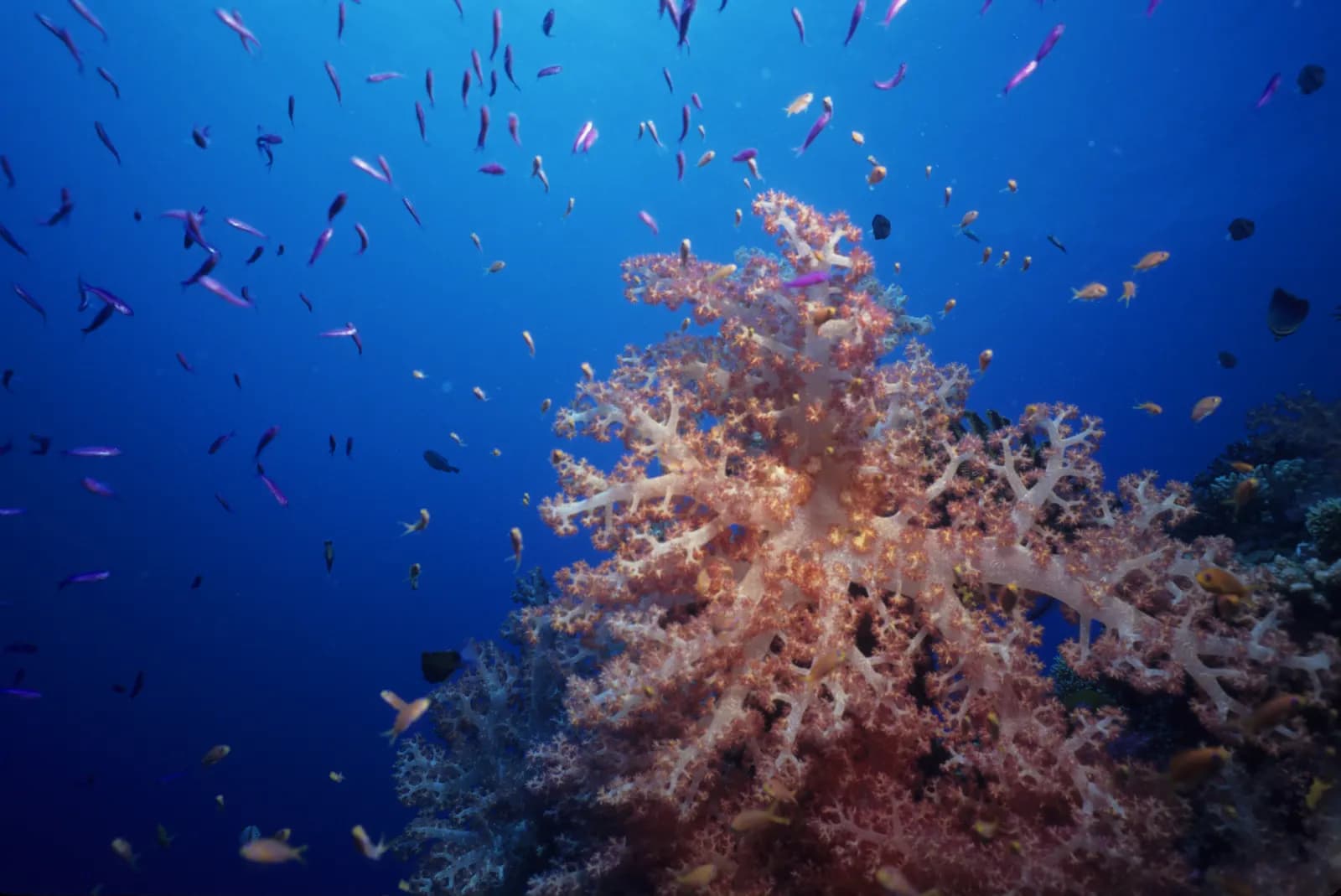
This is soft-coral country, and the current that feeds the corals is part of most dives. Rainbow Reef (9–20 m, 30–66 ft) has colorful soft corals, basslets and clown triggerfish. The Great White Wall (15–25 m, 49–82 ft) starts with a swim-through that opens onto a wall of pale soft corals; it is rated advanced and timed for slack tide. Cabbage Patch (8–20 m, 26–66 ft) is a gentle drift over fields of cabbage coral with unicornfish and dartfish.
Namena and Wakaya
Chimneys at Namena (3–25 m, 10–82 ft) are three coral bommies with nudibranchs, garden eels, barracuda and sharks; when the current runs, the dive becomes a drift. Blue Ridge off Wakaya (10–30 m, 33–98 ft) is a plateau and wall with ribbon eels, barracuda schools and the odd hammerhead.
Kadavu
Naiqoro Passage (21–36 m, 69–118 ft) is a current-swept wall on the Great Astrolabe Reef with soft-coral trees, sea fans and potato cod. It is an advanced dive.
Mamanuca and Yasawa
The island resorts west of Nadi run their own dive centers, which makes them the easiest base for a first Fiji trip. Ask each resort which sites it dives and how deep they go.
| Dive site | Depth | Level | Entry | Highlights |
|---|---|---|---|---|
| Shark Reef Marine Reserve (Beqa Lagoon) | 4–30 m (13–98 ft) | Advanced | Boat | Fiji's first national marine park: staged shark feeds at 30, 10 and 4 m with bull, lemon, silvertip and reef sharks, tigers now and then |
| Great White Wall (Taveuni) | 15–25 m (49–82 ft) | Advanced | Boat | Swim-through that opens onto a wall of pale soft corals; timed for slack tide in the Somosomo Strait |
| Rainbow Reef (Taveuni) | 9–20 m (30–66 ft) | Intermediate | Boat | Colourful soft corals, basslets and clown triggerfish; current is usually part of the dive |
| Cabbage Patch (Taveuni) | 8–20 m (26–66 ft) | Intermediate | Boat | Gentle drift over fields of cabbage coral with unicornfish and dartfish |
| Chimneys (Namena) | 3–25 m (10–82 ft) | Intermediate | Boat | Three coral bommies with nudibranchs, garden eels, barracuda and sharks; current can turn it into a drift |
| Blue Ridge (Wakaya) | 10–30 m (33–98 ft) | Intermediate | Boat | Plateau and wall with hard and soft corals, ribbon eels, barracuda schools and the odd hammerhead |
| Naiqoro Passage (Kadavu) | 21–36 m (69–118 ft) | Advanced | Boat | Current-swept wall on the Great Astrolabe Reef with soft coral trees, sea fans and potato cod |
What is the Beqa Lagoon shark dive like?
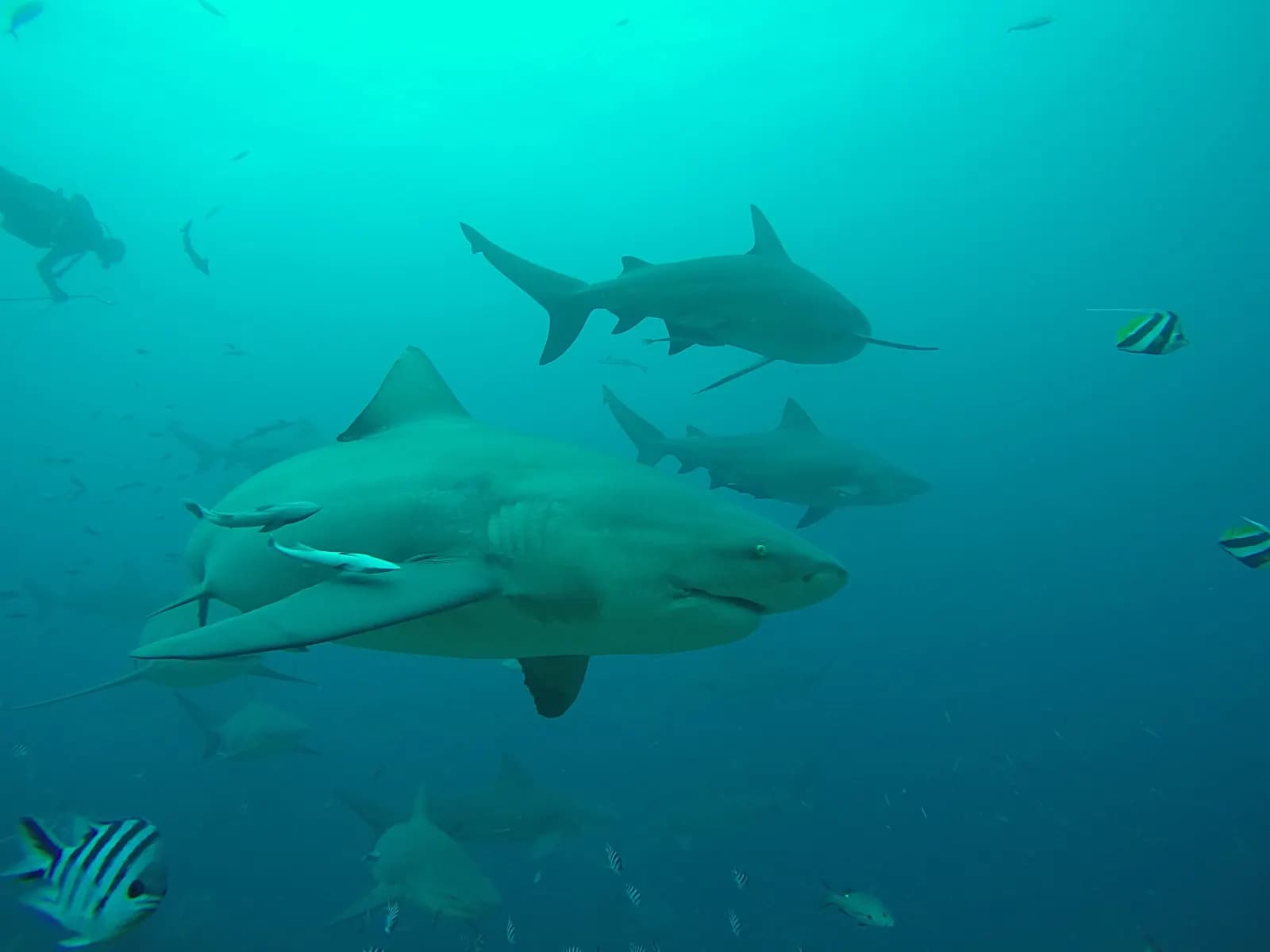
The Beqa Lagoon shark dive is a staged feed at Shark Reef Marine Reserve, Fiji's first national marine park, where divers watch bull, lemon, silvertip and reef sharks from stations at 30, 10 and 4 m (98, 33 and 13 ft), with a tiger shark now and then.
Beqa Adventure Divers in Pacific Harbour runs the dive. It is rated advanced in our table, and the first station is at 30 m (98 ft), so plan it as a deep dive and follow the briefing to the letter.
The shark dive costs FJD 500, plus a Shark Reef levy of FJD 25 per diving day and a FJD 20 daily fuel surcharge. The levy goes to the Galoa community, which gave up its fishing rights on the reef. The reserve was set up in 2004, became Fiji's first national marine park in 2014, and is managed day to day by the dive operator. Rates can change at the start of a new season, so ask for the one that applies to your travel dates.
How much does diving in Fiji cost?
A two-tank boat dive in Fiji usually costs about FJD 400 (FJD 295–475), a Discover Scuba session about FJD 340 (FJD 216–580) and an Open Water course about FJD 1,380 (FJD 975–2,050), prices checked November 2026.
Most of Fiji's dive centers belong to island resorts, and what a price covers varies:
- Gear: only Mantaray Island in the Yasawas includes equipment in its two-tank price; Matamanoa, Garden Island, Matava and Beqa Adventure Divers charge it on top.
- Day rates: Matava on Kadavu sells each diving day as a two-tank day for FJD 400, and Beqa Adventure Divers' FJD 475 is its soft-coral and wreck two-tank, not the shark dive.
- Try dives: Mantaray's price is per dive; Matamanoa's includes a pool session and one ocean dive.
- Indicative rates: Vomo marks its prices as indicative only, so ask for a written quote.
Prices are in Fijian dollars (FJD). For a price on your dates, ask Fiji dive centers for a quote.
Prices checked
| Item | Typical price | Range |
|---|---|---|
| Open Water course | FJD 1,380 | FJD 975–FJD 2,050 |
| Two-tank boat dive | FJD 400 | FJD 295–FJD 475 |
| Discover Scuba (try dive) | FJD 340 | FJD 216–FJD 580 |
Prices change; confirm with the center before you book.
Is Fiji a good place to learn to dive?
Fiji works well for learning if you stay at an island resort with its own dive center, but Open Water prices range from FJD 975 to FJD 2,050 because some courses leave out the eLearning part.
Matava's FJD 975 and Matamanoa's FJD 1,380 exclude PADI eLearning, Mantaray's FJD 995 is an SSI course, and Garden Island does not say what its price covers. Ask each center for the total with theory, certification card and gear, then set it against other places in our Open Water price index. Both PADI and SSI courses are sold here; the instructor matters more than the agency.
Many of Fiji's signature dives involve current or depth and are rated intermediate or advanced. After the course, log some calm reef dives at your resort before you head for the Somosomo Strait or the shark dive.
Do divers pay a marine park fee in Fiji?
Fiji has no national marine-park fee for divers; instead some reserves charge a levy through the dive operator, such as the FJD 25 per diving day that Beqa Adventure Divers adds for Shark Reef.
Ask about levies when you book. Waitabu Marine Park on Taveuni collects its entry fee on site and does not publish the amount, and if your trip includes Namena, ask the operator whether the reserve charges a fee. Fees change, so check the current one before you go.
Where is the nearest recompression chamber in Fiji?
Fiji's hyperbaric chambers are both on Viti Levu, at Pacific Specialist Healthcare hospital in Legalega, Nadi (opened at the end of 2024), and at Colonial War Memorial Hospital in Suva, which is nearer to Beqa Lagoon. Before your trip, confirm with your dive center that the nearer one is staffed.
Fiji's chamber service has had gaps: the old Suva chamber was out of service from 2017, and the multiplace unit that replaced it had no trained staff at first. Ask your dive center which chamber it would use and how it would get you there.
From Taveuni, Kadavu or the Yasawas, a diver with symptoms needs a boat or a flight to Viti Levu. Carry dive insurance that covers evacuation and chamber treatment, save DAN's emergency number, and see a dive doctor or DAN about fitness to dive.
Dive centers in Fiji
Loading dive centers…
Frequently asked questions
Can beginners dive in Fiji?
Yes, with a resort dive center. A Discover Scuba session costs about FJD 340, and Matamanoa's includes a pool session before one ocean dive. Several famous sites are not for beginners: the Beqa shark dive, the Great White Wall and Naiqoro Passage are rated advanced, and Rainbow Reef and Cabbage Patch usually come with current. Ask for sheltered reefs while you build experience.
How warm is the water in Fiji?
Fiji's sea averages 28.7 °C (84 °F) in February and March, the warmest months, and 25.3 °C (78 °F) in August and September, the coolest. During the May–October diving season it ranges from 25.3 to 27.3 °C (78–81 °F). Pack a full-length wetsuit for the cooler months if you plan several dives a day.
When is cyclone season in Fiji?
Fiji's tropical cyclone season runs from November to April, and the risk is highest from about January to March. Diving continues in those months, but a storm can cancel boats for days. If you travel then, leave spare days in your plan, choose bookings you can change and carry travel insurance that covers weather disruption.
What do you need to know before the Fiji shark dive?
The Beqa Lagoon shark dive follows a fixed routine: divers wait at stations at 30, 10 and 4 m (98, 33 and 13 ft) while guides feed bull, lemon and reef sharks. Because the first station is at 30 m, it is rated advanced. Dive within your certification, follow the briefing exactly and budget FJD 500 plus the FJD 25 reserve levy and a FJD 20 fuel surcharge.
Which airport do you fly into for diving in Fiji?
Most divers fly into Nadi International Airport (NAN) on Viti Levu, the island with both of Fiji's hyperbaric chambers. Nausori International Airport (SUV) near Suva is the other gateway and is closer to Pacific Harbour and Beqa Lagoon. Taveuni, Kadavu and the Mamanuca and Yasawa resorts need a domestic flight or a boat transfer on top, so plan the connection with your resort.
Can you see manta rays in Fiji?
Yes, in some areas. A Yasawa island resort reports a manta season from May to October, and off Kadavu mantas are reported throughout the year; Matava on Kadavu sells a manta dive for FJD 100 on top of its diving day. Sightings are never guaranteed, so ask the center what it has seen recently before you plan a trip around them.


