Dive guide · Palau
Scuba Diving in Palau
Palau, a small island nation in the western Pacific, is known for current-swept reef corners such as Blue Corner, manta cleaning stations in German Channel and the coral-encrusted WWII wreck Iro Maru. December to March brings the calmest seas, with water at 28.1–29.1 °C (83–84 °F). A two-dive boat day costs US$160–253, usually about US$209.
Key facts
- Best months
- December to March
- Water temperature
- 28.1–29.5 °C (83–85 °F)Monthly average, coolest to warmest month
- Level
- Intermediate to advanced
- Two-tank boat dive
- US$209Typical price, checked
- Discover Scuba (try dive)
- US$280Typical price, checked
- Open Water course
- US$680Typical price, checked
- Airport
- Roman Tmetuchl International Airport (ROR)
- Park fee
- Pristine Paradise Environmental Fee (included in international air tickets): US$100
- Park fee
- Koror State Rock Islands permit, valid 5 days: US$50
- Park fee
- Koror State Jellyfish Lake permit (includes Rock Islands), valid 5 days: US$100
- Nearest chamber
- Belau National Hospital hyperbaric chamber, Koror
Popular dive trips
Trips run by local operators, booked on Viator or GetYourGuide.
 ViatorFijiCertified Scuba Diving with Whitetip Marine Adventures teamView on Viator (opens in a new tab)
 GetYourGuideFijiDenarau: Mamanuca Islands 2-Tank Guided Scuba Diving TripView on GetYourGuide (opens in a new tab)
 ViatorGreat Barrier ReefCalypso Outer Great Barrier Reef Cruise from Port DouglasView on Viator (opens in a new tab)
 GetYourGuideGreat Barrier ReefPort Douglas: Outer Barrier Reef Snorkel and Dive OptionsView on GetYourGuide (opens in a new tab)
 ViatorHawaiiBeginner Scuba No Certification/Swimming Needed + Free VideosView on Viator (opens in a new tab)
 GetYourGuideHawaiiHonolulu: Beginner Scuba Diving Tour with VideosView on GetYourGuide (opens in a new tab)
Ratings from GetYourGuide travellers.
When is the best time to dive in Palau?
The best time to dive in Palau is December to March, when seas are usually calmest, rain is lowest and manta numbers at German Channel peak. Water ranges only from 28.1 °C (83 °F) in February to 29.5 °C (85 °F) in June, so temperature hardly affects the choice.
Boats go out all year in Palau, and local dive centers favor the drier stretch from November to April. Typhoons are rare.
- December to March: calmest seas and least rain. Mantas visit the German Channel cleaning stations year-round, but dive centers see the most from December to March.
- July to October: rain is more frequent and the sea can be choppier, which makes crossings to the outer reefs bumpier. Diving still runs.
- April to June and November: shoulder months between the two, with water near its warmest in May and June at 29.3–29.5 °C (85 °F).
Currents at the channels and corners are tidal, so book the current dives early in your trip and keep spare days for a second try. For visibility, ask the local centers what they are seeing that week.
| Month | Average water temperature | Season |
|---|---|---|
| January | 28.4 °C (83 °F) | Best month to dive |
| February | 28.1 °C (83 °F) | Best month to dive |
| March | 28.3 °C (83 °F) | Best month to dive |
| April | 28.8 °C (84 °F) | Outside the best months |
| May | 29.3 °C (85 °F) | Outside the best months |
| June | 29.5 °C (85 °F) | Outside the best months |
| July | 29.2 °C (85 °F) | Outside the best months |
| August | 29 °C (84 °F) | Outside the best months |
| September | 29.1 °C (84 °F) | Outside the best months |
| October | 29.2 °C (85 °F) | Outside the best months |
| November | 29.4 °C (85 °F) | Outside the best months |
| December | 29.1 °C (84 °F) | Best month to dive |
What are the best dive sites in Palau?
Palau's best-known dive sites are Blue Corner, a reef plateau at 15–40 m (49–131 ft) where divers hook in to watch sharks, Napoleon wrasse and turtles in the current, and German Channel at 6–30 m (20–98 ft) for mantas.
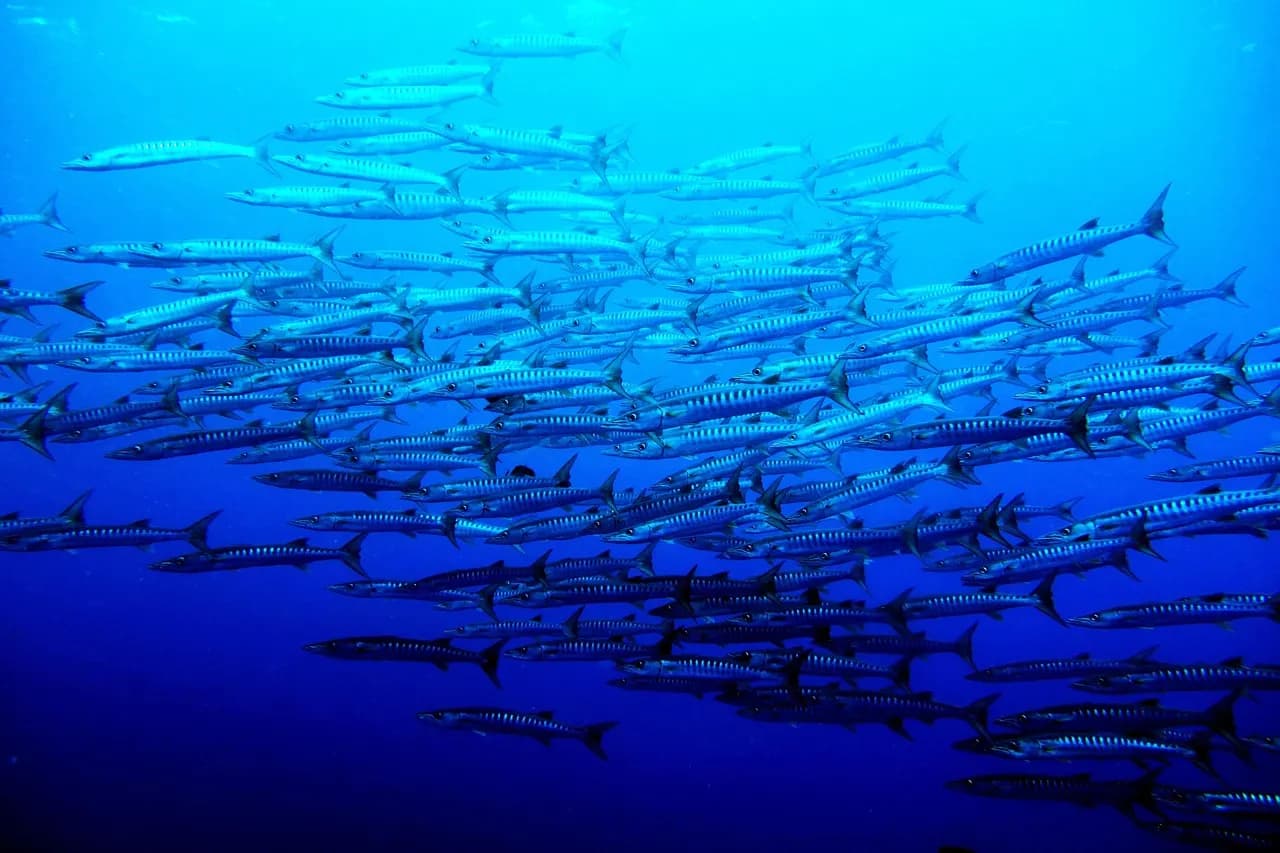
- Ulong Channel (5–20 m, 16–66 ft): a drift that starts at the channel mouth, where divers hook in to watch sharks, jacks, barracuda and groupers before letting go.
- German Channel (6–30 m, 20–98 ft): a channel dredged in 1908, now with manta cleaning stations, reef sharks and plenty of fish.
- Siaes Corner: a vertical wall that begins just below the surface and drops to 53 m (174 ft), far beyond recreational limits. Grey reef sharks and barracuda patrol the upper part, so plan the dive within your certification depth.
- Turtle Cove (17–30 m, 56–98 ft): a mini blue hole on the reef top that opens onto a wall with caves; grey reef, whitetip and leopard sharks.
- Iro Maru (10–30 m, 33–98 ft): a 143 m (469 ft) WWII wreck sitting upright on sand, heavily encrusted with coral.
- Chandelier Cave (3–10 m, 10–33 ft): five connected limestone chambers with stalactites in the Koror lagoon. It is an overhead environment, so go only with a guide who knows it.
Blue Corner and Siaes Corner are rated advanced. Reef hooks are part of the routine at Blue Corner: ask your center for one and practice with it on an easier channel first.
| Dive site | Depth | Level | Entry | Highlights |
|---|---|---|---|---|
| Blue Corner | 15–40 m (49–131 ft) | Advanced | Boat | Reef plateau where tidal currents bring sharks, schooling fish, Napoleon wrasse and turtles; reef hooks are used. |
| German Channel | 6–30 m (20–98 ft) | Intermediate | Boat | Channel dredged in 1908; manta ray cleaning stations, reef sharks and plenty of fish. |
| Ulong Channel | 5–20 m (16–66 ft) | Intermediate | Boat | Drift dive that starts at the channel mouth, where divers hook in to watch sharks, jacks, barracuda and groupers. |
| Siaes Corner | 10–53 m (33–174 ft) | Advanced | Boat | Vertical wall from just below the surface with grey reef sharks and barracuda. |
| Iro Maru | 10–30 m (33–98 ft) | Intermediate | Boat | 143 m WWII wreck sitting upright on sand, heavily encrusted with coral. |
| Chandelier Cave | 3–10 m (10–33 ft) | Intermediate | Boat | Five connected limestone chambers with stalactites; an overhead environment in the Koror lagoon. |
| Turtle Cove | 17–30 m (56–98 ft) | Intermediate | Boat | Mini blue hole on the reef top and a wall with caves; grey reef, whitetip and leopard sharks. |
What permits and fees do divers pay in Palau?
Divers in Palau pay the US$100 Pristine Paradise Environmental Fee (PPEF), already included in international air tickets issued since 1 January 2018, plus a Koror State Rock Islands permit of US$50 that is valid for 5 days.
The Rock Islands permit is not included in dive-day prices, so budget for it on top. A Jellyfish Lake permit costs US$100, includes the Rock Islands permit and is also valid for 5 days.
Some dive centers quote higher amounts (US$58 and US$113) or a 10-day validity. The figures below are the official ones, but fees change, so confirm the current amount when you book, and ask whether Jellyfish Lake is open to visitors before you pay for that permit.
| Fee | Amount | Validity and notes |
|---|---|---|
| Pristine Paradise Environmental Fee (PPEF) | US$100 | Included in international air tickets issued since 1 January 2018 |
| Koror State Rock Islands permit | US$50 | 5 days; not included in dive-day prices |
| Koror State Jellyfish Lake permit | US$100 | 5 days; includes the Rock Islands permit; check whether the lake is open |
How much does diving in Palau cost?
A boat day with two dives in Palau usually costs about US$209 (US$160 to US$253), a two-dive Discover Scuba day US$160 to US$330 and an Open Water course US$500 to US$723, at prices checked in November 2026.
Palau day boats include lunch, tanks and weights; rental gear and the Rock Islands permit are extra.
- Group size matters: Splash's US$160 rate applies to groups of four or more divers, while two divers pay US$270 each.
- Three dives for the price of two: DayDream's US$253 day rate (valid 1 October 2026 to 31 March 2027) is the same for one to three dives.
- Try dives: Palau's Discover Scuba programs are mostly two-dive days, at US$160 with Splash (a Rock Islands day), US$280 with Niu's Tour and US$330 with Neco Marine. Splash also sells a half-day, one-tank try dive for US$65.
Prices are in US dollars, Palau's currency. Some centers do not date their rates, so ask for the current one in writing.
Prices checked
| Item | Typical price | Range |
|---|---|---|
| Two-tank boat dive | US$209 | US$160–US$253 |
| Discover Scuba (try dive) | US$280 | US$160–US$330 |
| Open Water course | US$680 | US$500–US$723 |
| Marine park fee | US$50 | US$50 |
Prices change; confirm with the center before you book.
Can you learn to dive in Palau?
Yes, Palau dive centers teach the PADI Open Water course in 3–4 days for US$500 to US$723 with equipment included, typically about US$680.
Two details change the comparison. Splash's US$500 needs two or more students (US$600 for one), and Fish 'n Fins splits its US$723 into US$217 of eLearning and US$506 for the pool and open-water dives. Check whether the theory part is in the price before you compare Palau with other places in our Open Water price index.
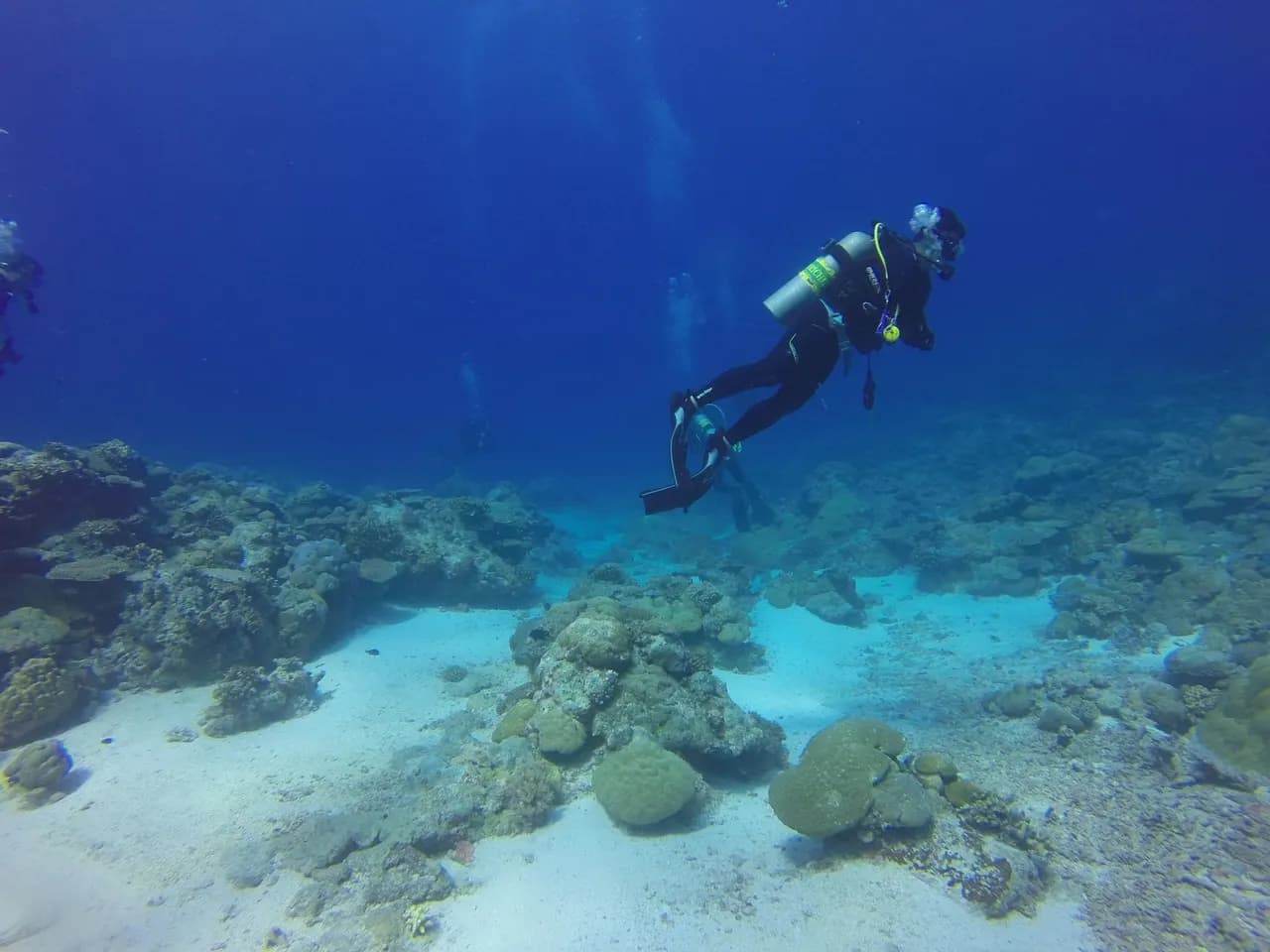
Palau's signature sites are current dives rated advanced, so a new diver gets more from a trip that adds a few guided channel dives, such as German Channel or Ulong Channel, after the course.
How do you choose a dive center in Palau?
Choose a Palau dive center by what its day rate covers (number of dives, lunch, gear, the Rock Islands permit), by its minimum group size and by whether it runs the sites you want in the current season.
Palau centers sell diving by the boat day. Ask before you book:
- how many divers the quoted rate assumes;
- whether it covers two or three dives;
- who buys the Rock Islands permit and when;
- whether nitrox and reef hooks are available.
For prices on your dates, ask Palau dive centers.
Loading dive centers…
Where is the recompression chamber in Palau?
Palau's recompression chamber is the hyperbaric chamber at Belau National Hospital in Koror, which you can reach on the hospital's phone numbers +680 488 2552 and +680 488 2553.
Having a chamber in Koror helps, but the outer reefs are still a boat ride from the hospital and any evacuation off the islands is by air. Carry dive insurance that covers chamber treatment and evacuation, and check that its depth limit fits sites like Blue Corner.
On current dives at Blue Corner and Ulong Channel, agree before you descend where the group hooks in, when it unhooks and how it surfaces together. Fly home only after the no-fly interval DAN currently recommends. For any symptoms after a dive, contact DAN or a dive doctor.
Frequently asked questions
Is Palau good for beginner divers?
Palau suits beginners who stay with a guide, but its most famous sites are not beginner dives: Blue Corner and Siaes Corner are rated advanced because of current and depth. German Channel and Ulong Channel are intermediate. A two-dive Discover Scuba day costs US$160 to US$330, and an Open Water course takes 3–4 days for US$500 to US$723.
When is manta season in Palau?
Mantas use the cleaning stations in Palau's German Channel all year, and dive centers see the highest numbers from about December to March. Those months also bring the calmest seas and least rain, which is why we rate them Palau's best months. German Channel lies at 6–30 m (20–98 ft) and is rated intermediate, so it is open to divers with some current experience.
Do you need a permit to dive in Palau?
Yes. Rock Islands dive trips need a Koror State Rock Islands permit, officially US$50 for 5 days; a Jellyfish Lake permit at US$100 includes it. On top, every international visitor pays the US$100 Pristine Paradise Environmental Fee, which is already included in international air tickets issued since 1 January 2018. Some centers quote slightly different amounts, so confirm the fee when you book.
How warm is the water in Palau?
Palau's water is warm all year: the sea averages 28.1 °C (83 °F) in February and 29.5 °C (85 °F) in June, the two ends of its range. In the December to March high season it sits at 28.1–29.1 °C (83–84 °F). The difference between seasons is in rain, wind and sea state, not in water temperature.
What is the rainy season in Palau?
Rain is more frequent in Palau from July to October, and seas can be choppier then, which makes the boat rides to the outer reefs bumpier. Diving still runs all year, and typhoons are rare. The drier November to April period, with its calmest stretch from December to March, is the period local dive centers favor.
Where is the nearest hyperbaric chamber to Palau's dive sites?
The nearest chamber is at Belau National Hospital in Koror; save the hospital's phone numbers, +680 488 2552 and +680 488 2553, before your first dive. Koror is the main town, but outer sites are still a boat ride away from the hospital. Make sure your insurance covers both chamber treatment and air evacuation.


