Dive guide · Tanzania
Scuba Diving in Zanzibar
Zanzibar's diving centers on Mnemba Atoll, with soft-coral slopes, drifts and a deeper wall, plus a shallow wreck off Stone Town and dolphins in Menai Bay. The sea stays at 25.5–29.2 °C (78–85 °F) all year, and two boat dives usually cost about US$110, before conservation fees of US$10–25 a day.

Key facts
- Best months
- March and October to November
- Water temperature
- 25.5–29.2 °C (78–85 °F)Monthly average, coolest to warmest month
- Level
- Beginner to advanced
- Open Water course
- US$490Typical price, checked
- Two-tank boat dive
- US$110Typical price, checked
- Discover Scuba (try dive)
- US$180Typical price, checked
- Airport
- Abeid Amani Karume International Airport (ZNZ)
- Park fee
- Mnemba special area entry, foreign visitor aged 16+, per day: US$25
- Park fee
- Other marine conservation areas (Menai Bay, Chumbe and Changuu-Bawe, Pemba Channel), non-East African visitor aged 16+, per day, from 1 September 2025: US$10
- Nearest chamber
- Zanzibar diver recompression chamber (Matemwe), Matemwe
Book a dive trip in Zanzibar
Trips run by local operators, booked on Viator or GetYourGuide.
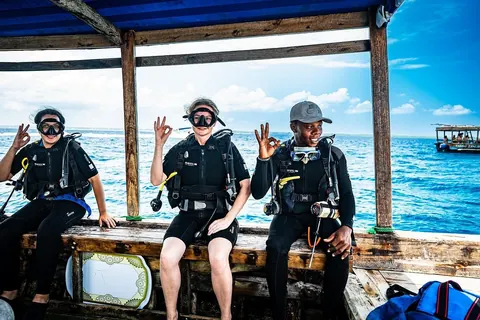 ViatorZanzibar 1 Day Scuba Diving beginner course and LunchView on Viator (opens in a new tab)
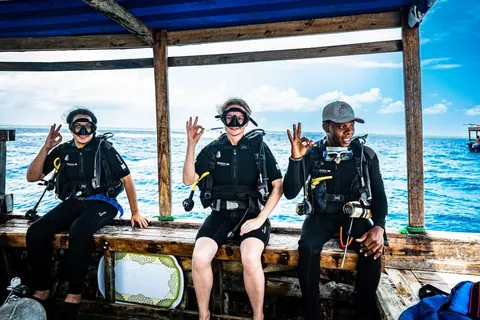 GetYourGuideZanzibar: 1-Day Diving Safari Course for Beginners with LunchView on GetYourGuide (opens in a new tab)
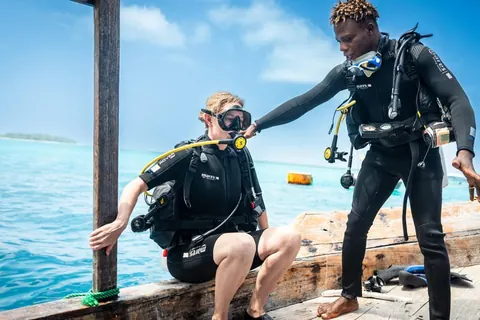 GetYourGuideZanzibar: 1-Day Diving Safari with 2 Scuba DivesView on GetYourGuide (opens in a new tab)
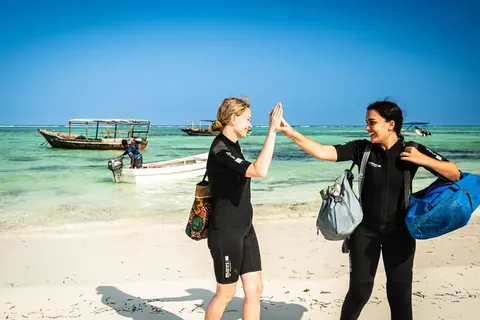 GetYourGuideZanzibar: 3-Day PADI Open Water Scuba Diving SafariView on GetYourGuide (opens in a new tab)
All Zanzibar trips on Viator (opens in a new tab)
Ratings from GetYourGuide travellers.
When is the best time to dive in Zanzibar?
Local dive centers rate March, October and November as the best months in Zanzibar, between the Kusi winds of June to September and the long rains of April and May, with the sea at 26.6–29.2 °C (80–85 °F) in those months.
Zanzibar is dived in every month and centers keep running in the wet season, so timing is about comfort on the boat rather than whether you can dive at all.
- April and May: the main rainy season; days can be very wet.
- June to September: the southerly Kusi monsoon brings stronger winds and choppier crossings, with August among the windiest months. The sea is at its coolest, 25.5–26.9 °C (78–80 °F).
- December to February: the centers disagree. One center says December and January bring the windiest weather of the north-easterly Kaskazi and trips may be cancelled; another, in Menai Bay in the south-west, says winds are weaker from December to late March. Ask your own center how its sites fare.
Whales and dolphins
Humpback whales pass Menai Bay for about three months, from August to October, and humpback and bottlenose dolphins live in the bay. A resident dolphin pod is also reported around Mnemba.
| Month | Average water temperature | Season |
|---|---|---|
| January | 28.2 °C (83 °F) | Outside the best months |
| February | 28.5 °C (83 °F) | Outside the best months |
| March | 29.2 °C (85 °F) | Best month to dive |
| April | 28.9 °C (84 °F) | Outside the best months |
| May | 28 °C (82 °F) | Outside the best months |
| June | 26.9 °C (80 °F) | Outside the best months |
| July | 25.9 °C (79 °F) | Outside the best months |
| August | 25.5 °C (78 °F) | Outside the best months |
| September | 25.8 °C (78 °F) | Outside the best months |
| October | 26.6 °C (80 °F) | Best month to dive |
| November | 27.7 °C (82 °F) | Best month to dive |
| December | 28.4 °C (83 °F) | Outside the best months |
What are the best dive sites in Zanzibar?
Zanzibar's best-known dive sites are on Mnemba Atoll, from the gentle soft-coral slope of Kichwani at 2–30 m (7–98 ft) to the Small Wall, an advanced drift at 5–40 m (16–131 ft), while Stone Town adds easy reefs and a shallow wreck.
Mnemba Atoll
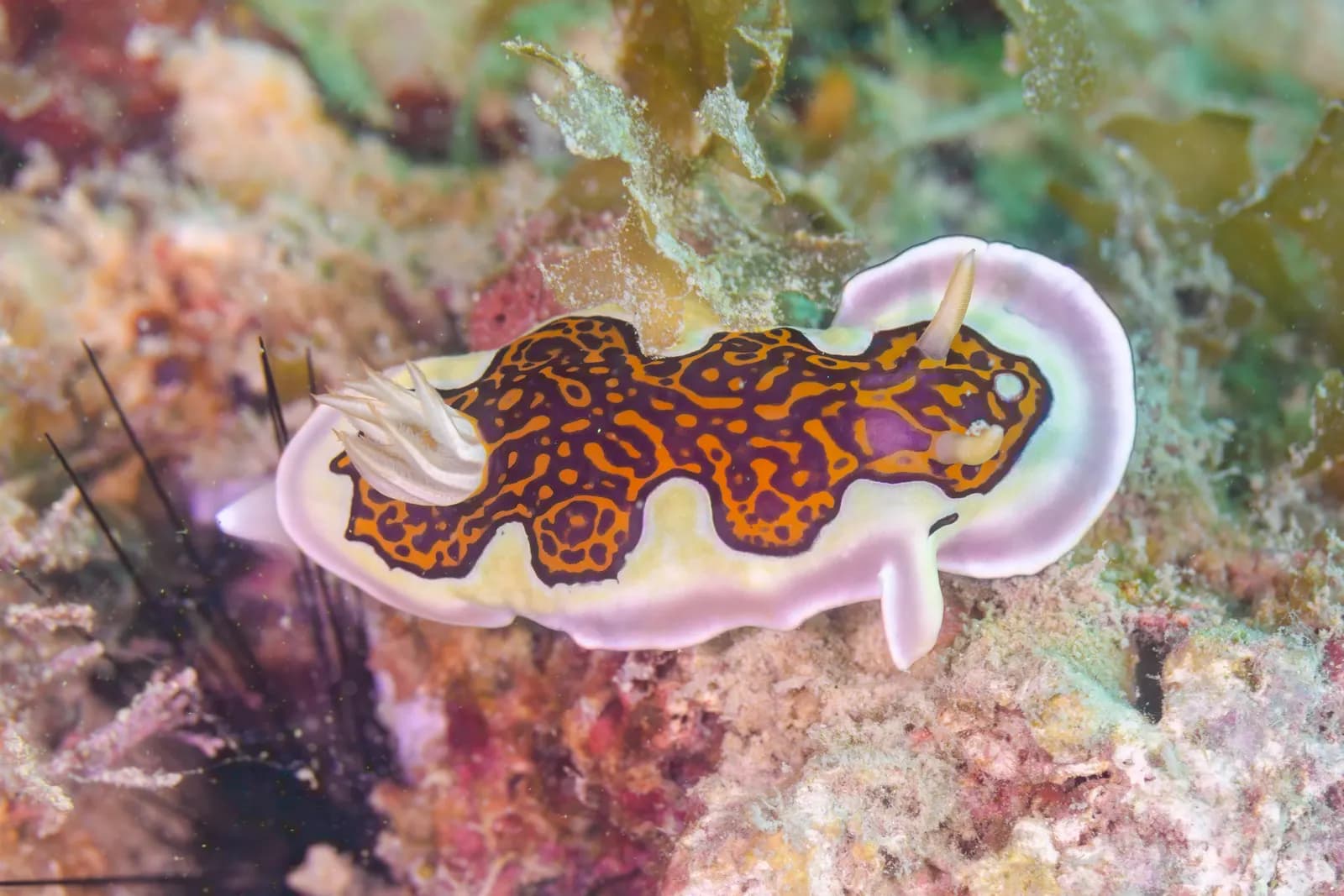
Kichwani is a gently sloping wall covered in soft corals, with schools of reef fish, pipefish, leaf fish and nudibranchs; snorkelers use it too. Wattabomi has coral blocks from 5 m (16 ft) with lionfish, scorpionfish, morays, frogfish and anemone shrimps. Mnemba Aquarium is a drift along hard-coral strips over sand at 12–25 m (39–82 ft), past surgeonfish, groupers, giant trevallies and a garden-eel field. On the Small Wall the reef slopes to 30 m (98 ft) before a vertical drop, with Napoleon wrasse, Zanzibar butterflyfish and the occasional whitetip reef shark. Mnemba Island itself is private, and boats may not land there.
Stone Town
Bawe Reef, around an island off Stone Town, has a coral wall on its north side and a long shallow reef on the south, with green and hawksbill turtles, cuttlefish and seahorses. The Great Northern was a British cable-laying ship, built in 1870, that sank in 1902; it lies coral-covered at 4–12 m (13–39 ft), home to shrimps and pipefish.
North-west and Menai Bay
Hunga Reef, a patch reef four nautical miles (7 km) off north-west Unguja, is dived on the slack tide for schools of snappers, fusiliers and emperors. Tumbatu Reef starts as a shallow coral wall off Tumbatu Island and turns into coral bommies with groupers, Picasso triggerfish and morays. In the south-west, Mnazi Mmoja off Kizimkazi lies in the Menai Bay Conservation Area at 15–25 m (49–82 ft) and is open to Open Water divers.
| Dive site | Depth | Level | Entry | Highlights |
|---|---|---|---|---|
| Kichwani (Mnemba) | 2–30 m (7–98 ft) | Beginner | Boat | Gently sloping wall covered in soft corals at Mnemba Atoll; reef-fish schools, pipefish, leaf fish and nudibranchs; also snorkelled |
| Wattabomi (Mnemba) | 5–20 m (16–66 ft) | Beginner | Boat | Coral blocks starting at 5 m with lionfish, scorpionfish, morays, frogfish and anemone shrimps |
| Mnemba Aquarium | 12–25 m (39–82 ft) | Intermediate | Boat | Drift along hard-coral strips over sand: surgeonfish, groupers, giant trevallies and a garden-eel field |
| The Small Wall (Mnemba) | 5–40 m (16–131 ft) | Advanced | Boat | Drift where the reef slopes to 30 m before a vertical drop; Napoleon wrasses, occasional whitetip reef sharks, Zanzibar butterflyfish |
| Bawe Reef (Stone Town) | 5–18 m (16–59 ft) | Beginner | Boat | Island reef off Stone Town: coral wall on the north side, long shallow reef on the south; green and hawksbill turtles, cuttlefish, seahorses |
| The Great Northern wreck (Stone Town) | 4–12 m (13–39 ft) | Beginner | Boat | British cable-laying ship built in 1870 that sank in 1902; shallow, coral-covered wreck with shrimps and pipefish |
| Hunga Reef | 16–18 m (52–59 ft) | Intermediate | Boat | Patch reef four nautical miles offshore of north-west Unguja; schools of snappers, fusiliers and emperors; dived on slack tide |
| Tumbatu Reef | 5–20 m (16–66 ft) | Beginner | Boat | Shallow coral wall off Tumbatu Island, then coral bommies; groupers, Picasso triggerfish, morays and nudibranchs |
| Mnazi Mmoja (Menai Bay) | 15–25 m (49–82 ft) | Beginner | Boat | Reef in the Menai Bay Conservation Area off Kizimkazi in south-west Unguja, open to Open Water divers; dolphins live in the bay |
How much does diving in Zanzibar cost?
In Zanzibar two boat dives usually cost about US$110 (US$100–110) without full equipment, a try-scuba day with two sea dives US$150–200, and an Open Water course US$490–550, with conservation fees extra (prices checked November 2026).
- Two boat dives: Buccaneer's one-day dive safari with two dives costs US$100, or US$135 with full rental; its Mnemba trip is US$165 with lunch and transfers. DiveTime charges US$110 for two dives in Menai Bay plus US$15 for rental. One Ocean's double dive is US$110 with soft gear, and a BCD and regulator add US$20 a day.
- Try dive: US$150 at DiveTime (US$120 for a single dive), US$180 at Buccaneer and US$200 at One Ocean, which adds a pool session before the two dives.
- Open Water: see the section on learning below.
None of these prices includes the marine conservation fee for the area you dive, so add it for every day at sea. For offers on your dates, ask Zanzibar centers for a quote.
Prices checked
| Item | Typical price | Range |
|---|---|---|
| Open Water course | US$490 | US$490–US$550 |
| Two-tank boat dive | US$110 | US$100–US$110 |
| Discover Scuba (try dive) | US$180 | US$150–US$200 |
Prices change; confirm with the center before you book.
How much are the marine conservation fees in Zanzibar?
Visiting Mnemba costs foreign visitors aged 16 and over a conservation fee of US$25 per day, and Zanzibar's other conservation areas, such as Menai Bay, are reported to charge US$10 per day from September 2025.
The Mnemba rate is set in Zanzibar's 2024 marine conservation regulations and was kept when the fees were revised in 2025. The US$10 rate covers the other conservation areas: Menai Bay, Chumbe and Changuu-Bawe, and the Pemba Channel. Children pay less, and the fee applies to snorkelers as well as divers.
Zanzibar revised these fees in 2024 and again in 2025, so check the current rate with your center before you go, and ask whether it collects the fee or you pay it yourself.
Is Zanzibar a good place to learn to dive?
Zanzibar is a good place to learn: six of the nine sites in our table are rated beginner, and an Open Water course costs US$490–550 for three to four days with equipment.
DiveTime and Buccaneer charge US$490 and One Ocean US$550. Buccaneer sells PADI eLearning separately for US$105, which makes US$595 in all, so ask what each price covers, and budget for the conservation fee on each day of open-water training.
Shallow sites such as Bawe Reef at 5–18 m (16–59 ft) and the Great Northern wreck at 4–12 m (13–39 ft) make relaxed first dives. The courses priced here are PADI courses; whichever agency you choose, a small group and a patient instructor matter more.
Is there a recompression chamber in Zanzibar?
A recompression chamber has operated at Matemwe in Zanzibar, but its current status is not published, so confirm it is working before you dive and make sure your insurance covers evacuation to Dar es Salaam or Nairobi.
Ask your center, before the first dive, which chamber it would use and how it would move an injured diver. Take dive insurance that pays for chamber treatment and an air evacuation, and put questions about fitness to dive or flying after diving to a dive doctor or DAN.
In the water, the Small Wall, where the reef slopes to 30 m (98 ft) before a vertical drop, and the Mnemba Aquarium drift are the dives to plan with care: go with a guide, agree a turn depth and keep an eye on the current.
Dive centers in Zanzibar
Loading dive centers…
Frequently asked questions
Can you snorkel at Mnemba Atoll?
Yes. Kichwani, a gently sloping soft-coral wall on Mnemba Atoll, is snorkeled as well as dived, and a resident dolphin pod is reported around the atoll. Snorkelers pay the same Mnemba conservation fee as divers, US$25 a day for visitors aged 16 and over, so ask whether a trip price includes it. Mnemba Island itself is private, and boats may not land there.
When is the rainy season in Zanzibar?
April and May are Zanzibar's main rainy season. Dive centers keep running, but days can be very wet. For drier weather and calmer crossings, local centers point to March, October and November, between the rains and the Kusi winds of June to September. The sea stays warm through the rains, averaging 28.9 °C (84 °F) in April and 28 °C (82 °F) in May.
How much does a dive trip to Mnemba cost?
Buccaneer Diving's Mnemba trip costs US$165, including lunch and transfers, against US$100 for its standard two-dive safari without rental. On top comes the Mnemba conservation fee of US$25 a day for visitors aged 16 and over. Other centers price Mnemba days differently, so ask for the full amount, fee and rental included, before you book.
Can you see dolphins when diving in Zanzibar?
Often, especially in Menai Bay off Kizimkazi in the south-west, where humpback and bottlenose dolphins live and the Mnazi Mmoja reef is open to Open Water divers. A resident pod is also reported around Mnemba. Humpback whales pass Menai Bay for about three months, from August to October. Give dolphins space and never chase them, from the boat or in the water.
How warm is the water in Zanzibar?
Zanzibar's sea averages 29.2 °C (85 °F) in March, the warmest month, and 25.5 °C (78 °F) in August, the coolest. From November to May it stays at 27.7–29.2 °C (82–85 °F), so a thin suit is enough for most divers. From July to September it is 25.5–25.9 °C (78–79 °F), when a full wetsuit is more comfortable.
How do you get to Zanzibar for diving?
Fly into Abeid Amani Karume International Airport (ZNZ) on Unguja, the main island. Then pick your base by the diving you want: Stone Town for Bawe Reef and the Great Northern wreck, Kendwa for Hunga and Tumbatu, Kizimkazi for Menai Bay and its dolphins, or a center that runs boats to Mnemba Atoll. Moving between bases eats into diving time.
