Dive guide · Ecuador
Scuba Diving in the Galápagos
The Galápagos Islands, Ecuador's Pacific archipelago, can be dived on day trips from Santa Cruz and San Cristóbal: schooling hammerheads at Gordon Rocks, sea lions and Galápagos sharks at Kicker Rock. December to May brings calmer seas and water at 23.3–26.8 °C (74–80 °F). A two-dive day trip costs about US$230, plus park entry.
Key facts
- Best months
- December to May
- Water temperature
- 21.8–26.8 °C (71–80 °F)Monthly average, coolest to warmest month
- Level
- Intermediate to advanced
- Open Water course
- US$630Typical price, checked
- Two-tank boat dive
- US$230Typical price, checked
- Discover Scuba (try dive)
- US$180Typical price, checked
- Airports
- Seymour Airport (Baltra) (GPS), San Cristóbal Airport (SCY)
- Park fee
- Galápagos protected-areas entry tribute, foreign visitors aged 12 and over: US$200
- Park fee
- Galápagos protected-areas entry tribute, foreign visitors under 12: US$100
- Park fee
- Galápagos protected-areas entry tribute, citizens of CAN and Mercosur countries aged 12 and over: US$100
- Park fee
- Galápagos protected-areas entry tribute, children under 2 (any nationality): free
- Nearest chamber
- Protesub recompression chamber (SSS Recompression Chamber Network), Puerto Ayora (Santa Cruz)
Book a dive trip in Galápagos
Trips run by local operators, booked on Viator or GetYourGuide.
 ViatorDiving Discovery in Punta Estrada Santa CruzView on Viator (opens in a new tab)
 GetYourGuideGalápagos: Discovery Diving One-Day ExperienceView on GetYourGuide (opens in a new tab)
 Viator5-Day Galapagos Diving Tour | Hiking & WildlifeView on Viator (opens in a new tab)
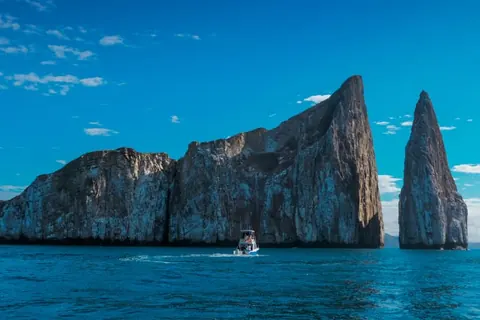 GetYourGuideKicker Rock: Scuba Diving Tour with 2 Dives and Full GearView on GetYourGuide (opens in a new tab)
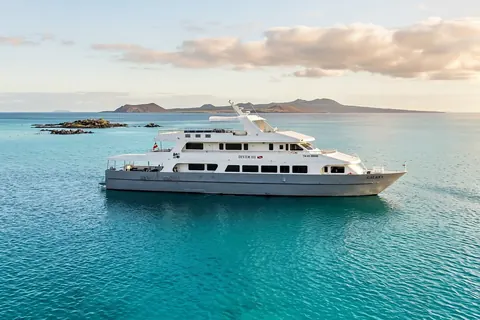 ViatorGalaxy Diver III Galapagos Liveaboard AdventureView on Viator (opens in a new tab)
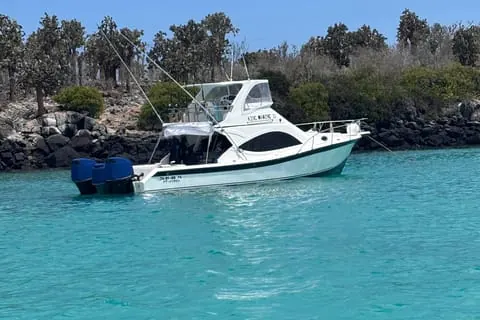 GetYourGuideGalápagos: Santa Fe Island Snorkeling TourView on GetYourGuide (opens in a new tab)
All Galápagos trips on Viator (opens in a new tab)
Ratings from GetYourGuide travellers.
When is the best time to dive in the Galápagos?
For day diving in the Galápagos, December to May is the easier season, with calmer seas and water at 23.3–26.8 °C (74–80 °F), while June to November brings cooler water down to 21.8 °C (71 °F), choppier crossings and stronger surge.
Galápagos sharks, sea turtles, rays and sea lions are seen on day dives all year, so the choice of season is about comfort as much as wildlife.
- Warm season (December to May): calmer seas and easier boat rides from Santa Cruz and San Cristóbal. A Santa Cruz center reports visibility of around 12 m (39 ft), though it changes from day to day.
- Cool season (June to November): the Humboldt-influenced season, with choppier seas, stronger surge and longer crossings. The same center reports visibility nearer 7 m (23 ft), and the water drops to 21.8 °C (71 °F) in August and September.
Mantas and hammerheads
Local centers disagree about mantas: one sees them more often in the cool season, from June to November, while another calls them a special treat at Beagle Rocks and the Plazas in the warm season. One Santa Cruz center reports hammerheads all year, and one San Cristóbal center sees them more often at Kicker Rock in the warmer months. Treat any season as a better chance, not a promise.
| Month | Average water temperature | Season |
|---|---|---|
| January | 24.7 °C (76 °F) | Best month to dive |
| February | 26.3 °C (79 °F) | Best month to dive |
| March | 26.8 °C (80 °F) | Best month to dive |
| April | 26 °C (79 °F) | Best month to dive |
| May | 24.9 °C (77 °F) | Best month to dive |
| June | 23.7 °C (75 °F) | Outside the best months |
| July | 22.6 °C (73 °F) | Outside the best months |
| August | 21.8 °C (71 °F) | Outside the best months |
| September | 21.8 °C (71 °F) | Outside the best months |
| October | 22 °C (72 °F) | Outside the best months |
| November | 22.6 °C (73 °F) | Outside the best months |
| December | 23.3 °C (74 °F) | Best month to dive |
In season in: January · February · March · April · May · December
What are the best day-trip dive sites in the Galápagos?
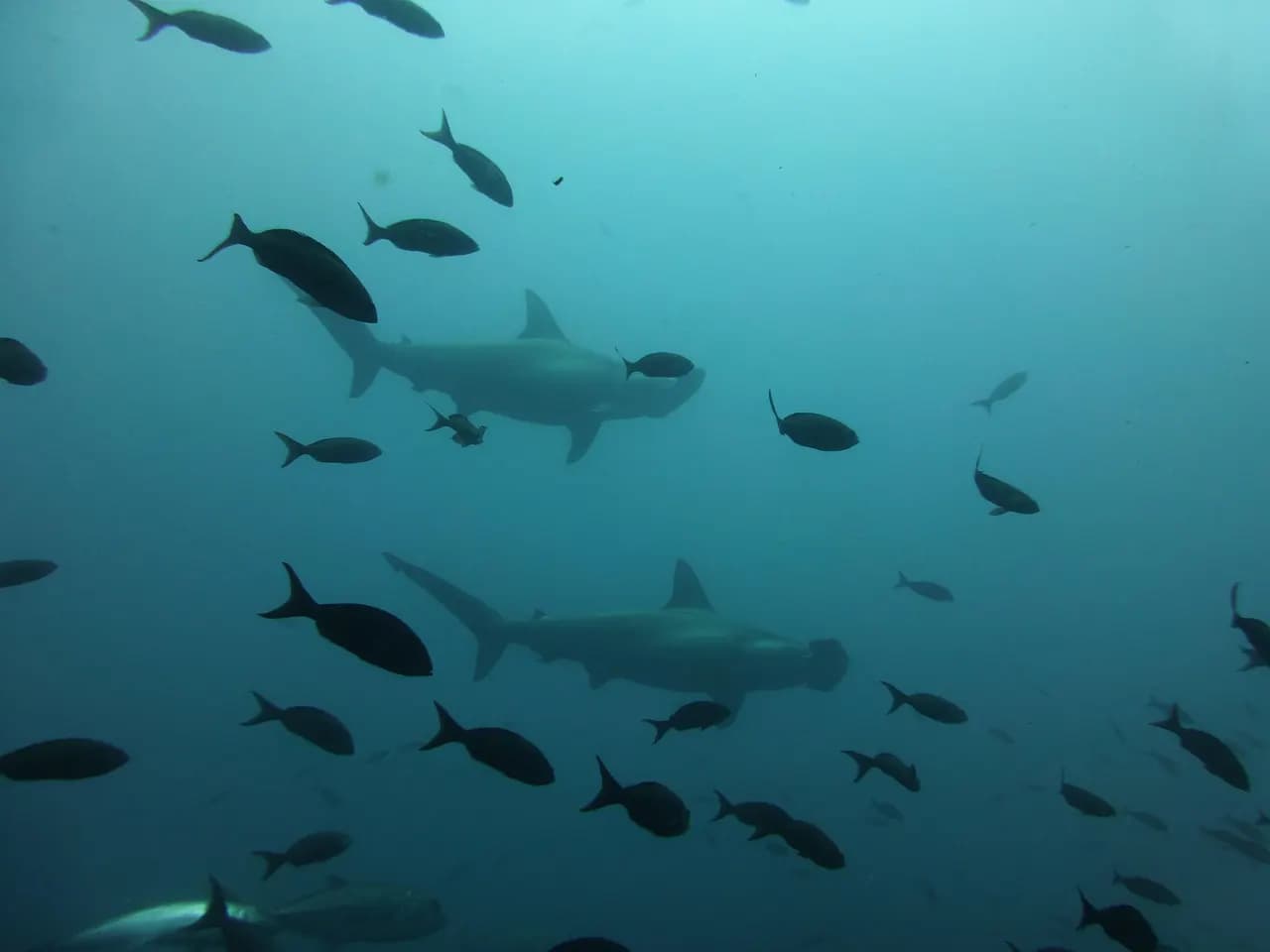
The best-known Galápagos day-trip site is Gordon Rocks off Santa Cruz (8–30 m, 26–98 ft), an eroded crater with schooling hammerheads, followed by Kicker Rock off San Cristóbal (18–22 m, 59–72 ft) and the North Seymour Channel (8–18 m, 26–59 ft).
From Santa Cruz (Puerto Ayora)
- Gordon Rocks: pinnacles inside an eroded crater, with hammerheads at cleaning stations, strong currents and few visual references. The outer walls drop far below the pinnacles, so watch your computer. Centers ask for Advanced certification and at least 25 logged dives.
- North Seymour Channel: a drift over rocky reef and sand with Galápagos, whitetip and hammerhead sharks at cleaning stations.
- Bartolomé (18–20 m, 59–66 ft): sea lions, turtles, whitetip reef sharks and stingrays, with mantas and mobulas on some days.
- Punta Estrada (11–14 m, 36–46 ft): a night dive close to Puerto Ayora.
From San Cristóbal
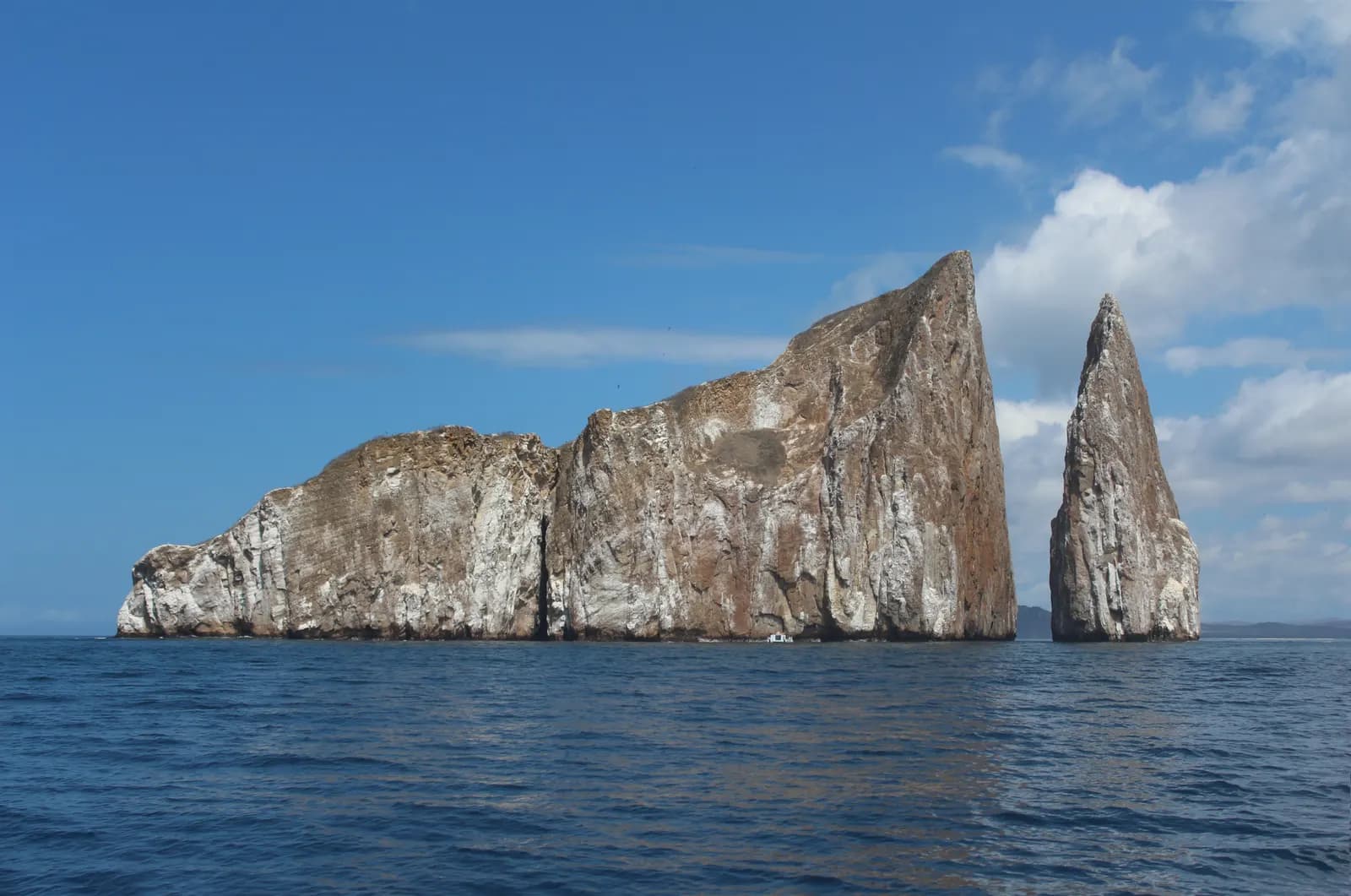
- Kicker Rock (León Dormido): a channel between two rock towers, then the west corner, with Galápagos sharks, eagle rays, turtles and sea lions.
- Whale Rock (Roca Ballena) (16–25 m, 52–82 ft): jacks, turtles, rays and the odd shark, with strong currents that depend on the season.
- The Cave (24–33 m, 79–108 ft): a short cave entered at 24 m (79 ft), for divers with deep or advanced certification.
Darwin and Wolf, the far-north islands, are out of reach for day boats.
| Dive site | Depth | Level | Entry | Highlights |
|---|---|---|---|---|
| Gordon Rocks (Santa Cruz) | 8–30 m (26–98 ft) | Advanced | Boat | Eroded crater with pinnacles; schooling hammerheads at cleaning stations; strong currents, few visual references |
| North Seymour Channel | 8–18 m (26–59 ft) | Intermediate | Boat | Drift over rocky reef and sand with Galápagos, whitetip and hammerhead sharks at cleaning stations |
| Bartolomé | 18–20 m (59–66 ft) | Intermediate | Boat | Sea lions, turtles, whitetip reef sharks and stingrays; mantas and mobulas some days |
| Kicker Rock / León Dormido (San Cristóbal) | 18–22 m (59–72 ft) | Intermediate | Boat | Channel between two rock towers, then the west corner: Galápagos sharks, eagle rays, turtles, sea lions |
| Whale Rock / Roca Ballena (San Cristóbal) | 16–25 m (52–82 ft) | Advanced | Boat | Jacks, turtles, rays and the odd shark; strong, season-dependent currents |
| The Cave (San Cristóbal) | 24–33 m (79–108 ft) | Advanced | Boat | Short cave entered at 24 m with small colourful corals; deep or advanced certification required |
| Punta Estrada night dive (Academy Bay, Santa Cruz) | 11–14 m (36–46 ft) | Intermediate | Boat | Night dive close to Puerto Ayora |
Do you need experience to dive in the Galápagos?
Most Galápagos day dives are rated intermediate or advanced because of current and surge, and Gordon Rocks needs Advanced certification plus 25 logged dives, but beginners can still try a Discover Scuba dive in a sheltered bay.
Try dives stay shallow. Aquaventures on San Cristóbal runs one dive to 8 m (26 ft) in Bahía Naufragio, Galápagos Dive Academy one dive in Academy Bay off Santa Cruz, and Scuba Iguana two dives to 12 m (39 ft) with lunch. An Open Water course costs about US$630 per person when two students share it.
If you are newly certified, start with North Seymour, Bartolomé or Kicker Rock and keep Gordon Rocks for later in the trip. Practice controlled descents and staying close to your buddy before you dive in strong current, where few visual references make depth easy to lose.
How much does diving in the Galápagos cost?
A two-dive day trip in the Galápagos usually costs about US$230 (US$230–250) with gear and lunch, a Discover Scuba dive about US$180 (US$125–380) and an Open Water course about US$630 (US$605–1,140), prices checked November 2026; park entry is extra.
- Day trips: Aquaventures charges US$230 for Kicker Rock from San Cristóbal; Galápagos Dive Academy's long-range day trips from Santa Cruz run US$230–280; Academy Bay's start from US$250.
- Try dives: the prices are per person for two students; a single student pays more, US$270 at Dive Academy and US$475 at Scuba Iguana.
- Open Water: per person for two students where centers tier their prices; the highest figure leaves out PADI eLearning.
All prices are in US dollars, Ecuador's currency. For prices on your dates, ask Galápagos dive centers.
Prices checked
| Item | Typical price | Range |
|---|---|---|
| Open Water course | US$630 | US$605–US$1,140 |
| Two-tank boat dive | US$230 | US$230–US$250 |
| Discover Scuba (try dive) | US$180 | US$125–US$380 |
Prices change; confirm with the center before you book.
How much is the Galápagos National Park entry fee?
Foreign visitors aged 12 and over pay a Galápagos protected-areas entry tribute of US$200 and children under 12 pay US$100, and the tribute is not included in dive prices.
Citizens of the Andean Community (CAN) and Mercosur countries pay US$100 from age 12, and children under 2 enter free. You also need a transit control card, bought in Quito or Guayaquil before the flight to the islands; ask your airline or dive center for the current price. Fees change, so check the current amounts before you travel.
| Visitor | Amount |
|---|---|
| Foreign visitors aged 12 and over | US$200 |
| Foreign visitors under 12 | US$100 |
| Citizens of CAN and Mercosur countries aged 12 and over | US$100 |
| Children under 2, any nationality | Free |
Liveaboard or land-based: which is better in the Galápagos?
Land-based day diving in the Galápagos suits divers who want hotel nights, island visits and flexible days around Santa Cruz and San Cristóbal, while a liveaboard is the only way to dive Darwin and Wolf in the far north.
Day boats return to port every afternoon, so you can mix diving with land tours and pay day by day. A liveaboard covers far more water and reaches the remote northern islands that day boats never visit. Routes, boats and prices per night are in our Galápagos liveaboard guide.
Where is the nearest recompression chamber in the Galápagos?
The nearest recompression chamber for Galápagos divers is the Protesub chamber in Puerto Ayora on Santa Cruz, reported as part of the SSS Recompression Chamber Network and open 24 hours; confirm it with your dive center before you dive.
Divers based on San Cristóbal would need a transfer to Santa Cruz. Because the islands are remote, carry dive insurance that covers chamber treatment and air evacuation; Scuba Iguana's try dive even includes insurance that pays 80% of chamber treatment. Ask a dive doctor or DAN about fitness to dive.
At current sites such as Gordon Rocks and Whale Rock, stay with your guide, agree on the plan before you drop in and surface with the group so the boat can pick everyone up together.
Dive centers in Galápagos
Loading dive centers…
Frequently asked questions
Can you see hammerhead sharks on Galápagos day trips?
Yes. Gordon Rocks off Santa Cruz is the best-known day-trip site for schooling hammerheads at cleaning stations, and hammerheads also visit the North Seymour Channel. One Santa Cruz center reports them all year, while one San Cristóbal center sees them more often at Kicker Rock in the warmer months. Gordon Rocks needs Advanced certification and 25 logged dives.
How cold is the water in the Galápagos?
The sea around the central Galápagos averages 26.8 °C (80 °F) in March, the warmest month, and 21.8 °C (71 °F) in August and September, the coolest. From June to November the cooler Humboldt-influenced season also brings choppier seas. Bring a thicker wetsuit and a hood for those months, and ask your center what it recommends for the sites on your trip.
Is the Galápagos good for beginner divers?
Only in part. Discover Scuba dives stay in sheltered bays, such as one dive to 8 m (26 ft) in Bahía Naufragio, and cost about US$180 per person when two students share. The famous sites have current and surge: most are rated intermediate or advanced, and Gordon Rocks needs Advanced certification plus 25 logged dives. Newly certified divers should log some easier dives first.
When is manta season in the Galápagos?
There is no clear manta season on Galápagos day trips. One Santa Cruz center sees mantas more often in the cool season, from June to November; another calls them a special treat at Beagle Rocks and the Plazas from January to May. Mantas and mobulas also turn up at Bartolomé on some days. Ask your center what it has seen in recent weeks.
How do you get to the Galápagos for diving?
Fly from mainland Ecuador to Seymour Airport (GPS) on Baltra, next to Santa Cruz, or to San Cristóbal Airport (SCY). Most day-dive centers are in Puerto Ayora on Santa Cruz or on San Cristóbal, so choose the airport for the island you will stay on. Budget for the US$200 park entry tribute for foreign adults and the transit control card.
Can you dive Darwin and Wolf on a day trip?
No. Darwin and Wolf, the far-north islands, are dived only from liveaboards; day boats from Santa Cruz and San Cristóbal stay with sites such as Gordon Rocks, North Seymour, Bartolomé and Kicker Rock. If Darwin and Wolf are your goal, compare routes and nightly prices in our Galápagos liveaboard guide before you book.


