Scuba Diving Destinations
DreamDiver's destination guides cover 39 places in seven regions: Egypt's Red Sea, Southeast Asia, the Indian Ocean, Australia and the Pacific, the Caribbean with Florida, the eastern Pacific and the Mediterranean. Each guide gives the best months, the sea temperature month by month, dive sites with depths and levels, and what diving and courses cost there.
Popular dive trips
Trips run by local operators, booked on Viator or GetYourGuide.
 ViatorBaliDiscover Scuba Diving in Tulamben, BaliView on Viator (opens in a new tab)
 GetYourGuideBaliBali: Tulamben Bay Beginner's Dive ExperienceView on GetYourGuide (opens in a new tab)
 ViatorHurghadaHurghada Diving Adventure one Day with two Dives Boat TripView on Viator (opens in a new tab)
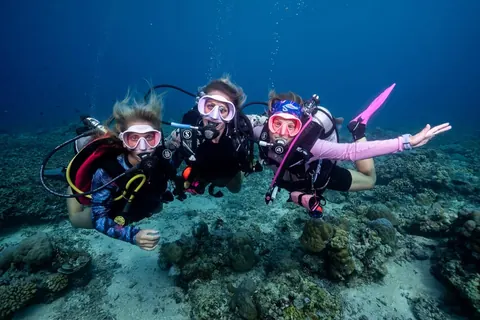 GetYourGuideGili IslandsGili Trawangan: Discover Scuba Diving for BeginnersView on GetYourGuide (opens in a new tab)
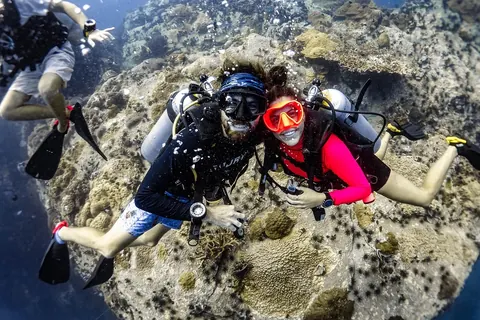 ViatorKoh TaoOpen Water Course - Become certified diver in 3 daysView on Viator (opens in a new tab)
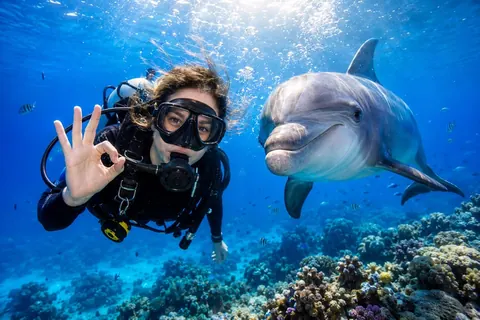 GetYourGuideHurghadaHurghada: Full-Day Boat Trip with 2 Scuba Dives and LunchView on GetYourGuide (opens in a new tab)
Ratings from GetYourGuide travellers.
Which scuba diving regions does DreamDiver cover?
DreamDiver covers seven diving regions: Egypt's Red Sea with Hurghada, Sharm el Sheikh, Dahab and Marsa Alam; Southeast Asia; the Indian Ocean; Australia and the Pacific; the Caribbean with Florida; the eastern Pacific; and the Mediterranean.
The list groups every published guide by region, and each region has an overview page of its own. A place covered inside a larger guide, such as Nusa Penida and Tulamben next to Bali, Koh Tao and Phuket under Thailand or Cairns on the Great Barrier Reef, is listed under that guide.
What is diving like in Egypt's Red Sea?
Egypt's Red Sea offers wrecks, coral walls and reef sharks within reach of four resort towns, with surface water from 22.4 °C (72 °F) in February to 28.9 °C (84 °F) in August.
- Hurghada: boat diving in every month on reefs and wrecks, including day trips to Abu Nuhas and the Thistlegorm area. A two-tank boat day usually costs EUR 50 (EUR 50–76).
- Sharm el Sheikh: Ras Mohammed, the Straits of Tiran and the SS Thistlegorm. Best months are May to September, when mantas and whale sharks are most often reported.
- Dahab: shore diving from the town's reefs to the Blue Hole and The Canyon. Dive centers charge EUR 20–23 for Blue Hole and Ras Abu Galum park entry; there is no official fee list, so check the current charge before you go.
- Marsa Alam: shore bays such as Marsa Abu Dabbab, where green turtles graze the seagrass, and boat days to Elphinstone and the spinner dolphins of Shaab Samadai. Two boat dives usually cost about EUR 91.
The Red Sea overview compares the four towns. The far offshore reefs of the Brothers and Daedalus, with hammerheads in summer and oceanic whitetips mainly in autumn, are the domain of Red Sea liveaboards.
Where can you dive in Southeast Asia?
In Southeast Asia, DreamDiver covers Bali, Tulamben and Amed, Nusa Penida, the Gili Islands, Komodo and Raja Ampat in Indonesia, Koh Tao and Phuket in Thailand, Vietnam with Phu Quoc, the Philippines and Malaysia, where monthly surface averages run from 24.5 °C (76 °F) off Nha Trang in January to 30.4 °C (87 °F) at Phu Quoc in May.
- Bali: the USAT Liberty wreck from the beach at Tulamben, macro and muck diving at Seraya, and reefs off Padang Bai and Candidasa. Best months April to November.
- Tulamben & Amed: Bali's north-east coast, where most dives start from the beach. The Liberty lies at 3–28 m (10–92 ft), and an Open Water course usually costs about IDR 5.2 million.
- Nusa Penida: reef mantas at Manta Point in every month and oceanic sunfish (mola) mainly from July to November, on drift dives that suit divers with some experience.
- Gili Islands: three small islands off Lombok with short boat rides, turtles on most of the main reefs and many sites rated for beginners. Seas are calmest from April to October.
- Komodo: current-swept reefs with reef mantas, sharks and soft coral, dived on day trips from Labuan Bajo; north and central sites are calmest from April to October. Routes and boats are on the Komodo liveaboards page.
- Raja Ampat: reefs dived from eco-resorts or by boat, best from October to April, when seas are generally calmer. Its monthly average never drops below 28.5 °C (83 °F). Routes and boats are on the Raja Ampat liveaboards page.
- Thailand: two coasts with opposite seasons. Koh Tao, in the Gulf, is best from February to October, with granite pinnacles, many dive schools and an Open Water course for about THB 11,500; whale sharks are recorded there in all seasons. Phuket, on the Andaman Sea, is best from November to April, with day boats to Phi Phi and, from Khao Lak, the Similan Islands, also sailed on Similan Islands liveaboards.
- Vietnam: Nha Trang Bay and its Hon Mun marine park, best from February to August and a relaxed place for first dives, and Phu Quoc in the Gulf of Thailand, whose shallow reefs are best from November to April.
- Philippines: thresher sharks at Monad Shoal off Malapascua, the Pescador Island wall at Moalboal and World War II wrecks in Coron, best in the dry season from December to May. Tubbataha is reached only by liveaboard, from March to June.
- Malaysia: Sipadan, a permit-only island park off Sabah with whitetip reef sharks on nearly every dive, and the east-coast islands of Tioman, the Perhentians and Redang, open about February to October.
The Southeast Asia overview sets these places side by side by season and price.
Where can you dive in the Indian Ocean?
In the Indian Ocean, DreamDiver covers the Maldives, with channel drift dives, mantas and whale sharks in water of 28.1–29.7 °C (83–85 °F), Zanzibar off Tanzania, where Mnemba Atoll is the main dive area and the sea stays at 25.5–29.2 °C (78–85 °F), and Mauritius, at 23.5–27.9 °C (74–82 °F).
- Our Maldives guide rates January to April best, when reef mantas use cleaning stations on the western side of the atolls; from about June to October they move to the eastern side. Whale sharks are encountered in the South Ari Marine Protected Area throughout the year. Prices differ widely between local-island centers and resorts: an Open Water course costs USD 475 to USD 913.77, typically about USD 785.07. Boats that move between the atolls are on the Maldives liveaboards page.
- Zanzibar: soft-coral slopes, drifts and a deeper wall on Mnemba Atoll, a shallow wreck off Stone Town and dolphins in Menai Bay. Local centers rate March, October and November best, and two boat dives usually cost about USD 110, before conservation fees of USD 10–25 a day.
- Mauritius: the Stella Maru wreck, reefs off Grand Baie and Coin de Mire in the north and coral gardens at Belle Mare in the east, dived all year. Our pick is April–May and October–December, and two boat dives usually cost about MUR 5,100.
Our Indian Ocean overview compares the three.
Where can you dive in Australia and the Pacific?
In Australia and the Pacific, DreamDiver covers the Great Barrier Reef with its gateway Cairns and Port Douglas, Palau in Micronesia, Fiji, Okinawa in southern Japan, and Hawaii, with a separate guide to Maui.
- Great Barrier Reef: outer-reef day trips, the SS Yongala wreck off Townsville, dwarf minke whales mainly in June and July, and mass coral spawning after the October to December full moons. Marine stingers are most likely from November to May.
- Cairns and Port Douglas: the main base for reef day trips. A day with two certified dives usually costs about AUD 417.
- Palau: current-swept walls and channels such as Blue Corner and German Channel, best from December to March, when seas are usually calmest and manta numbers peak.
- Hawaii: Kona on the Big Island for the manta night dive and year-round boat diving, Oahu for wrecks off Waikiki and summer shore dives on the North Shore; May to October is calmest. Maui has its own guide, with Molokini Crater, shore dives along West Maui and humpback whales from about November to April.
- Fiji: the staged shark dive in Beqa Lagoon, the soft-coral walls of Taveuni's Somosomo Strait and the Great Astrolabe Reef off Kadavu, best from May to October, outside the cyclone season.
- Okinawa: more than 150 dive sites in the Kerama Islands, manta points off Ishigaki and caves and a WWII wreck around Okinawa Island. May to October is the main season, though typhoons can stop boats.
The Australia and Pacific overview compares these guides by season, water and price.
Where can you dive in the Caribbean and Florida?
In the Caribbean and Florida, DreamDiver covers Cozumel, Cancun and the Riviera Maya, Belize, Roatan and Utila, Bonaire, Curaçao, the Florida Keys and Key Largo, where even the coolest month averages 23.8 °C (75 °F) or more.
- Cozumel: drift dives along walls such as Palancar, Santa Rosa and Columbia. Divers and snorkelers pay the Arrecifes de Cozumel National Park fee of MXN 225.56 per person per day. Best months December to May, outside the June to November hurricane season.
- Cancun & Riviera Maya: reef dives at the MUSA sculptures and off Isla Mujeres, Akumal's turtles and cenotes such as Angelita and The Pit, with whale sharks from Isla Mujeres in summer and bull sharks off Playa del Carmen from November to March.
- Belize: the barrier reef off Ambergris Caye and Caye Caulker and the atolls of Lighthouse Reef, home of the Great Blue Hole, Turneffe and Glover's Reef. Whale sharks gather at Gladden Spit mainly from March to June.
- Roatan & Utila: reef walls, wrecks such as the Odyssey and a shark dive on Roatan, budget courses and whale sharks in any month on Utila. An Open Water course costs USD 350–530.
- Bonaire: shore diving at sites such as Salt Pier and Yellow Submarine, rated good in every month. The STINAPA Nature Fee is USD 40 per visitor aged 13 or older, valid for the calendar year.
- Curaçao: more than 38 dive sites reached from the beach, from a shallow tugboat wreck to the Watamula wall, and diving all year.
- Florida Keys: reefs and wrecks from Key Largo to Key West, including the Spiegel Grove and the Benwood. Record heat in summer 2023 caused widespread coral bleaching and mortality in the marine sanctuary, so older reef descriptions may no longer hold. Key Largo has its own guide to the Spiegel Grove, the Christ of the Abyss and its shallow reefs.
Our Caribbean overview puts these islands and coasts side by side.
Where can you dive in the eastern Pacific?
In the eastern Pacific, DreamDiver covers Cabo San Lucas and La Paz at the tip of Mexico's Baja California and the Galápagos Islands off Ecuador, where the water is cooler than at most tropical destinations, down to 21.3 °C (70 °F) and 21.8 °C (71 °F) in their coolest months.
- Cabo San Lucas & La Paz: sea lions and sandfalls in the Cabo San Lucas marine park, the Cabo Pulmo reef up the coast and La Paz's seamounts with schooling hammerheads. November to April brings humpback whales and La Paz whale sharks, and two tanks usually cost about USD 145. Boats to Socorro, for giant mantas, dolphins and sharks, sail from Cabo San Lucas between November and July.
- Galápagos: day trips from Santa Cruz and San Cristóbal to Gordon Rocks for schooling hammerheads and Kicker Rock for sea lions and Galápagos sharks. December to May brings calmer seas, and a two-dive day costs about USD 230, plus park entry. Darwin and Wolf are reached only on Galápagos liveaboards.
The eastern Pacific overview compares the two.
Where can you dive in the Mediterranean?
In the Mediterranean, DreamDiver covers Malta, Gozo and Comino, a shore-diving destination with wrecks such as the Um El Faroud and the P29, where the sea warms from 15.4 °C (60 °F) in February to 26.5 °C (80 °F) in August.
- Malta & Gozo: Gozo's Blue Hole and Inland Sea tunnel, Cathedral Cave and the caves of Comino, most of them entered from land. Shore diving runs all year and boat trips mainly from May to October; an Open Water course usually costs about EUR 540, with eLearning or digital learning included.
The Mediterranean overview has the region at a glance.
How warm is the water at each diving destination?
Across DreamDiver's 39 guides, monthly surface averages run from 15.4 °C (60 °F) around Malta in February and March to 30.4 °C (87 °F) at Phu Quoc in May.
These are long-term monthly averages at the surface; it can be colder at depth. Best months are each guide's own pick for its place; the Thailand overview gives February to April, the only months when both of its coasts are in season.
| Destination | Coolest month | Warmest month | Best months |
|---|---|---|---|
| Red Sea (Egypt) | Feb: 22.4 °C (72 °F) | Aug: 28.9 °C (84 °F) | Apr–Nov |
| Hurghada | Feb–Mar: 22.4 °C (72 °F) | Aug: 28.7 °C (84 °F) | All year |
| Sharm el Sheikh | Mar: 22.6 °C (73 °F) | Aug: 29.0 °C (84 °F) | May–Sep |
| Dahab | Feb–Mar: 22.0 °C (72 °F) | Aug: 28.0 °C (82 °F) | Mar–Nov |
| Marsa Alam | Feb: 22.6 °C (73 °F) | Aug: 29.5 °C (85 °F) | Apr–Nov |
| Bali | Aug: 26.7 °C (80 °F) | Apr: 28.9 °C (84 °F) | Apr–Nov |
| Tulamben & Amed | Aug: 27.8 °C (82 °F) | Apr: 29.6 °C (85 °F) | Apr–Nov |
| Nusa Penida | Aug: 26.7 °C (80 °F) | Apr: 28.9 °C (84 °F) | Apr–Nov |
| Gili Islands | Aug: 27.5 °C (82 °F) | Apr: 29.4 °C (85 °F) | Apr–Oct |
| Komodo | Aug: 26.6 °C (80 °F) | Dec: 29.1 °C (84 °F) | Apr–Oct |
| Raja Ampat | Aug: 28.5 °C (83 °F) | Nov: 29.4 °C (85 °F) | Oct–Apr |
| Thailand | Jan: 28.4 °C (83 °F) | May: 29.9 °C (86 °F) | Feb–Apr |
| Koh Tao | Jan: 27.7 °C (82 °F) | May: 30.2 °C (86 °F) | Feb–Oct |
| Phuket | Jan: 28.4 °C (83 °F) | May: 29.9 °C (86 °F) | Nov–Apr |
| Vietnam | Jan: 24.5 °C (76 °F) | May, Sep: 28.9 °C (84 °F) | Feb–Aug |
| Phu Quoc | Jan: 27.9 °C (82 °F) | May: 30.4 °C (87 °F) | Nov–Apr |
| Philippines | Feb: 27.1 °C (81 °F) | Jun: 29.5 °C (85 °F) | Dec–May |
| Malaysia | Feb: 28.1 °C (83 °F) | May: 29.6 °C (85 °F) | Apr–Oct |
| Maldives | Jan: 28.1 °C (83 °F) | Apr: 29.7 °C (85 °F) | Jan–Apr |
| Zanzibar | Aug: 25.5 °C (78 °F) | Mar: 29.2 °C (85 °F) | Mar, Oct–Nov |
| Mauritius | Aug: 23.5 °C (74 °F) | Feb: 27.9 °C (82 °F) | Apr–May, Oct–Dec |
| Great Barrier Reef | Aug: 23.4 °C (74 °F) | Feb: 28.7 °C (84 °F) | May–Oct |
| Cairns & Port Douglas | Jul–Aug: 24.1 °C (75 °F) | Feb: 29.0 °C (84 °F) | May–Oct |
| Palau | Feb: 28.1 °C (83 °F) | Jun: 29.5 °C (85 °F) | Dec–Mar |
| Hawaii | Feb–Mar: 24.4 °C (76 °F) | Sep–Oct: 27.0 °C (81 °F) | May–Oct |
| Maui | Feb–Mar: 24.3 °C (76 °F) | Sep: 26.9 °C (80 °F) | May–Sep |
| Fiji | Aug–Sep: 25.3 °C (78 °F) | Feb–Mar: 28.7 °C (84 °F) | May–Oct |
| Okinawa | Feb: 21.7 °C (71 °F) | Aug: 28.9 °C (84 °F) | May–Oct |
| Cozumel | Feb: 26.5 °C (80 °F) | Sep: 29.4 °C (85 °F) | Dec–May |
| Cancun & Riviera Maya | Feb–Mar: 26.4 °C (80 °F) | Sep: 29.2 °C (85 °F) | Dec–May |
| Belize | Jan–Feb: 26.5 °C (80 °F) | Sep: 29.6 °C (85 °F) | Dec–May |
| Roatan & Utila | Feb: 26.7 °C (80 °F) | Sep: 29.6 °C (85 °F) | Mar–Jun |
| Bonaire | Feb–Mar: 26.5 °C (80 °F) | Sep–Oct: 28.8 °C (84 °F) | All year |
| Curaçao | Feb–Mar: 26.4 °C (80 °F) | Oct: 28.8 °C (84 °F) | All year |
| Florida Keys | Jan–Feb: 23.8 °C (75 °F) | Aug: 29.9 °C (86 °F) | Apr–Jul |
| Key Largo | Jan–Feb: 24.0 °C (75 °F) | Aug: 29.9 °C (86 °F) | Apr–Jul |
| Cabo San Lucas & La Paz | Apr: 21.3 °C (70 °F) | Sep–Oct: 28.7 °C (84 °F) | Nov–Apr |
| Galápagos | Aug–Sep: 21.8 °C (71 °F) | Mar: 26.8 °C (80 °F) | Dec–May |
| Malta & Gozo | Feb–Mar: 15.4 °C (60 °F) | Aug: 26.5 °C (80 °F) | May–Oct |
Where should you go diving in each month?
May offers the widest choice, with 30 of DreamDiver's 37 destination guides in their best months, while January, November and December have the fewest, 14 each.
Destinations in their best months, as rated in each guide (the Red Sea and Thailand overviews are left out because their towns and coasts are listed):
- January: Hurghada, Raja Ampat, Phuket, Phu Quoc, Philippines, Maldives, Palau, Cozumel, Cancun & Riviera Maya, Belize, Bonaire, Curaçao, Cabo San Lucas & La Paz, Galápagos
- February: Hurghada, Raja Ampat, Koh Tao, Phuket, Vietnam, Phu Quoc, Philippines, Maldives, Palau, Cozumel, Cancun & Riviera Maya, Belize, Bonaire, Curaçao, Cabo San Lucas & La Paz, Galápagos
- March: Hurghada, Dahab, Raja Ampat, Koh Tao, Phuket, Vietnam, Phu Quoc, Philippines, Maldives, Zanzibar, Palau, Cozumel, Cancun & Riviera Maya, Belize, Roatan & Utila, Bonaire, Curaçao, Cabo San Lucas & La Paz, Galápagos
- April: Hurghada, Dahab, Marsa Alam, Bali, Tulamben & Amed, Nusa Penida, Gili Islands, Komodo, Raja Ampat, Koh Tao, Phuket, Vietnam, Phu Quoc, Philippines, Malaysia, Maldives, Mauritius, Cozumel, Cancun & Riviera Maya, Belize, Roatan & Utila, Bonaire, Curaçao, Florida Keys, Key Largo, Cabo San Lucas & La Paz, Galápagos
- May: Hurghada, Sharm el Sheikh, Dahab, Marsa Alam, Bali, Tulamben & Amed, Nusa Penida, Gili Islands, Komodo, Koh Tao, Vietnam, Philippines, Malaysia, Mauritius, Great Barrier Reef, Cairns & Port Douglas, Hawaii, Maui, Fiji, Okinawa, Cozumel, Cancun & Riviera Maya, Belize, Roatan & Utila, Bonaire, Curaçao, Florida Keys, Key Largo, Galápagos, Malta & Gozo
- June: Hurghada, Sharm el Sheikh, Dahab, Marsa Alam, Bali, Tulamben & Amed, Nusa Penida, Gili Islands, Komodo, Koh Tao, Vietnam, Malaysia, Great Barrier Reef, Cairns & Port Douglas, Hawaii, Maui, Fiji, Okinawa, Roatan & Utila, Bonaire, Curaçao, Florida Keys, Key Largo, Malta & Gozo
- July: Hurghada, Sharm el Sheikh, Dahab, Marsa Alam, Bali, Tulamben & Amed, Nusa Penida, Gili Islands, Komodo, Koh Tao, Vietnam, Malaysia, Great Barrier Reef, Cairns & Port Douglas, Hawaii, Maui, Fiji, Okinawa, Bonaire, Curaçao, Florida Keys, Key Largo, Malta & Gozo
- August: Hurghada, Sharm el Sheikh, Dahab, Marsa Alam, Bali, Tulamben & Amed, Nusa Penida, Gili Islands, Komodo, Koh Tao, Vietnam, Malaysia, Great Barrier Reef, Cairns & Port Douglas, Hawaii, Maui, Fiji, Okinawa, Bonaire, Curaçao, Malta & Gozo
- September: Hurghada, Sharm el Sheikh, Dahab, Marsa Alam, Bali, Tulamben & Amed, Nusa Penida, Gili Islands, Komodo, Koh Tao, Malaysia, Great Barrier Reef, Cairns & Port Douglas, Hawaii, Maui, Fiji, Okinawa, Bonaire, Curaçao, Malta & Gozo
- October: Hurghada, Dahab, Marsa Alam, Bali, Tulamben & Amed, Nusa Penida, Gili Islands, Komodo, Raja Ampat, Koh Tao, Malaysia, Zanzibar, Mauritius, Great Barrier Reef, Cairns & Port Douglas, Hawaii, Fiji, Okinawa, Bonaire, Curaçao, Malta & Gozo
- November: Hurghada, Dahab, Marsa Alam, Bali, Tulamben & Amed, Nusa Penida, Raja Ampat, Phuket, Phu Quoc, Zanzibar, Mauritius, Bonaire, Curaçao, Cabo San Lucas & La Paz
- December: Hurghada, Raja Ampat, Phuket, Phu Quoc, Philippines, Mauritius, Palau, Cozumel, Cancun & Riviera Maya, Belize, Bonaire, Curaçao, Cabo San Lucas & La Paz, Galápagos
A month outside the list is not closed: in Palau, for example, diving runs all year, with more rain and choppier seas from July to October.
Which diving destinations are far from a recompression chamber?
Many of DreamDiver's destinations need a boat, road or air transfer to reach a recompression chamber, among them Nusa Penida, the Gili Islands, Raja Ampat, Nha Trang and Phu Quoc in Vietnam, Sipadan, the Maldives atolls away from Malé, the outer Great Barrier Reef, Kona, Maui and the atolls of Belize.
- Nusa Penida: the nearest listed chamber is at Kasih Ibu Hospital Saba in Gianyar on mainland Bali, across the Badung Strait.
- Gili Islands: there is no chamber on the islands; the nearest is at Mataram City Hospital on Lombok, whose status is not confirmed, with Kasih Ibu Hospital Saba on Bali as the fallback.
- Komodo: a chamber is listed at Siloam Hospitals Labuan Bajo, but its type and hours are not confirmed; the fallback is Bali.
- Raja Ampat: a chamber is listed at the regional hospital in Waisai, but its working status is unclear; evacuation is to Sorong, Bali or Jakarta.
- Vietnam and Phu Quoc: no chamber is confirmed in Nha Trang or on Phu Quoc; divers with decompression illness have been treated at Military Hospital 175 in Ho Chi Minh City.
- Philippines: the TIEZA chamber in Mandaue City, Cebu, nearest to Malapascua and Moalboal, was reported working in 2025; confirm it is operating before you go.
- Malaysia: the confirmed chamber for Sipadan divers is at the naval base hospital in Sepanggar, Kota Kinabalu; a chamber reported in Semporna is unconfirmed.
- Maldives: the chamber in our guide is the clinic on Bandos Island in North Malé Atoll.
- Zanzibar: a chamber has operated at Matemwe, but its current status is not published; make sure your insurance covers evacuation to Dar es Salaam or Nairobi.
- Great Barrier Reef and Cairns: the Townsville Hyperbaric Medicine Unit, in Townsville.
- Fiji: both chambers are on Viti Levu, in Nadi and Suva, so divers on Taveuni or Kadavu need a transfer.
- Okinawa: the hyperbaric unit at University of the Ryukyus Hospital is in Ginowan on Okinawa Island, not on Ishigaki or in the Kerama Islands.
- Hawaii and Maui: the University of Hawaiʻi Hyperbaric Treatment Center is in Honolulu, on Oahu; divers hurt off Kona or Maui are flown there.
- Belize: the chamber in San Pedro on Ambergris Caye is a long boat ride from Lighthouse Reef and the Blue Hole.
- Roatan: the chamber at Anthony's Key Resort keeps posted hours, 8:00–17:00 Monday to Saturday and 8:00–12:00 on Sunday, so ask how your shop reaches it outside them.
- Cabo San Lucas and La Paz: no chamber in La Paz is confirmed, so an injured diver there may have to be taken to Cabo San Lucas.
- Galápagos: the Protesub chamber in Puerto Ayora on Santa Cruz, far from Darwin and Wolf; confirm it with your dive center.
For these places, choose dive insurance that covers evacuation and chamber treatment. Each guide's safety section names the nearest chamber.
Frequently asked questions
Where is the warmest water for scuba diving?
Among DreamDiver's destinations, Phu Quoc reaches the highest monthly average, 30.4 °C (87 °F) in May, just ahead of Koh Tao's 30.2 °C (86 °F), while Raja Ampat is the most even and never drops below 28.5 °C (83 °F). The Maldives, Palau, Malaysia and Phuket also stay above 28 °C (82 °F) in every month. These are surface averages, and the water can be cooler at depth.
Where can you scuba dive all year round?
Hurghada, Bonaire and Curaçao are the three places our guides rate as good in every month. In Hurghada the water cools to 22.4 °C (72 °F) in February and March; in Bonaire and Curaçao it stays between 26.4 °C (80 °F) and 28.8 °C (84 °F). Dahab and Koh Tao follow with nine best months each.
How much does a day of diving cost at these destinations?
A two-tank boat day usually costs about EUR 50 in Hurghada, THB 2,200 on Koh Tao and IDR 1.3 million in Amed, rising to USD 209 in Palau and Hawaii, USD 230 on a Galápagos day trip and AUD 417 on a reef day trip from Cairns. Prices were checked in November 2026, and each guide says what its price includes.
Can you dive at these destinations without a certificate?
Yes, as a try dive with an instructor. Discover Scuba sessions usually cost about EUR 55 in Hurghada (a day with two boat dives), EUR 81.50 in Marsa Alam, THB 2,500 on Koh Tao and USD 100 in Cozumel (one shore dive). To dive with a buddy and no instructor you need a certificate such as Open Water; our learning to dive guide explains the steps.
Which diving destinations have the coolest water?
Malta is the coolest of our destinations, at 15.4 °C (60 °F) in February and March, followed by Cabo San Lucas at 21.3 °C (70 °F) in April, Okinawa at 21.7 °C (71 °F) in February and the Galápagos at 21.8 °C (71 °F) in August and September. Dahab and the other Egyptian towns cool to about 22 °C (72 °F) in late winter, so pack a thicker suit.


