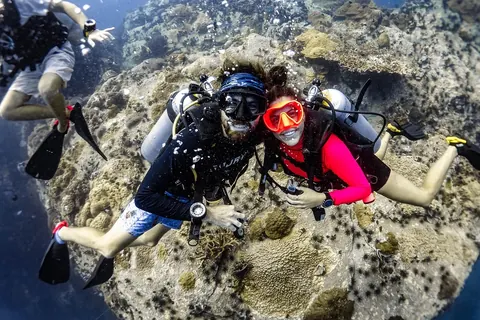
The best BCD depends on where you dive. A jacket such as the Cressi Start Pro (about US$400) is simple and forgiving for new divers, back-inflate BCDs such as the Cressi Patrol or Zeagle Ranger help you stay flat, and travel BCDs such as the 2.5 kg Cressi Travelight and the Scubapro Hydros Pro 2 save luggage weight.
Frequent travelers who want a premium, modular BCD
Weights: Monorail rail pockets: 10 lb standard, 5 lb mini
US$1,198
Typical street prices in US dollars. Prices change with sales and from shop to shop; check before you buy.
The BCDs in this guide
Cressi Start Pro
Best for
New divers who want a tough, simple jacket with plenty of lift
Typical price
US$400
The Start Pro is the jacket Cressi builds for dive schools: 500-denier Cordura outside, big wings for lift and a weight system that keeps its pockets attached when you drop the weights. A rigid backplate with a handle makes the whole rig easy to carry.
Divers who want back-inflation and good trim on a budget
Typical price
US$450
The Patrol keeps its air cell behind you, so the front stays clear and the BCD does not squeeze your chest when it fills. It has a lot of lift for its price, Cressi's quick-release integrated weights and a harness that adjusts a full size up or down.
Specs
Style
Back-inflate
Lift
19.3 kg (42.7 lb), size M
Weights
Flat Lock Aid integrated weights, optional trim pockets
Harness
Adjusts a full size up or down
Dump valves
3
Sizes
S to XL
Pros
Back-inflation makes it easier to stay flat in the water
The harness fits over a rash guard or a drysuit
Good lift for the price
Cons
Back-inflate BCDs can tip you forward at the surface
Fewer sizes than Cressi's school jacket
Cressi Travelight
Best for
Warm-water travelers who count every kilo
Typical price
US$500
The Travelight weighs 2.5 kg in size M and folds into its own 36 × 25 × 15 cm carry bag, held by a strap that doubles as a crotch strap. It still has integrated weights and two zipped pockets. Lift is modest, so it suits warm water and a thin wetsuit.
Specs
Weight
2.5 kg (5.5 lb), size M
Style
Jacket (wraparound)
Lift
9.1 kg (20.2 lb), size M
Packed size
36 × 25 × 15 cm in its own bag
Weights
Flat Lock Aid integrated, plus 2 rear trim pockets
Pros
Very light and packs small
Carry bag included
Integrated weights despite the light build
Cons
Low lift: not for cold water or heavy steel tanks
Lighter fabrics than a school jacket
Mares Bolt SLS
Best for
Travelers who want a streamlined back-inflate BCD
Typical price
US$658
The Bolt SLS is Mares' streamlined back-inflate BCD, built from 420-denier Cordura and sold as a travel BCD. Its SLS integrated weights release quickly, so you can leave the weight belt at home.
Specs
Style
Back-inflate
Lift
Up to 21 kg (46 lb), by size
Weights
SLS integrated, quick release
Material
420-denier Cordura
Pros
Streamlined back-inflate design for good trim
Light 420-denier fabric packs well
Integrated weights, no belt needed
Cons
Pricier than Cressi's back-inflate Patrol
Back-inflation takes a little practice at the surface
Zeagle Ranger
Best for
Divers who want one rugged BCD from the tropics to a drysuit
Typical price
US$950
The Ranger is Zeagle's heavy-duty back-inflate BCD: 1050-denier ballistic nylon, a 20 kg (44 lb) lift bladder and the Ripcord weight release that dumps your weights with one pull. Its modular build takes twin tanks, drysuits and technical add-ons.
Specs
Lift
20 kg (44 lb) ballistic bladder
Style
Back-inflate, modular
Weights
Ripcord one-pull release plus rear trim pockets
Material
1050-denier ballistic nylon
Dry weight
3.8 kg (8.4 lb)
D-rings
6 stainless steel
Pros
Built for years of hard use
Lots of lift for cold water and steel tanks
After a Ripcord release the pockets stay on the BCD
Cons
Heavy to fly with
Expensive next to simpler back-inflate BCDs
Scubapro Hydros Pro 2
Best for
Frequent travelers who want a premium, modular BCD
Typical price
US$1,198
The Hydros Pro 2 keeps the Monprene gel harness and quick-dry build of Scubapro's travel BCD and adds the Monorail weight system: the pockets slide onto a rail and lock with one hand. It folds to about 59 × 29 × 14 cm for packing.
Specs
Weights
Monorail rail pockets: 10 lb standard, 5 lb mini
Style
Back-inflate
Harness
Monprene gel harness, Ergo-Lite backplate
Packed size
About 59 × 29 × 14 cm
Tank band
Super Cinch 2
Bladder
Quick-dry
Pros
Dries fast between dives and packs flat
Weight pockets fit with one hand
A comfortable gel harness
Cons
The most expensive BCD in this guide
Monorail parts do not fit the original Hydros Pro
Partner
Popular dive trips
Trips run by local operators, booked on Viator or GetYourGuide.
Choose a jacket BCD such as the Cressi Start Pro if you want to float upright and comfortably at the surface, and a back-inflate BCD such as the Cressi Patrol, Mares Bolt SLS or Zeagle Ranger if you care more about lying flat and streamlined underwater.
Jacket
A jacket wraps air around your sides and chest. At the surface it holds you upright with your head well out of the water, which new divers find reassuring. When it is full it can squeeze the chest a little, and underwater the air shifts as you turn, so holding a flat trim takes more effort.
Back-inflate
All the air sits behind you. The front stays clear for gauges and lights, nothing presses on your chest, and the buoyancy sits where it helps you stay horizontal. At the surface a back-inflate BCD tends to tip you forward, so you learn to lean back or deflate a little. Most divers adapt within a few dives.
Wings
A backplate and wing takes the back-inflate idea further, with a rigid plate and a simple harness. It is the usual set-up for technical and cave divers. The Zeagle Ranger's modular build can grow in that direction with twin tanks and accessories.
How much lift does a BCD need?
A BCD needs enough lift to float you and all your gear at the surface, so warm-water divers in a thin wetsuit get by with the 9.1 kg (20.2 lb) of the Cressi Travelight, while cold-water divers in thick neoprene or a drysuit want something like the 19.3 kg (42.7 lb) of the Cressi Patrol or 20 kg (44 lb) of the Zeagle Ranger.
Lift figures depend on size: makers usually quote size M, and larger sizes hold more air. What adds to the lift you need:
a thick wetsuit or drysuit, which needs more lead and loses buoyancy as it compresses at depth;
steel tanks, which are heavier in the water than aluminium ones;
cameras, lights and other heavy accessories.
More lift than you need is not free either: a big bladder adds drag and makes small buoyancy changes less precise. If you dive mostly in the tropics, a mid-lift BCD is usually the better buy.
How should a BCD fit, and do you need integrated weights?
A BCD fits when it is snug but not tight with your usual wetsuit on and fully inflated, and integrated weights, which every BCD in this guide has, let you leave the weight belt at home and drop the lead with one pull if you need to.
Try a BCD with the suit you dive in, then inflate it fully: it should not ride up to your chin or squeeze your ribs. Check that you can reach the inflator, the dumps and the weight handles easily, including with gloves if you dive cold.
Integrated systems differ. On the Cressi Start Pro the weights fall out but the pockets stay attached. On the Zeagle Ranger one pull of the Ripcord drops the weights while the pockets stay on the BCD. The Scubapro Hydros Pro 2's Monorail pockets slide onto a rail and lock with one hand. Whatever the system, practice the release on land before you dive.
What makes a BCD good for travel?
A travel BCD is light, folds small and dries fast: the Cressi Travelight weighs 2.5 kg (5.5 lb) in size M and packs into a 36 × 25 × 15 cm bag, and the Scubapro Hydros Pro 2 folds to about 59 × 29 × 14 cm with a quick-dry bladder.
Weight matters most when you fly, since airlines count every kilo of dive gear. A light BCD often gives up some lift and some toughness, so match it to the diving you travel for: warm-water holidays suit the Travelight, while the Mares Bolt SLS and Hydros Pro 2 give more structure for divers who travel often. A rugged BCD such as the Zeagle Ranger is the better choice if you dive locally in cold water and fly less.
Should you buy a BCD or rent one?
Rent a BCD for your first trips and buy one once you know which style and size you like: a BCD you own fits every time and you know where every dump and pocket is, but it is also the bulkiest piece of gear to carry.
Many divers buy in this order: mask, then a dive computer, then fins, then the BCD and regulator. If you dive mainly on holiday, a rental BCD from a good dive center is often fine. If you dive at home, in a drysuit or with your own camera, owning the BCD pays off quickly. New to diving? Start with how to get scuba certified and what the course costs.
How do you look after a BCD?
After each dive day, rinse the BCD outside, run fresh water into the bladder through the inflator, swirl it round and drain it out of the dump valves, then store it partly inflated in the shade.
Salt left inside the bladder dries into crystals that wear the valves and seams, so the inside rinse matters more than the outside one.
Hang it on a wide hanger, not by one shoulder, and away from direct sun.
Push the inflator buttons while rinsing to flush salt out of the mechanism.
Have the inflator and dump valves checked when your regulator is serviced, and after any leak or sticking button.
Frequently asked questions
What is the best BCD for a beginner?
A comfortable jacket with plenty of lift and simple controls. The Cressi Start Pro (about US$400) is built for dive schools, with 500-denier Cordura, 15.2 kg (33.7 lb) of lift in size M and weight pockets that stay attached when you release the lead. If you already know you want back-inflation, the Cressi Patrol (about US$450) is a budget way to try it.
Is a back-inflate BCD good for beginners?
It can be. A back-inflate BCD makes it easier to lie flat underwater and keeps the chest free, which helps new divers learn good trim. The catch is at the surface, where it tends to push you face forward until you learn to lean back. Many instructors still start students in jackets, so try both styles in a pool if you can.
Can I take a BCD on a plane?
Yes. A BCD goes in checked luggage or, if it is small enough, in the cabin; what limits you is the airline's size and weight allowance. Take the weights out first. A travel BCD such as the 2.5 kg Cressi Travelight, which folds into its own small bag, or the Scubapro Hydros Pro 2 saves a lot of weight compared with a heavy-duty jacket.
What is the difference between a BCD and a wing?
A wing is a type of back-inflate buoyancy compensator mounted on a rigid backplate with a simple harness. A typical recreational BCD, jacket or back-inflate, has padding, pockets and integrated weights built in. Wings are the standard for technical, cave and twin-tank diving because they are modular and streamlined, while BCDs are quicker to set up for recreational dives.
How long does a BCD last?
With good care a BCD lasts many years: the shell fabric and bladder usually outlive several inflator services. Replace it when the bladder leaks and cannot be repaired, the fabric frays at the straps, or the weight system no longer locks reliably. Heavy-duty builds such as the Zeagle Ranger's 1050-denier ballistic nylon are made for years of hard use.