Diving region
Scuba Diving in the Caribbean
For Caribbean diving, pick by style: Bonaire and Curaçao for easy shore diving in any month, Cozumel for drift dives, Belize for the Great Blue Hole, Roatan and Utila for budget courses, Cancun and the Riviera Maya for cenotes, and the Florida Keys for wrecks. December to May keeps you clear of the June–November hurricane season.
Dive trips in the Caribbean
Trips run by local operators, booked on Viator or GetYourGuide.
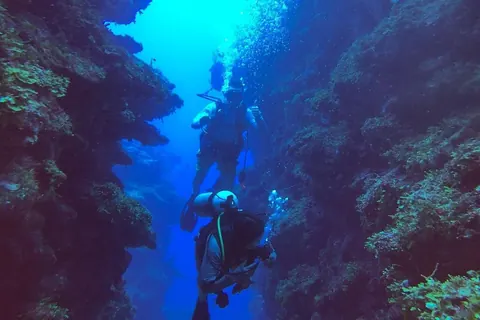 ViatorBelizePrivate Reef Diving near Ambergris Caye BelizeView on Viator (opens in a new tab)
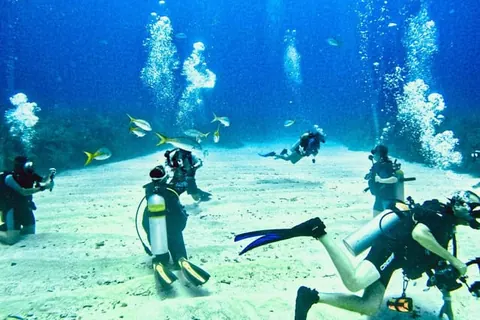 GetYourGuideBelizeAmbergris Caye: Discover Scuba Diving ExperienceView on GetYourGuide (opens in a new tab)
 ViatorBonaireSmall Group Diving experience in CaribbeanView on Viator (opens in a new tab)
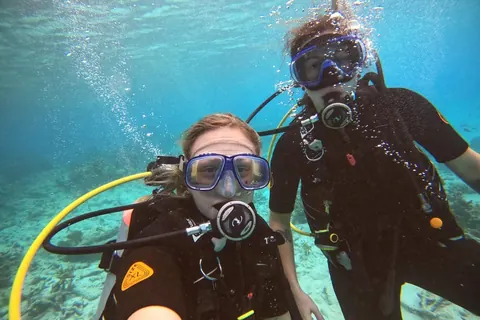 GetYourGuideBonaireBonaire: First-Time Scuba Diving ExperienceView on GetYourGuide (opens in a new tab)
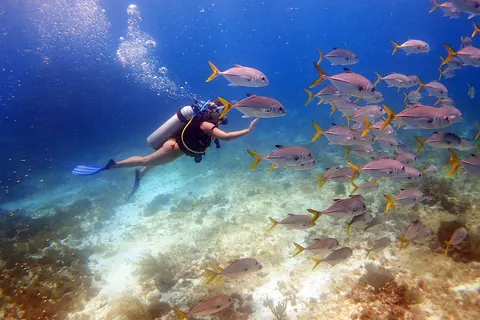 ViatorCancun & Riviera MayaDiving in the Mexican Caribbean for Beginners 2 Tanks 2 DivesView on Viator (opens in a new tab)
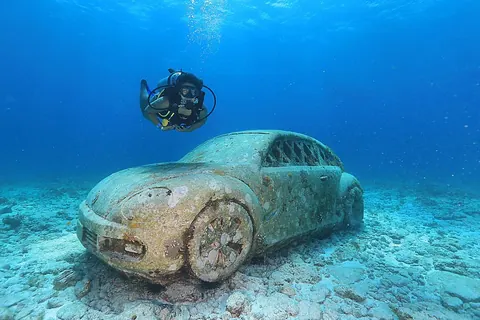 GetYourGuideCancun & Riviera MayaCancun: Scuba Diving for Beginners at MUSA Underwater Museum & ReefView on GetYourGuide (opens in a new tab)
Ratings from GetYourGuide travellers.
Where is the best diving in the Caribbean?
The best Caribbean diving depends on your style: Bonaire and Curaçao for shore diving on your own schedule, Cozumel for drift dives along coral walls, Belize for the Great Blue Hole and atoll walls, Roatan and Utila for affordable courses and whale sharks in any month, Cancun and the Riviera Maya for cenotes, and the Florida Keys for shallow reefs and big wrecks.
Seven guides cover the region, and the table compares their best months, water and typical prices, all in US dollars.
- Belize: barrier-reef dives from Ambergris Caye and Caye Caulker, and day trips to the atolls: Lighthouse Reef with the Great Blue Hole, Turneffe and Glover's Reef.
- Bonaire: a Dutch Caribbean island where you load tanks into a car, drive to a site and walk in.
- Cancun & Riviera Maya: shallow reefs and the MUSA sculptures off Cancun and Isla Mujeres, turtles at Akumal, bull sharks off Playa del Carmen in winter and jungle cenotes such as Angelita and The Pit.
- Cozumel: every site in our table is a boat dive run as a drift, along walls and buttresses such as Palancar and Santa Rosa.
- Curaçao: Bonaire's neighbor to the west, with more than 38 sites you can reach from the beach, a shallow tugboat wreck and the Watamula wall.
- Florida Keys: spur-and-groove reefs and big wrecks from Key Largo to Key West inside a national marine sanctuary. Record heat in summer 2023 caused widespread coral bleaching and death there, so older reef descriptions may no longer match what you see.
- Roatan & Utila: Honduras' Bay Islands, with walls, wrecks and a shark dive on Roatan, and budget courses and whale sharks on Utila.
| Place | Best months | Water | Two-tank boat dive | Open Water course |
|---|---|---|---|---|
| Belize | December to May | 26.5–29.6 °C (80–85 °F) | US$94.50 | US$525 |
| Bonaire | All year | 26.5–28.8 °C (80–84 °F) | US$130 | US$575 |
| Cancun & Riviera Maya | December to May | 26.4–29.2 °C (80–85 °F) | US$127 | US$489 |
| Cozumel | December to May | 26.5–29.4 °C (80–85 °F) | US$118 | US$573.50 |
| Curaçao | All year | 26.4–28.8 °C (80–84 °F) | US$190 | US$515 |
| Florida Keys | April to July | 23.8–29.9 °C (75–86 °F) | US$112.50 | US$595 |
| Roatan & Utila | March to June | 26.7–29.6 °C (80–85 °F) | US$106 | US$439.50 |
Water: average temperature of the coolest and the warmest month. Prices: typical prices; each guide says when they were checked.
When is the best time to dive in the Caribbean?
December to May is the safest window for most Caribbean diving, outside the June–November Atlantic hurricane season, whose storms cluster between mid-August and mid-October; Bonaire and Curaçao, on the southern edge of the hurricane belt, can be dived in any month.
Each destination fine-tunes that window:
- Cozumel, Cancun and Belize: December to May. In Belize, December to April is the dry high season with very little rain, while June to November brings both rain and storms.
- Roatan and Utila: March to June is the driest stretch. The wettest months fall roughly between October and January, though how long the wet spell lasts varies from year to year.
- Florida Keys: April to July skips the coolest water, 23.8 °C (75 °F) in January and February, and the late-summer storm peak. Waterspouts and summer thunderstorms are most common from June to September.
- Bonaire and Curaçao: all year. Direct hits on the Dutch Leeward Islands are rare, and on average a tropical cyclone passes within 100 nautical miles (185 km) of Curaçao only about once every 11 years.
Apart from the Florida Keys, the sea stays between 26.4 °C (80 °F) and 29.6 °C (85 °F) all year, coolest in February and warmest around September and October.
Where can you see whale sharks, sharks and turtles in the Caribbean?
For whale sharks in the Caribbean, go to Isla Mujeres from June to mid-September, Gladden Spit off Placencia in Belize from March to June, or Utila in any month, with the most sightings in March and April; for bull sharks, dive off Playa del Carmen from November to March.
- Whale sharks: the Tiburón Ballena Biosphere Reserve off northern Quintana Roo allows watching and swimming with them only from 15 May to 17 September. At Gladden Spit they feed on snapper spawn around the full and last-quarter moons, with the clearest records in April and May.
- Sharks: the bull-shark dives off Playa del Carmen are for advanced divers. Roatan's Cara a Cara is an operator-run shark dive with Caribbean reef sharks at 24–30 m (79–98 ft), and The Elbow off Turneffe Atoll in Belize offers a chance of hammerheads.
- Turtles: hawksbill, green and loggerhead turtles feed on Gonzalo's Reef at Akumal, and turtles are often seen at Bonaire's Salt Pier and on Curaçao's Playa Porto Mari reef.
- Eagle rays: look for them on Belize's Half Moon Caye Wall and at The Elbow, Bonaire's Yellow Submarine and Roatan's Blue Channel.
- Coral spawning: Curaçao's corals spawn on predictable nights after the late-summer and autumn full moons, mainly August to October, though spawning largely failed across the Caribbean after the 2024 heat.
How much does diving in the Caribbean cost?
A two-tank boat dive in the Caribbean costs US$85–135 in Belize, Roatan, Cozumel and the Florida Keys, about US$127 around Cancun, US$125–131 on Bonaire and US$130–150 for a morning trip on Curaçao, and an Open Water course costs US$350–684 (prices checked November 2026).
What a price includes changes the comparison more than the headline figure:
- Taxes: San Pedro shops in Belize quote before 12.5% sales tax, and on Roatan 15–19% tax is included at some shops and added at others.
- Gear: most two-tank prices cover tanks and weights only, and rental gear is extra in Cozumel, the Florida Keys, Bonaire and much of Belize.
- eLearning: Bonaire's Open Water prices, US$565–621, all include PADI eLearning, while the two cheapest Curaçao courses leave it out, which adds about US$200.
- Park fees: Bonaire's STINAPA Nature Fee is US$40 per visitor aged 13 and over for the calendar year. Cozumel's marine park costs MXN 225.56 per person per day and the Cancun-area reef parks MXN 125.32. A Great Blue Hole day in Belize carries BZD 60 for the Blue Hole and BZD 20 for Half Moon Caye, the Roatan Marine Park asks a voluntary US$10, and Curaçao has no published dive fee. Fees change, so check before you go.
The cheapest course in the range is US$350 at a Utila school that includes accommodation; the top is US$684 around Cancun.
Which Caribbean destinations suit beginners, and which suit experienced divers?
Bonaire, Curaçao and the Florida Keys are the easiest Caribbean places to start, with calm shore entries and shallow reefs, while the Great Blue Hole, the Riviera Maya cenotes, Cozumel's Punta Sur and the Spiegel Grove wreck off Key Largo are advanced dives.
- Bonaire: four of the six sites in our table are beginner shore dives, among them Yellow Submarine and Salt Pier, and Red Slave is for advanced divers only. STINAPA requires an orientation dive before your first dive on the island.
- Curaçao: the Tugboat wreck in Caracas Bay (5–12 m, 16–39 ft) and Playa Porto Mari are easy beach entries, while Watamula, a wall at the north-west tip that reaches 40 m (131 ft), can have strong currents.
- Florida Keys: six of the eleven sites in our table are beginner reefs or shallow wrecks no deeper than 18 m (59 ft), such as Molasses Reef and the Benwood wreck.
- Cozumel: shallow drifts such as Columbia Shallows (5–12 m, 16–39 ft) and Palancar Gardens suit newer divers who are comfortable in current.
- Advanced: the Great Blue Hole dive drops down a sheer wall to stalactite ledges at about 40 m (131 ft). In Angelita and The Pit you sink through a halocline to a hydrogen-sulphide cloud at about 25–30 m (82–98 ft). Punta Sur's Devil's Throat lies at 27–40 m (89–131 ft), and the Spiegel Grove, a former Navy landing ship, sits at 20–40 m (66–131 ft).
How do you get to the Caribbean's dive destinations?
Caribbean dive trips start at Cancún (CUN) for the Riviera Maya and Cozumel, which also has its own airport (CZM), Belize City (BZE) for Belize, Roatan (RTB) and Utila (UII) for the Bay Islands, Bonaire (BON), Curaçao (CUR), and Miami (MIA), Marathon (MTH) or Key West (EYW) for the Florida Keys.
- Mexico: Cancun, the Riviera Maya and Cozumel fit into one trip, and Tulum (TQO) serves the southern Riviera Maya.
- Bonaire and Curaçao: close neighbors with the same style of shore diving.
- Belize: atoll day trips, the Blue Hole among them, leave from Ambergris Caye and Caye Caulker and involve a long boat ride.
- Florida Keys: the chain runs from Key Largo to Key West, so you can drive down from Miami and dive along the way.
- Snorkelers in your group: see our snorkeling guides to Cozumel, Cancun & Riviera Maya, the Florida Keys and Key West, plus Aruba, Puerto Rico and Turks and Caicos.
Where are the recompression chambers in the Caribbean?
Each Caribbean destination in this guide has a recompression chamber in its main dive area: the Costamed Hyperbaric Center on Cozumel, the SSS chamber in Playa del Carmen, Subaquatic Safety Belize in San Pedro, Cornerstone Medical Services on Roatan, the hospital chamber in Kralendijk on Bonaire, the Curaçao Medical Center in Willemstad and Mariners Hospital in Tavernier in the Florida Keys.
Some come with caveats. Roatan's chamber posts hours of 8:00–17:00 Monday to Saturday and 8:00–12:00 on Sunday, the Curaçao chamber publishes no opening hours, and Bonaire's hospital does not advertise its chamber, so ask your dive shop how it reaches treatment out of hours. Lighthouse Reef and the Blue Hole are a long boat ride from San Pedro. Carry dive insurance that covers chamber treatment and evacuation, and ask a dive doctor or DAN about fitness to dive.
Frequently asked questions
What is the best Caribbean island for scuba diving?
There is no single best island; it depends on how you like to dive. Bonaire suits divers who want unlimited shore diving on their own schedule, Cozumel those who love drifting along walls, and Belize anyone set on the Great Blue Hole. Roatan and Utila are the budget pick for courses, and Curaçao, next door to Bonaire, offers more than 38 beach sites.
When is hurricane season in the Caribbean?
The Atlantic hurricane season runs from June to November, with most storms between mid-August and mid-October. Cozumel, Cancun, Belize, Roatan and the Florida Keys all lie inside it, so December to May is the safer window there. Bonaire and Curaçao sit on the southern edge of the hurricane belt, where direct hits are rare, which makes them year-round choices.
Where is the cheapest place to learn to dive in the Caribbean?
Roatan and Utila, in Honduras' Bay Islands, have the lowest Open Water prices in this guide, US$350–530, with one Utila school including accommodation at US$350. Courses cost US$425–575 on Curaçao, US$450–684 around Cancun and US$565–621 on Bonaire, where every center includes PADI eLearning. Compare what is included before you book; our Open Water price index lists every destination.
Where can you swim with whale sharks in the Caribbean?
In three places in this guide: Isla Mujeres off Cancun, where trips run from June to mid-September inside the Tiburón Ballena reserve's 15 May to 17 September season; Gladden Spit off Placencia in Belize, mainly March to June around the full and last-quarter moons; and Utila, where whale sharks are sighted in every month but most often in March and April.
Can you dive the Caribbean from shore?
Yes, and Bonaire and Curaçao are built for it. On Bonaire you buy shore tanks, drive to a site and walk in, and four of the six sites in our table are beginner shore dives. Curaçao has more than 38 sites you can reach from the beach, including the Tugboat wreck in Caracas Bay. Elsewhere in this guide, apart from the cenotes, most diving is by boat.
How warm is the Caribbean for diving?
Warm. Apart from the Florida Keys, the destinations in this guide average 26.4–29.6 °C (80–85 °F) through the year, coolest in February and warmest around September. The Florida Keys drop to 23.8 °C (75 °F) in January and February and reach 29.9 °C (86 °F) in August, so winter divers there should pack a thicker suit.


