Dive guide · Egypt
Scuba Diving in Marsa Alam
Marsa Alam, on Egypt's southern Red Sea coast, mixes easy shore diving with big offshore reefs: oceanic whitetips at Elphinstone, green turtles and the odd dugong at Abu Dabbab, spinner dolphins at Samadai. The main season runs April to November, and the sea averages 22.6–29.5 °C (73–85 °F) over the year.

Key facts
- Best months
- April to November
- Water temperature
- 22.6–29.5 °C (73–85 °F)Monthly average, coolest to warmest month
- Level
- Beginner to advanced
- Open Water course
- €384Typical price, checked
- Two-tank boat dive
- €91.20Typical price, checked
- Discover Scuba (try dive)
- €81.50Typical price, checked
- Snorkel tour
- €63Typical price, checked
- Airport
- Marsa Alam International Airport (RMF)
- Nearest chamber
- Marsa Alam Baromedical, Marsa Shagra (Marsa Alam)
Book a dive trip in Marsa Alam
Trips run by local operators, booked on Viator or GetYourGuide.
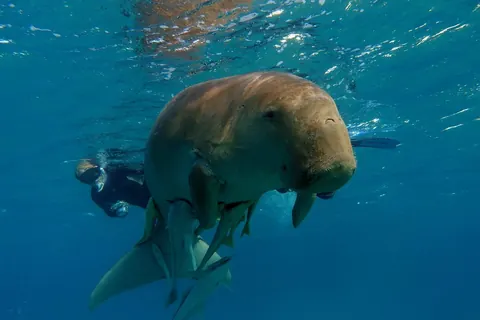 ViatorDaily Dive with Dugongs & Turtles at Marsa Mubarak | Marsa AlamView on Viator (opens in a new tab)
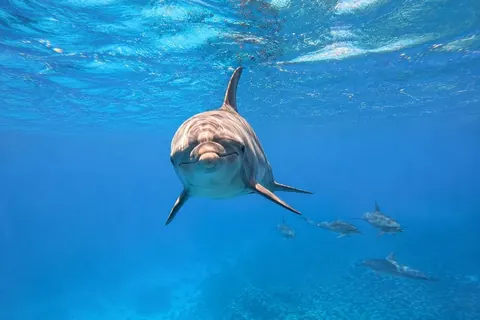 GetYourGuideMarsa Alam: Samadai Dolphin House Snorkeling or DivingView on GetYourGuide (opens in a new tab)
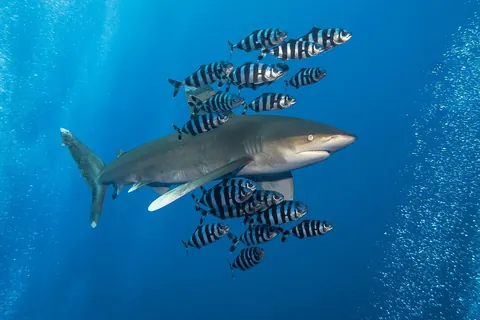 ViatorDive Elphinstone Reef in Marsa AlamView on Viator (opens in a new tab)
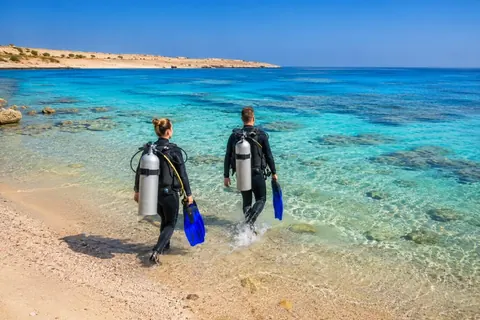 GetYourGuideMarsa Alam: House Reef Or Shore Dive Experience with TransferView on GetYourGuide (opens in a new tab)
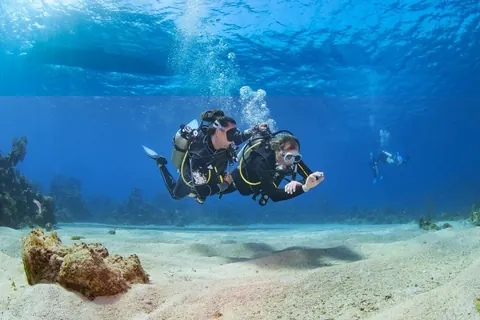 ViatorMagic Red Sea Discovery - Discover Scuba Diving Marsa AlamView on Viator (opens in a new tab)
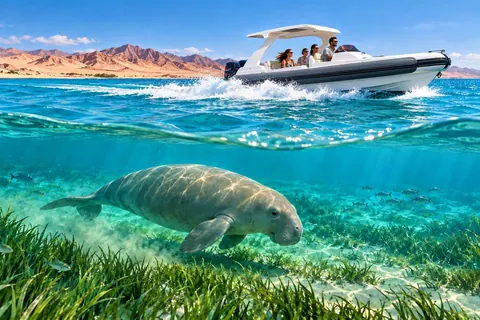 GetYourGuideMarsa Alam: Dugong & Turtle Snorkeling by SpeedboatView on GetYourGuide (opens in a new tab)
All Marsa Alam trips on Viator (opens in a new tab)
Ratings from GetYourGuide travellers.
When is the best time to dive in Marsa Alam?
The best time to dive in Marsa Alam is April to November, when the offshore reefs are dived most and the sea warms from 23.7 °C (75 °F) in April to 29.5 °C (85 °F) in August; house-reef and shore diving carry on through the winter.
Marsa Alam is the warmest of Egypt's dive towns in our guides: in August its sea averages 29.5 °C (85 °F), almost a degree warmer than Hurghada's 28.7 °C (84 °F). The coolest month is February, at 22.6 °C (73 °F), and from December to April the water stays at 22.6–24.5 °C (73–76 °F), so bring a full wetsuit with a hood or vest for a winter trip.
Animals by season
- Oceanic whitetips: at Elphinstone Reef they turn up mainly in autumn, and encounters peak in October and November. Some boats report them over a longer season, but autumn is the time to plan around.
- Spinner dolphins: they rest in the Samadai lagoon by day on most days of the year. Numbers are highest in late spring and early summer, with a peak in June, and lowest from February to April.
- Dugongs: a few graze the seagrass of Marsa Abu Dabbab and Marsa Mubarak. The odds are said to improve from about May to November, yet even local guides rate them below fifty-fifty, so count a dugong as luck, never as a plan.
| Month | Average water temperature | Season |
|---|---|---|
| January | 23.2 °C (74 °F) | Outside the best months |
| February | 22.6 °C (73 °F) | Outside the best months |
| March | 22.8 °C (73 °F) | Outside the best months |
| April | 23.7 °C (75 °F) | Best month to dive |
| May | 25.4 °C (78 °F) | Best month to dive |
| June | 27 °C (81 °F) | Best month to dive |
| July | 28.6 °C (83 °F) | Best month to dive |
| August | 29.5 °C (85 °F) | Best month to dive |
| September | 28.6 °C (83 °F) | Best month to dive |
| October | 27.6 °C (82 °F) | Best month to dive |
| November | 26.3 °C (79 °F) | Best month to dive |
| December | 24.5 °C (76 °F) | Outside the best months |
In season in: April · May · June · July · August · September · October · November
What are the best dive sites in Marsa Alam?
Marsa Alam's dive sites range from shore-entry bays such as Marsa Abu Dabbab, 0–20 m (0–66 ft), where turtles graze the seagrass, to Elphinstone Reef, an advanced offshore wall dived from 5 m to 40 m (16–131 ft) in strong current.
Shore bays and a wreck
Marsa Abu Dabbab is a sandy bay with a seagrass meadow where green turtles and dugongs feed; on the sand, look for guitar rays, ghost pipefish and frogfish. Marsa Mubarak, near Port Ghalib, has two reefs and seagrass down to 25 m (82 ft), with turtles, nudibranchs and octopus. South of town, the Abu Ghusun wreck is the freighter Hamada, which sank in 1993 and lies on its side no deeper than 17 m (56 ft), a short swim from the beach; groupers, Napoleon wrasse and turtles live around it.
Offshore reefs
Elphinstone Reef, north of Marsa Alam, has plateaus and walls that drop far below sport-diving limits, and its currents are strong; centers ask for 50 or more logged dives. Shaab Abu Dabbab 2 is the gentle offshore option, 7–18 m (23–59 ft), with a cave, red anemones, Napoleon wrasse and the wreck of a small boat.
Dolphin reefs and the far south
Shaab Samadai, known as the Dolphin House, is a horseshoe reef divided into zones: the dolphins' resting area is closed to visitors, snorkelers keep to their own zone, and divers explore the outer reef with its caves and pinnacles to 25 m (82 ft). Shaab Sataya, about 130 km (81 mi) south of town, is a long crescent reef where spinner dolphins also rest, with pinnacles, trevallies and rays; it is listed for all levels but reaches 40 m (131 ft). In the Fury Shoals, Shaab Abu Galawa shelters a lagoon with the Tien Hsing barge wreck at 5–18 m (16–59 ft) and a small sailing-boat wreck.
| Dive site | Depth | Level | Entry | Highlights |
|---|---|---|---|---|
| Elphinstone Reef | 5–40 m (16–131 ft) | Advanced | Boat | Offshore reef north of Marsa Alam with plateaus and walls dropping far below sport limits; oceanic whitetips mainly in autumn; strong currents, centers ask for 50+ logged dives |
| Marsa Abu Dabbab | 0–20 m (0–66 ft) | Beginner | Shore | Sandy bay with a seagrass meadow where dugongs and green turtles feed; guitar rays, ghost pipefish and frogfish |
| Shaab Samadai (Dolphin House) | 5–25 m (16–82 ft) | Beginner | Boat | Horseshoe reef whose lagoon is a resting area for spinner dolphins; zoned: dolphin no-entry zone, snorkel zone, divers on the outer reef with caves and pinnacles |
| Abu Ghusun wreck (Hamada) | 0–17 m (0–56 ft) | Beginner | Shore | Freighter Hamada that sank in 1993, lying on its side in shallow water south of Marsa Alam; reached by a short swim from shore; groupers, Napoleons, turtles |
| Shaab Abu Dabbab 2 | 7–18 m (23–59 ft) | Beginner | Boat | Offshore Abu Dabbab reef with a cave, red anemones, Napoleon wrasse and the wreck of a small boat |
| Marsa Mubarak | 0–25 m (0–82 ft) | Beginner | Shore | Bay with two reefs and seagrass near Port Ghalib where turtles and dugongs are seen; nudibranchs and octopus |
| Shaab Abu Galawa (Fury Shoals) | 5–30 m (16–98 ft) | Beginner | Boat | Lagoon reef in the Fury Shoals far south with the Tien Hsing barge wreck at 5-18 m and a small sailing-boat wreck |
| Shaab Sataya (Dolphin Reef) | 5–40 m (16–131 ft) | Beginner | Boat | Long crescent reef about 130 km south of Marsa Alam, a resting area of spinner dolphins; pinnacles, trevallies and rays |
How much does diving in Marsa Alam cost?
In Marsa Alam two boat dives usually add up to about EUR 91 (EUR 73–103), a try dive costs EUR 80–105, and an Open Water course usually costs about EUR 384 (EUR 345–460) before materials and certification (prices checked November 2026).
Most Marsa Alam centers sell house-reef packages and charge boat days on top, so the boat figure mixes formats:
- Two boat dives: Werner Lau adds a boat day with two dives on local reefs to its house-reef package for EUR 73. Emperor in Port Ghalib charges EUR 91.20 at the counter for an extra boat day, including 14% VAT, nitrox and marine park fees (EUR 80 booked ahead). At Coraya, two dives at EUR 35 each plus a EUR 33 full-day boat supplement from Port Ghalib come to EUR 103. Equipment rental is extra at all three.
- Try dive: EUR 80 for a try dive by car at Werner Lau or a theory, pool and sea session at Coraya, EUR 83 with equipment at Red Sea Diving Safari, and EUR 105 for Emperor's boat-based Discover Scuba Diving, booked ahead.
- Snorkel trip: EUR 58–65, usually about EUR 63, for a full day on the boat (food and drinks included on Coraya's EUR 58 trip from Port Ghalib) or a half-day trip to Wadi El Gemal Island.
Fees on top
These are the amounts dive centers charge, not an official schedule:
- Dolphin House (Samadai) entry: EUR 15–27 per person, usually about EUR 19.
- Permission fee: EUR 8 per diving day at Werner Lau and Coraya.
- Chamber support: EUR 7, compulsory at Red Sea Diving Safari and an optional donation at Emperor.
- Shore sites: EUR 6–17 for some sites at Werner Lau; EUR 11 for Marsa Abu Dabbab at Red Sea Diving Safari.
Fees change, so ask for the full price before you pay, or request quotes from Marsa Alam centers.
Prices checked
| Item | Typical price | Range |
|---|---|---|
| Open Water course | €384 | €345–€460 |
| Two-tank boat dive | €91.20 | €73–€103 |
| Discover Scuba (try dive) | €81.50 | €80–€105 |
| Snorkel tour | €63 | €58–€65 |
| Marine park fee | €19 | €15–€27 |
Prices change; confirm with the center before you book.
Is Marsa Alam a good place to learn to dive?
Marsa Alam is a good place to learn because centers train on house reefs and shore bays such as Marsa Abu Dabbab, and an Open Water course costs EUR 345–460 plus EUR 50–90 for materials and certification.
Learning from a house reef means you walk in for every skill session instead of waiting on a boat schedule. Every center in our price table charges the agency materials or certification separately: EUR 50 at Werner Lau, EUR 90 at Emperor and Coraya. Emperor's EUR 345 is its online pre-book price, Werner Lau's IAC/SSI course costs EUR 410 (its CMAS course EUR 490) and Coraya's EUR 460, with equipment included.
So compare totals, not headline prices, when you set Marsa Alam against Hurghada, where courses run EUR 350–418. PADI, SSI and CMAS courses are all on offer here; choose the instructor and the group size rather than the agency.
Can you snorkel with dolphins in Marsa Alam?
Snorkelers in Marsa Alam can join boat trips to Shaab Samadai, where spinner dolphins rest in the lagoon; a snorkel day on the boat costs EUR 58–65, and centers add a Dolphin House entry of EUR 15–27.
Samadai is a managed reef. Its management plan sets three zones (a core area for the dolphins alone, a snorkel zone closed to speedboats, and an outer area for mooring and diving), caps the number of boats and visitors each day and fixes hours for snorkel and dive boats. Check the current rules with your center before you go.
In the water, stay calm at the surface, keep out of the dolphins' zone and let them choose how close to come; never chase them. From shore, the seagrass at Marsa Abu Dabbab is the easiest place to look for green turtles, and if a dugong is feeding, keep your distance and leave it a clear path to the surface.
Liveaboard or land-based diving in Marsa Alam?
Land-based diving from Marsa Alam covers the shore bays, Elphinstone, Samadai and the Abu Dabbab reefs, while St Johns and the Fury Shoals in the deep south are the classic week-long liveaboard route out of Port Ghalib, sailed all year.
A resort base gives you variety without a week at sea: a house-reef dive in the morning, a boat day when the weather suits. Pick a liveaboard if the far south or the offshore marine parks top your list. Routes, boats and the fees added on top are compared on our Red Sea liveaboards page.
Where is the nearest recompression chamber to Marsa Alam?
Marsa Alam has two recompression facilities: Marsa Alam Baromedical at Marsa Shagra, 22 km (14 mi) north of town, and Marsa Alam Deco International at Port Ghalib Hospital.
For the far south, there is Hamata Deco International at the marina of Hamata, 135 km (84 mi) south of Marsa Alam. Opening hours are not published, so ask your center which chamber it works with and how it would get you there.
Current is the main hazard at Elphinstone, where the walls fall far past recreational depth: agree a turn depth before you descend and stay with your guide. Take dive insurance that pays for chamber treatment and evacuation, especially for a liveaboard in the deep south, and put fitness-to-dive questions to a dive doctor or DAN.
Dive centers in Marsa Alam
Loading dive centers…
Frequently asked questions
When can you see oceanic whitetip sharks at Elphinstone?
Oceanic whitetips visit Elphinstone Reef, north of Marsa Alam, mainly in autumn, and encounters peak in October and November. Some boats report them over a longer season, so they are possible outside those months, but not likely. Elphinstone is an advanced dive with strong currents and deep walls, and centers ask for 50 or more logged dives. When the sharks are around, stay close to the reef and to your guide.
Will I see a dugong at Abu Dabbab?
Maybe, but do not plan on it. A few dugongs feed on the seagrass of Marsa Abu Dabbab and nearby Marsa Mubarak, and the chances are said to improve from about May to November, yet local guides put the odds below fifty-fifty. Green turtles in the same bays are far more dependable. Both are easy shore dives, to 20 m (66 ft) and 25 m (82 ft).
How much is the Dolphin House entry fee in Marsa Alam?
Dive centers in Marsa Alam charge EUR 15–27 per person for entry to Shaab Samadai, the Dolphin House: EUR 15 on Werner Lau's snorkel trips, EUR 19 at Red Sea Diving Safari and EUR 27 at Coraya. It comes on top of the boat trip. These are the centers' own figures and fees change, so ask for the total price, entry included, when you book.
Is Marsa Alam good for beginner divers?
Yes. Seven of the eight Marsa Alam sites in our table are rated beginner, including the shore bays of Marsa Abu Dabbab and Marsa Mubarak and the Abu Ghusun wreck, which lies no deeper than 17 m (56 ft). A try dive costs EUR 80–105. Leave Elphinstone, with its strong currents and deep walls, until you have about 50 logged dives.
How warm is the sea in Marsa Alam?
The sea off Marsa Alam averages 22.6 °C (73 °F) in February, the coolest month, and 29.5 °C (85 °F) in August, the warmest. From June to October it holds 27–29.5 °C (81–85 °F), warm enough for a thin suit. From December to April it sits at 22.6–24.5 °C (73–76 °F), so bring a full wetsuit with a hood or vest.
Which airport do you fly into for diving in Marsa Alam?
Fly into Marsa Alam International Airport (RMF). Ask your hotel or dive center to arrange the transfer, and check where its boats leave from: Emperor and Coraya run their boat days out of Port Ghalib, which is also the departure port for liveaboards to St Johns and the Fury Shoals. For Hurghada or Sharm el Sheikh, use those towns' own airports.
Is Marsa Alam or Hurghada better for diving?
It depends on the trip. Marsa Alam suits shore diving from house reefs, turtle and dugong bays, the Samadai dolphins and, in autumn, oceanic whitetips at Elphinstone. Hurghada has cheaper day boats, EUR 50–76 for two dives, and easier access to the northern wrecks. Marsa Alam's sea is a little warmer in summer, 29.5 °C (85 °F) in August against 28.7 °C (84 °F).


