Dive guide · Indonesia
Scuba Diving in the Gili Islands
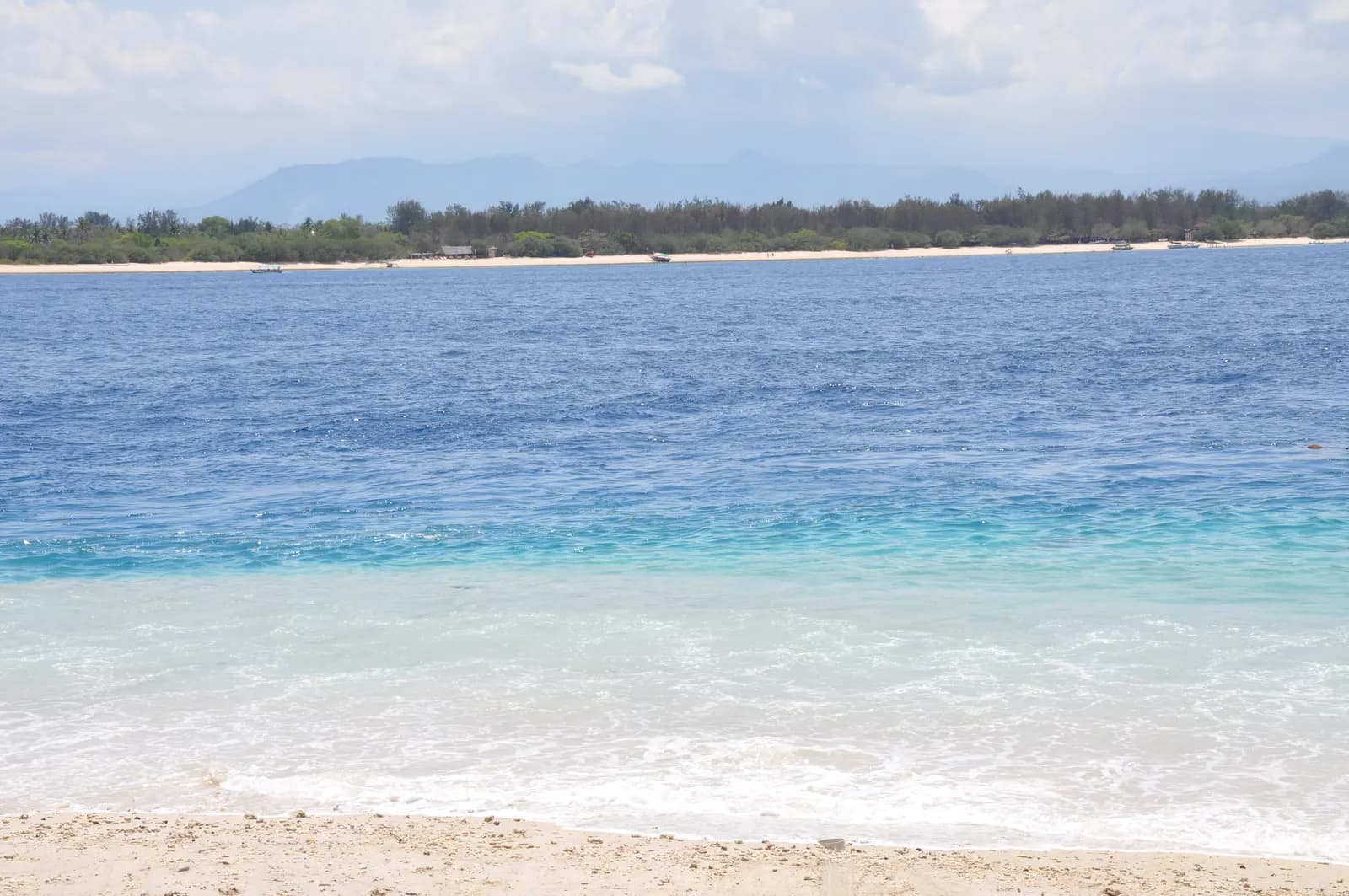
The Gili Islands, Gili Trawangan, Gili Meno and Gili Air off Lombok, are an easy-going place to dive: short boat rides, turtles on most of the main reefs and plenty of sites rated for beginners. Seas are calmest from April to October. A single boat dive costs IDR 640,000–700,000 with equipment (prices checked November 2026).
Key facts
- Best months
- April to October
- Water temperature
- 27.5–29.4 °C (82–85 °F)Monthly average, coolest to warmest month
- Level
- Beginner to advanced
- Open Water course
- IDR 6,900,000Typical price, checked
- Two-tank boat dive
- IDR 1,280,000Typical price, checked
- Discover Scuba (try dive)
- IDR 1,350,000Typical price, checked
- Airports
- Lombok International Airport (LOP), I Gusti Ngurah Rai International Airport (DPS)
- Park fee
- National marine conservation area (Gili Matra) entry ticket, foreign visitor, per person per day (KKP category B rate): IDR 100,000
- Park fee
- National marine conservation area annual entry ticket, foreign visitor, per person per year (KKP category B rate): IDR 500,000
- Nearest chamber
- Rumah Sakit Kota Mataram (Mataram City Hospital), Mataram, Lombok
Book a dive trip in Gili Islands
Trips run by local operators, booked on GetYourGuide.
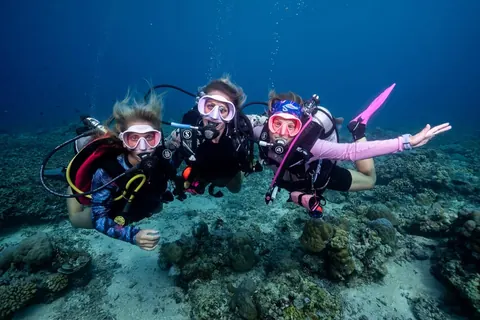 GetYourGuideGili Trawangan: Discover Scuba Diving for BeginnersView on GetYourGuide (opens in a new tab)
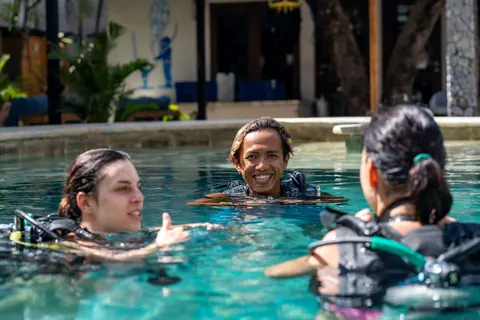 GetYourGuideManta Dive Gili Trawangan: Discover Scuba DivingView on GetYourGuide (opens in a new tab)
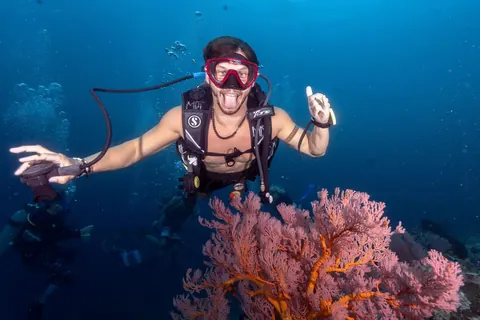 GetYourGuideGili Trawangan: Fun Diving for Certified DiversView on GetYourGuide (opens in a new tab)
Ratings from GetYourGuide travellers.
When is the best time to dive the Gili Islands?
The Gili Islands have their calmest seas and most dependable boat trips from April to October, while December to March is the rainy season but diving carries on, especially around Gili Trawangan. The sea stays between 27.5 °C (82 °F) in August and 29.4 °C (85 °F) in April.
Flat water from April to October means the short crossings to the outer sites run day after day, which matters most for drift dives such as Shark Point. The coolest water of the year, 27.5–27.8 °C (82 °F), comes from July to September, right in the calm season, so the steadiest conditions come with water about 2 °C (4 °F) cooler than in April.
The wet months
From December to March rain is the main change. Centers keep diving, and the sites around Gili Trawangan stay workable all year; the sea is at 28.5–29.0 °C (83–84 °F) in those months.
| Month | Average water temperature | Season |
|---|---|---|
| January | 28.7 °C (84 °F) | Outside the best months |
| February | 28.5 °C (83 °F) | Outside the best months |
| March | 28.8 °C (84 °F) | Outside the best months |
| April | 29.4 °C (85 °F) | Best month to dive |
| May | 29.2 °C (85 °F) | Best month to dive |
| June | 28.6 °C (83 °F) | Best month to dive |
| July | 27.8 °C (82 °F) | Best month to dive |
| August | 27.5 °C (82 °F) | Best month to dive |
| September | 27.8 °C (82 °F) | Best month to dive |
| October | 28.5 °C (83 °F) | Best month to dive |
| November | 29.2 °C (85 °F) | Outside the best months |
| December | 29 °C (84 °F) | Outside the best months |
In season in: April · May · June · July · August · September · October
What are the best dive sites in the Gili Islands?
The best-known Gili Islands dives are Shark Point off Gili Trawangan, a drift at 6–30 m (20–98 ft) with reef sharks and turtles, the Bounty Wreck off Gili Meno at 6–18 m (20–59 ft), and the macro wall and slope of Air Wall and Hans Reef off Gili Air.
Gili Trawangan
- Shark Point: a drift over a reef slope and deeper canyons, with reef sharks resting in the gullies, turtles, schooling jacks and batfish, plus a small wreck for advanced divers.
- Halik: a slope off the north side with relaxed turtles in the shallows and soft corals deeper down, often used for try dives and courses.
- Manta Point: a gentle staghorn-coral slope off the south with turtles, reef sharks, sweetlips and batfish. Despite the name, mantas turn up only occasionally.
Gili Meno
- Bounty Wreck: a sunken pontoon left from an old jetty build, now fully coral-covered, with sweetlips, frogfish and scorpionfish.
- Meno Wall: a wall off the west coast with crustaceans, sleeping turtles and Spanish dancers, and a favorite night dive.
Gili Air
- Air Wall: a steep wall between Gili Air and Gili Meno for nudibranchs, pygmy seahorses and blue-spotted stingrays.
- Hans Reef: a sandy slope with coral mounds where frogfish, leaf scorpionfish, ribbon eels and seahorses hide; another popular night dive.
The deep one
Deep Turbo (20–30 m, 66–98 ft) is the only advanced site in the table: sea mounds rising from sand, with overhangs, big sea fans, garden eels and rays, and a chance of sharks and eagle rays.
| Dive site | Depth | Level | Entry | Highlights |
|---|---|---|---|---|
| Shark Point, Gili Trawangan | 6–30 m (20–98 ft) | Intermediate | Boat | Drift over a reef slope and deeper canyons; reef sharks resting in the gullies, turtles, schooling jacks and batfish; a small wreck for advanced divers |
| Manta Point, Gili Trawangan | 8–24 m (26–79 ft) | Beginner | Boat | Gentle staghorn-coral slope off the south of Gili T with turtles, reef sharks, sweetlips and batfish; mantas only occasionally |
| Halik, Gili Trawangan | 5–24 m (16–79 ft) | Beginner | Boat | Slope on the north side of Gili T with soft corals deeper, relaxed turtles in the shallows and a common choice for try dives and courses |
| Deep Turbo | 20–30 m (66–98 ft) | Advanced | Boat | Sea mounds rising from a sandy bottom with overhangs and big sea fans; garden eels, rays and the chance of sharks and eagle rays |
| Bounty Wreck, Gili Meno | 6–18 m (20–59 ft) | Beginner | Boat | Sunken pontoon from an old jetty build, now fully coral-covered; sweetlips, frogfish and scorpionfish |
| Meno Wall | 5–25 m (16–82 ft) | Beginner | Boat | Wall off west Gili Meno known for crustaceans, sleeping turtles and Spanish dancers; a favourite night dive |
| Air Wall, Gili Air | 10–25 m (33–82 ft) | Beginner | Boat | Steep wall between Gili Air and Gili Meno for macro: nudibranchs, pygmy seahorses, blue-spotted stingrays and turtles |
| Hans Reef, Gili Air | 4–24 m (13–79 ft) | Beginner | Boat | Sandy slope with coral mounds off Gili Air; frogfish, leaf scorpionfish, ribbon eels and seahorses, and a popular night dive |
How does a dive day work in the Gili Islands?
Gili Islands dive centers sell single boat dives rather than two-tank trips: the boat takes you to one site and brings you back to the island before the next dive, so two dives simply cost twice the single rate, IDR 1.28–1.4 million.
The format makes it easy to dive once in the morning and have the rest of the day free, or to add a night dive at Meno Wall or Hans Reef. Centers on Gili Trawangan and Gili Air charge almost the same: Trawangan Dive and Manta Dive IDR 640,000 a dive and Oceans 5 IDR 700,000, equipment included, with discounts once you book three dives or more.
Centers on both islands dive sites around all three, so choose your island for where you want to stay rather than for the diving.
How much does diving in the Gili Islands cost?
A boat dive in the Gili Islands costs IDR 640,000–700,000, an Open Water course IDR 6.9–7.0 million and a try dive IDR 1,350,000, with the IDR 100,000 marine park ticket on top (prices checked November 2026).
Prices barely change from one center to the next:
- Open Water: three days with equipment and certification for IDR 6.9–7.0 million. These are walk-in prices; Gili Air Divers takes 10 % off when you book online.
- Try dive: a half day with skills practice in a pool or confined water and one open-water dive, IDR 1,350,000 at Manta Dive, Gili Air Divers and Gili Divers (IDR 1,215,000 online at Gili Air Divers).
- Extras: the marine park ticket and, at Trawangan Dive, IDR 50,000 for the Gili Eco Trust, a local conservation group rather than a government fee.
For prices on your dates, ask Gili dive centers for a quote.
Prices checked
| Item | Typical price | Range |
|---|---|---|
| Open Water course | IDR 6,900,000 | IDR 6,900,000–IDR 7,000,000 |
| Two-tank boat dive | IDR 1,280,000 | IDR 1,280,000–IDR 1,400,000 |
| Discover Scuba (try dive) | IDR 1,350,000 | IDR 1,350,000 |
Prices change; confirm with the center before you book.
What is the marine park fee in the Gili Islands?
Divers in the Gili Islands pay a marine park ticket of IDR 100,000, which dive centers collect, but whether it covers one day or your whole stay is unclear, so check when you book.
The waters around the three islands form Gili Matra, a national marine conservation area under Indonesia's Ministry of Marine Affairs and Fisheries. The ministry's rate sheet lists IDR 100,000 per foreign visitor per day, or IDR 500,000 for a year, while dive centers present the IDR 100,000 as a one-off or once-a-year charge. The amount matches; the basis does not. Ask your center which it collects before you add up the cost of a long stay.
Is there a recompression chamber near the Gili Islands?
No chamber is listed on the Gili Islands themselves: the nearest is at Rumah Sakit Kota Mataram (Mataram City Hospital) on Lombok, whose status is not confirmed, with Kasih Ibu Hospital Saba on Bali as the fallback.
Check the Mataram chamber's status with your dive center before you start diving, and know how you would get there: any evacuation begins with a boat crossing to Lombok. Take out dive insurance that covers chamber treatment and evacuation; our dive insurance guide explains what to look for.
Shark Point is a drift dive, so carry a surface marker buoy and stay with your guide. If you feel unwell after a dive, tell your guide at once and call DAN or your insurer's emergency line.
Dive centers in Gili Islands
Loading dive centers…
Frequently asked questions
Are the Gili Islands good for beginner divers?
Yes. Six of the eight sites in this guide are rated beginner, including Halik off Gili Trawangan, which centers often use for try dives and courses, and Hans Reef off Gili Air. A try dive costs IDR 1,350,000 and a three-day Open Water course IDR 6.9–7.0 million. Leave Deep Turbo, at 20–30 m (66–98 ft), and the Shark Point drift until you have more experience.
Can you see manta rays in the Gili Islands?
Only now and then. Manta Point off the south of Gili Trawangan is named for them, but mantas appear there only occasionally; the dive is better known as a gentle staghorn-coral slope with turtles, reef sharks, sweetlips and batfish. If mantas are the main goal, Nusa Penida off Bali has them in every month; see our Nusa Penida guide.
Can you snorkel with turtles in the Gili Islands?
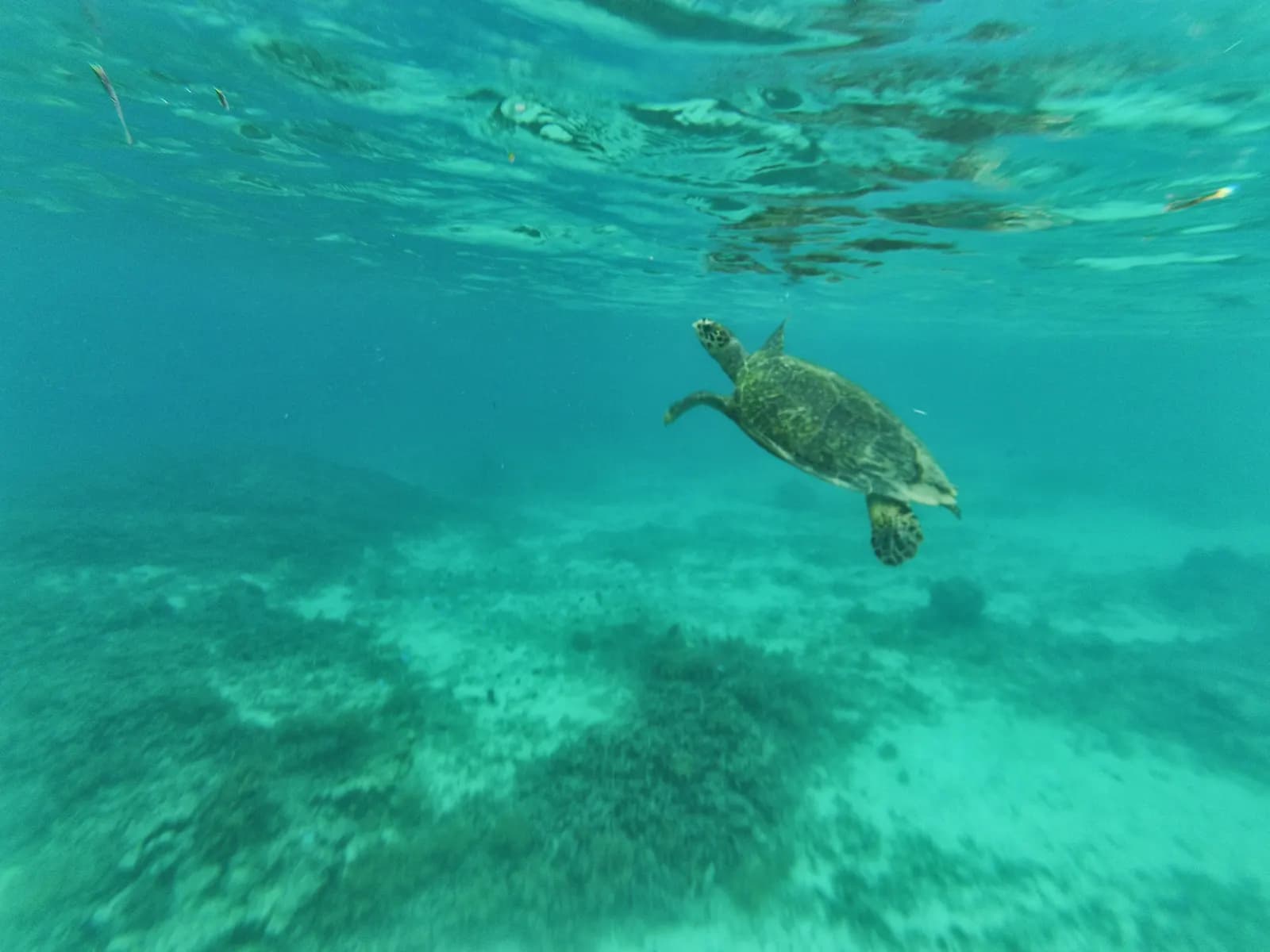
Turtles turn up on most Gili dives, and some rest in shallow water. At Halik, off the north side of Gili Trawangan, relaxed turtles stay in the shallows above a slope that starts at 5 m (16 ft). Ask a dive center whether snorkelers can join its boat to such a site, keep your distance and never touch or chase a turtle.
How much is the Gili Islands marine park fee?
Dive centers collect an IDR 100,000 ticket for Gili Matra, the national marine conservation area around the three islands. Centers describe it as a one-off or once-a-year charge, while the ministry's rate sheet lists IDR 100,000 per day or IDR 500,000 per year for foreign visitors, so check which applies when you book. One center also asks IDR 50,000 for the Gili Eco Trust.
How do you get to the Gili Islands for diving?
Fly into Lombok International Airport (LOP) or Bali's I Gusti Ngurah Rai International Airport (DPS), then continue by boat, since the islands have no airport. Dive centers sit on Gili Trawangan and Gili Air, and centers on both islands dive sites around all three. Remember that the nearest listed chamber is on Lombok, so arrange insurance before the crossing.
Can you dive the Gili Islands in the rainy season?
Yes. December to March is the rainy season on the Gilis, but centers keep diving and the sites around Gili Trawangan are workable all year. The sea is warm then, 28.5–29.0 °C (83–84 °F). If calm crossings and drift dives such as Shark Point matter most to you, April to October is the more dependable window.