Dive guide · Japan
Scuba Diving in Okinawa
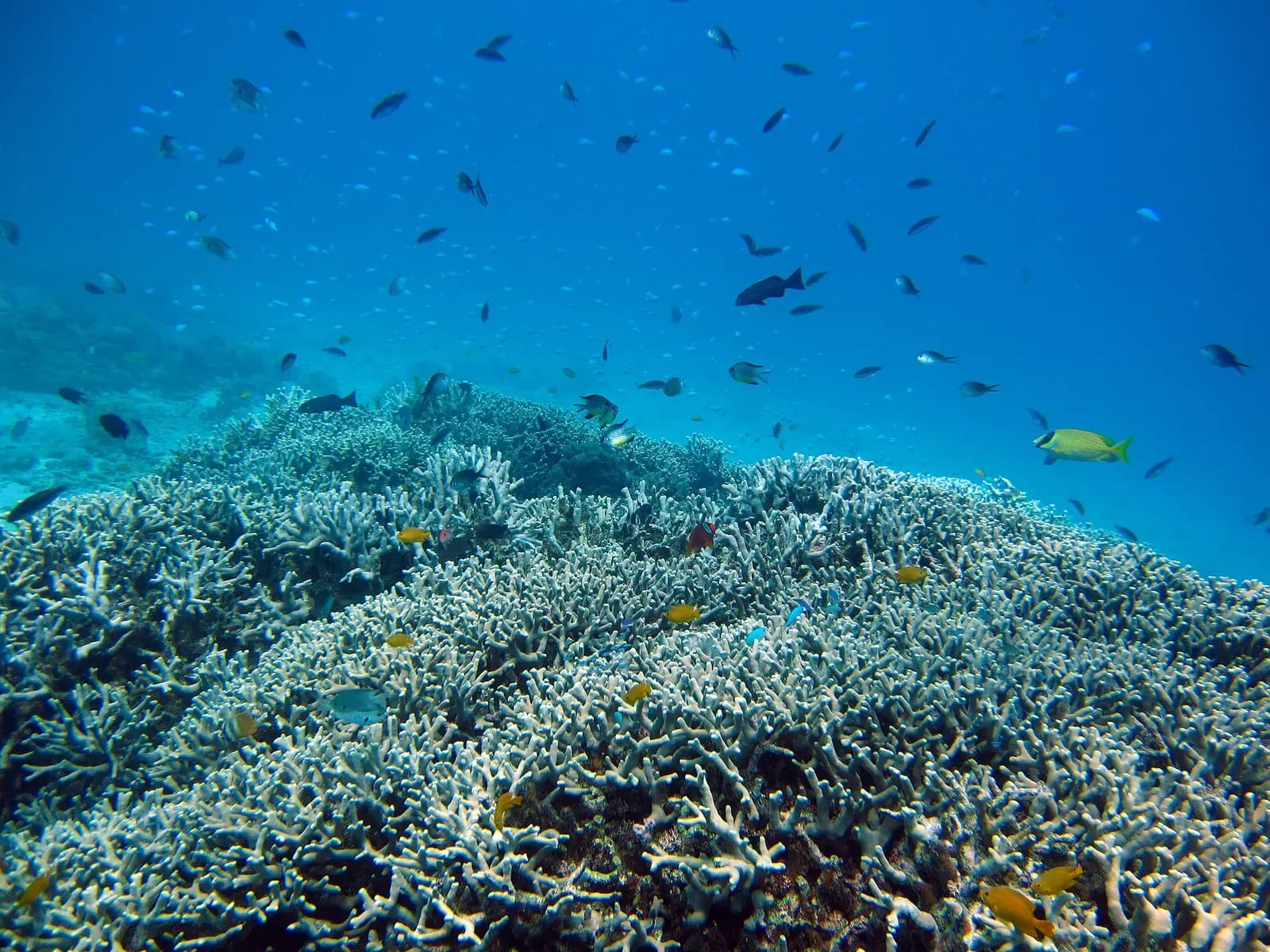
Okinawa, Japan's southernmost prefecture, offers three kinds of diving: more than 150 dive sites in the Kerama Islands west of Naha, manta points off Ishigaki, and caves and a WWII wreck around Okinawa Island itself. May to October is the main season, with water at 24.8–28.9 °C (77–84 °F), though typhoons can stop boats.
Key facts
- Best months
- May to October
- Water temperature
- 21.7–28.9 °C (71–84 °F)Monthly average, coolest to warmest month
- Level
- Beginner to advanced
- Open Water course
- JP¥99,000Typical price, checked
- Two-tank boat dive
- JP¥21,000Typical price, checked
- Discover Scuba (try dive)
- JP¥32,000Typical price, checked
- Airports
- Naha Airport (OKA), New Ishigaki Airport (ISG)
- Park fee
- Zamami Village environmental tax (Churashima tax) per person per trip to Zamami in the Kerama Islands, collected with the ferry or air fare; free up to junior-high-school age: JP¥100
- Nearest chamber
- University of the Ryukyus Hospital, Department of Hyperbaric Medicine, Ginowan
Book a dive trip in Okinawa
Trips run by local operators, booked on Viator or GetYourGuide.
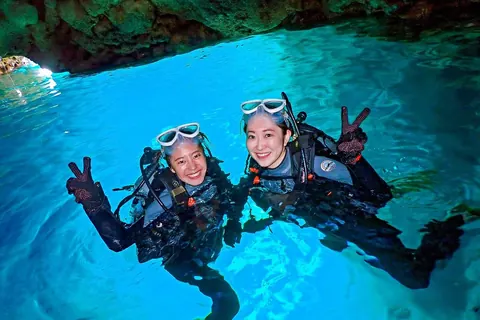 ViatorBlue Cave Introductory Dive–Private Guide, Boat Tour&Free PhotosView on Viator (opens in a new tab)
 GetYourGuideOkinawa: Blue Cave Scuba Diving Tour with GoPro PhotosView on GetYourGuide (opens in a new tab)
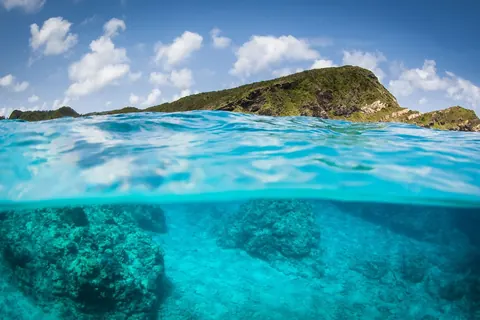 ViatorNaha: Full-Day Introductory diving & Snorkeling in the Kerama Islands, OkinawaView on Viator (opens in a new tab)
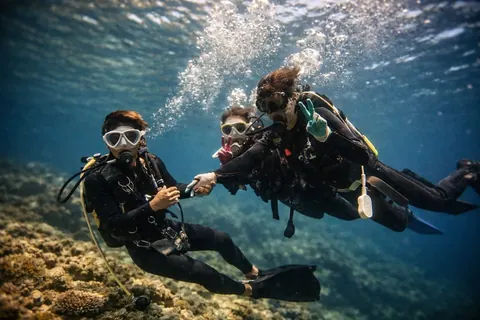 GetYourGuideOkinawa: Blue Cave Snorkeling, Trial Dive or Fun Dive with PhotosView on GetYourGuide (opens in a new tab)
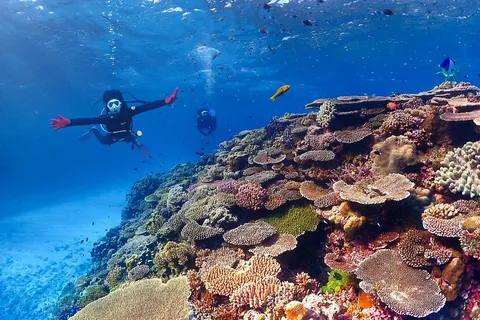 ViatorOkinawa: Scuba Diving Tour with Wagyu BBQ Lunch and English guideView on Viator (opens in a new tab)
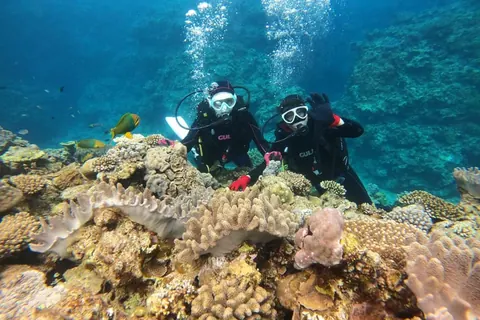 GetYourGuideOkinawa: Discover SCUBA Diving at Minna, Sesoko or MotobuView on GetYourGuide (opens in a new tab)
All Okinawa trips on Viator (opens in a new tab)
Ratings from GetYourGuide travellers.
When is the best time to dive in Okinawa?
The best time to dive in Okinawa is May to October, when Ishigaki's Kabira manta points are open and the sea is at 24.8–28.9 °C (77–84 °F), but typhoons come close mostly from July to October, so plan spare days.
Typhoons
On average about 7 to 8 typhoons a year pass close to Okinawa, most often in August and September. When one comes through, ports close and boat diving can stop for several days, so a late-summer trip needs slack in the schedule.
Area by area
- Kerama Islands: July to September is the top season, with many calm days. Exposed offshore sites such as Shimosone are dived only in summer.
- Ishigaki: the Kabira manta points are dived mainly from spring to autumn, best about May to October. In winter north winds usually close the Kabira side, and manta trips move to Kuroshima.
- Winter (January to March): humpback whales gather around the Keramas, and divers sometimes hear whale song underwater.
Sea temperature
The sea around Okinawa Island warms from 24.8 °C (77 °F) in May to 28.9 °C (84 °F) in August, then cools to 21.7 °C (71 °F) by February. Winter divers need a noticeably thicker suit than summer divers.
| Month | Average water temperature | Season |
|---|---|---|
| January | 22.6 °C (73 °F) | Outside the best months |
| February | 21.7 °C (71 °F) | Outside the best months |
| March | 21.8 °C (71 °F) | Outside the best months |
| April | 22.9 °C (73 °F) | Outside the best months |
| May | 24.8 °C (77 °F) | Best month to dive |
| June | 26.9 °C (80 °F) | Best month to dive |
| July | 28.7 °C (84 °F) | Best month to dive |
| August | 28.9 °C (84 °F) | Best month to dive |
| September | 28.3 °C (83 °F) | Best month to dive |
| October | 27 °C (81 °F) | Best month to dive |
| November | 25.4 °C (78 °F) | Outside the best months |
| December | 23.9 °C (75 °F) | Outside the best months |
In season in: May · June · July · August · September · October
What are the best dive sites in Okinawa?
Okinawa's best-known dive sites are the manta points at Kabira on Ishigaki (8–20 m, 26–66 ft), the Yonara Channel drift between Ishigaki and Iriomote (25–30 m, 82–98 ft) and the shallow sand and reef of the Kerama Islands, such as Hanari at 4–8 m (13–26 ft).
The table covers the Yaeyama Islands around Ishigaki in most detail; several entries are dive areas with a depth range rather than single sites. Ishigaki's calm west side (Sukuji, Osaki and Nagura) is rated beginner, with shallow sand and reef points deeper down. Fairy basslets gather around 25 m (82 ft) at Sukuji, giant cuttlefish lay eggs along the west coast in spring, and a huge pavona coral grows in Nagura Bay.
Farther out, the reefs of Taketomi, Kohama, Iriomote, Kuroshima and Aragusuku reach 30–40 m (98–131 ft). Expect garden eels and glassfish schools at Taketomi, a cave packed with cardinalfish in the Kohama and Iriomote area, and white sand with clear water around Kuroshima.
| Dive site | Depth | Level | Entry | Highlights |
|---|---|---|---|---|
| Kabira Manta Point / Manta Scramble (Ishigaki) | 8–20 m (26–66 ft) | Intermediate | Boat | Manta cleaning stations on reef mounds off Kabira; closed by north winds in winter |
| Yonara Channel (Ishigaki–Iriomote) | 25–30 m (82–98 ft) | Advanced | Boat | Drift dive for experienced divers, best on the ebb tide; mantas pass through the channel |
| Sukuji (Ishigaki) | 10–30 m (33–98 ft) | Beginner | Boat | Calm area west of Kabira: shallow sand, reef points deeper, fairy basslets around 25 m |
| Osaki and Nagura (Ishigaki west coast) | 5–30 m (16–98 ft) | Beginner | Boat | Reef fish, gobies and batfish; giant cuttlefish lay eggs in spring; a huge pavona coral in Nagura Bay |
| Taketomi Island reefs | 5–40 m (16–131 ft) | Intermediate | Boat | Garden eels, big schools of glassfish and the occasional tuna near Ishigaki port |
| Kohama and Iriomote reefs | 5–30 m (16–98 ft) | Intermediate | Boat | Mixed reefs, caves, sand and a wreck; cardinalfish fill a cave and mantas sometimes pass |
| Kuroshima and Aragusuku (Panari) | 7–30 m (23–98 ft) | Intermediate | Boat | Small reefs on white sand with clear water; mantas feed near Kuroshima in winter |
| Hanari (Kerama Islands) | 4–8 m (13–26 ft) | Beginner | Boat | White sand shallows with rocks, cardinalfish schools, shrimps and crabs |
What is diving in the Kerama Islands like?
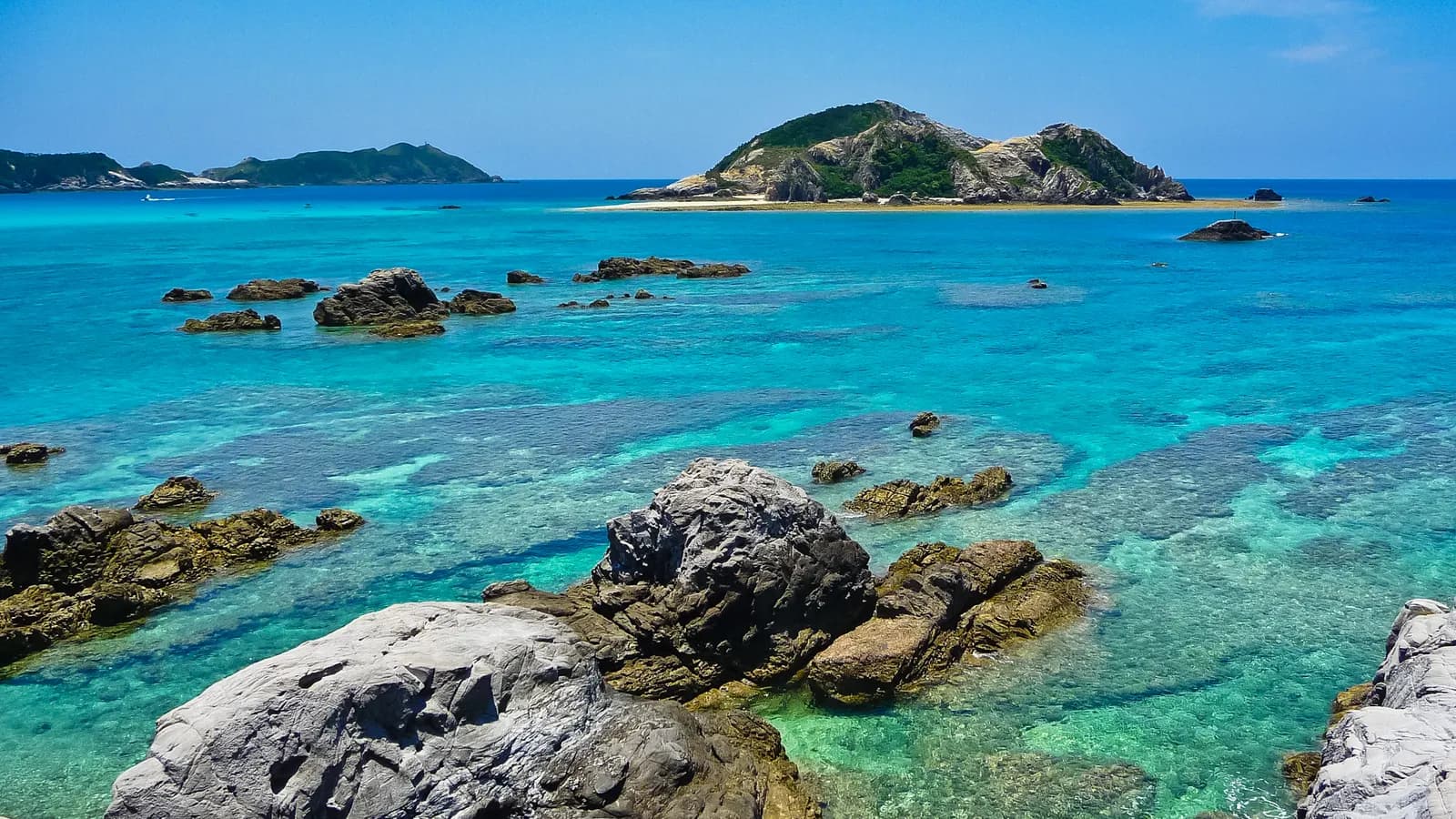
The Kerama Islands, a boat ride west of Naha, have more than 150 dive sites, most within 15 minutes by boat from the islands, and they suit certified divers better than complete beginners.
Day boats from Naha cross to the Keramas, or you can stay on Zamami or Tokashiki and dive with a local shop. Hanari (4–8 m, 13–26 ft) is an easy dive over white sand and rocks with cardinalfish schools, shrimps and crabs. Other Kerama sites go deeper: Nishibama to about 25 m (82 ft), Amuro Gyosho to 15 m (49 ft), Ugan, rated advanced, to 25 m (82 ft), and Shimosone, an exposed offshore site dived only in summer, to 40 m (131 ft).
Zamami Village charges a Churashima environmental tax of JPY 100 per person per trip, collected with your ferry or air fare; children up to junior-high-school age pay nothing.
From January to March humpback whales winter around the islands. Zamami's whale-watching rules ban swimming with the whales and keep boats 100 m (328 ft) away, so skip any tour that sells a whale swim and watch from a whale-watching boat instead.
Where can you dive with manta rays in Okinawa?
Okinawa's manta dives are around Ishigaki in the Yaeyama Islands: Kabira Manta Point (8–20 m, 26–66 ft) from about May to October, Kuroshima in winter, and the Yonara Channel between Ishigaki and Iriomote for experienced divers.
At Kabira the mantas come to cleaning stations on reef mounds. Keep low and still near the mounds, give the rays room and never chase them. The Yonara Channel (25–30 m, 82–98 ft) is a drift dive, best on the ebb tide, with mantas passing through; it is rated advanced. When north winds close the Kabira side in winter, centers take manta trips to Kuroshima instead.
Ishigaki has its own airport, New Ishigaki (ISG), and its own dive centers, so a manta trip does not have to start from Okinawa Island.
Can you dive from Okinawa Island itself?
Yes: Okinawa Island has sites of its own, such as Cape Maeda with its Blue Cave (up to 40 m, 131 ft) and Sunabe (up to 25 m, 82 ft), both rated beginner, while the wreck of the USS Emmons at about 45 m (148 ft) is for experienced divers only.
- Gorilla Chop (up to 15 m, 49 ft) and Odo (up to 30 m, 98 ft, intermediate) are two more Okinawa Island sites.
- Manza Dream Hole (about 23 m, 75 ft) is dived with Advanced certification.
- USS Emmons, a warship sunk on 7 April 1945 and found again in 2001, lies at about 45 m (148 ft), beyond the usual recreational limit. Centers ask for Advanced certification and at least 30 logged dives; dive it only within your own training and depth limits.
Diving on Okinawa Island itself saves the boat crossing to the Keramas, which suits a short stay in Naha.
How much does diving in Okinawa cost?
A two-tank boat dive in Okinawa usually costs about JPY 21,000 (JPY 15,000–27,500), a two-dive Discover Scuba about JPY 32,000 (JPY 22,800–34,100) and an Open Water course about JPY 99,000 (JPY 75,000–130,000), prices checked November 2026.
The boat-dive figures mix the islands on purpose: Ishigaki, the Keramas from Naha and Okinawa Island itself.
- Boat dives: the Kabira manta trip with Manta Holic, sold through Fusaki Beach Resort, includes boat, lunch and tax; Prime Scuba on Ishigaki adds JPY 7,000 for gear; KUMODIVE's Kerama day from Naha is a from-price with JPY 5,000 for gear; Piranha Divers on Okinawa Island includes the 10% tax, gear extra.
- Try dives: all three programs are two dives with full equipment; Prime Scuba's includes the boat and lunch.
- Open Water: the spread is wide because inclusions differ. KUMODIVE quotes a from-price, Piranha's SDI course includes eLearning and gear, and Seasir's all-in price covers eLearning, rental, boat and lunch.
All three Open Water prices are for courses taught in English; Japanese-only shops often list a lower base fee with boat and license fees added. For current prices, ask Okinawa dive centers.
Prices checked
| Item | Typical price | Range |
|---|---|---|
| Open Water course | JP¥99,000 | JP¥75,000–JP¥130,000 |
| Two-tank boat dive | JP¥21,000 | JP¥15,000–JP¥27,500 |
| Discover Scuba (try dive) | JP¥32,000 | JP¥22,800–JP¥34,100 |
Prices change; confirm with the center before you book.
Where is the nearest recompression chamber in Okinawa?
Okinawa's hyperbaric unit is the Department of Hyperbaric Medicine at University of the Ryukyus Hospital in Ginowan, on Okinawa Island, which treats decompression sickness; patients from outside need a referral, which your dive center or the 119 emergency service arranges.
The hospital does not say that it offers round-the-clock emergency cover, so before your trip ask your dive center how it handles a diving accident at night or on a weekend. From Ishigaki or the Keramas, a diver with symptoms may have to be moved to Okinawa Island; ask your Ishigaki center where it sends divers.
Carry dive insurance that covers evacuation and chamber treatment, and see a dive doctor or DAN about fitness to dive. On drift dives such as the Yonara Channel, agree on the plan with your guide before you descend and stay with the group.
Dive centers in Okinawa
Loading dive centers…
Frequently asked questions
Can you swim with whales in Okinawa?
No. Humpback whales winter around the Kerama Islands from about January to March, and the local whale-watching rules on Zamami ban swimming with them and keep boats 100 m (328 ft) away. Some tours still advertise whale swims; skip them. Watch from a whale-watching boat instead, and on winter dives listen for whale song, which divers sometimes hear underwater.
Is Okinawa good for beginner divers?
Yes, in places. Hanari in the Kerama Islands (4–8 m, 13–26 ft) and Ishigaki's calm west side are rated beginner, and Cape Maeda and Sunabe on Okinawa Island are too. A two-dive Discover Scuba costs about JPY 32,000 with equipment. The Keramas as a whole suit certified divers better, and the Yonara Channel and the USS Emmons are for experienced divers only.
How cold is the water in Okinawa in winter?
The sea around Okinawa Island cools to 21.7 °C (71 °F) in February and 21.8 °C (71 °F) in March, its coldest months, after 22.6 °C (73 °F) in January. That is about 7 °C (13 °F) cooler than in August, when it reaches 28.9 °C (84 °F). For whale-season dives, bring a thicker wetsuit or ask your center about a semi-dry suit.
How do you get to the Kerama Islands for diving?
Fly into Naha Airport (OKA) on Okinawa Island. Dive centers in Naha run day boats to the Kerama Islands, or you can take a ferry to Zamami or Tokashiki and dive with a shop on the island. Zamami adds a Churashima environmental tax of JPY 100 per person per trip, collected with the fare. Ishigaki, for the mantas, has its own airport (ISG).
Do typhoons affect diving in Okinawa?
Yes. Typhoons approach Okinawa mainly from July to October, most often in August and September, about 7 to 8 times a year on average. When one passes, ports close and boat diving can stop for several days. If you travel in late summer, keep spare days, book refundable transfers and check the forecast with your dive center before each boat day.
When can you see manta rays on Ishigaki?
Kabira Manta Point on Ishigaki is dived mainly from spring to autumn, best about May to October, when mantas visit its cleaning stations at 8–20 m (26–66 ft). In winter north winds usually close the Kabira side, and centers run manta trips to Kuroshima instead. Experienced divers can also meet mantas drifting through the Yonara Channel on the ebb tide.


