Dive guide · Vietnam
Scuba Diving in Phu Quoc
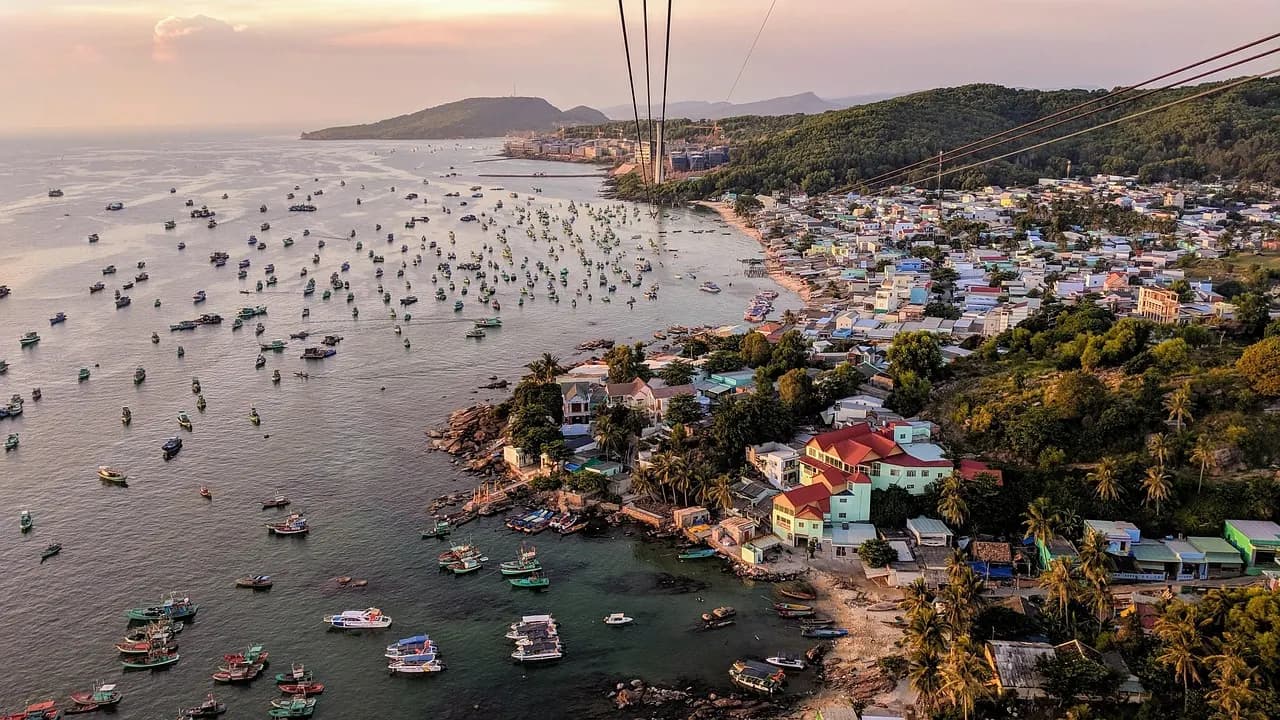
Phu Quoc, an island in the Gulf of Thailand off south-west Vietnam, is a gentle place to dive, with shallow reefs, most no deeper than 12 m (39 ft), around the An Thoi islands and off the north coast. The season runs from November to April. A day trip with two dives costs USD 90–100 (prices checked November 2026).
Key facts
- Best months
- November to April
- Water temperature
- 27.9–30.4 °C (82–87 °F)Monthly average, coolest to warmest month
- Level
- Beginner to intermediate
- Open Water course
- US$450Typical price, checked
- Two-tank boat dive
- US$95Typical price, checked
- Discover Scuba (try dive)
- US$105Typical price, checked
- Snorkel tour
- US$37.50Typical price, checked
- Airport
- Phu Quoc International Airport (PQC)
- Nearest chamber
- Military Hospital 175 (Benh vien Quan y 175), Ho Chi Minh City
Book a dive trip in Phu Quoc
Trips run by local operators, booked on Viator or GetYourGuide.
 Viator[GROUP] SCUBA DIVING for Certified Divers in Phu Quoc IslandView on Viator (opens in a new tab)
 GetYourGuidePhu Quoc: Scuba Diving Experience for All LevelsView on GetYourGuide (opens in a new tab)
 ViatorScuba Diving in Phu Quoc Full Day Trip (For Certificated Divers)View on Viator (opens in a new tab)
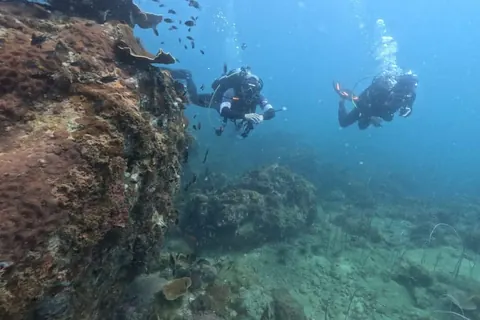 GetYourGuidePhu Quoc: One-Day Scuba Diving TourView on GetYourGuide (opens in a new tab)
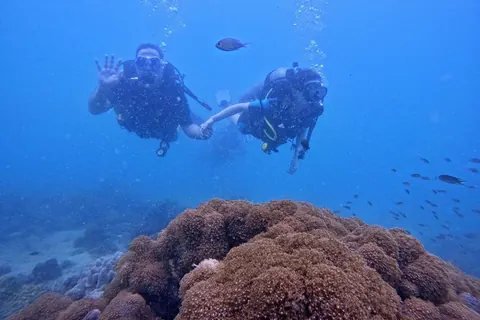 Viator[GROUP] SCUBA DIVING For Beginners in Phu Quoc Island (TRY DIVE)View on Viator (opens in a new tab)
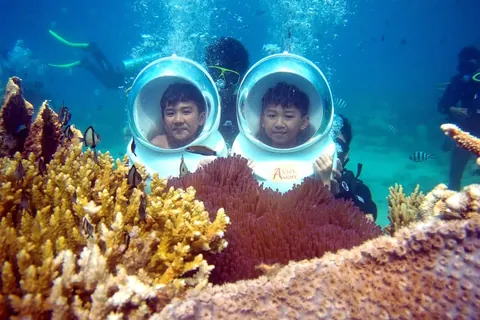 GetYourGuidePhu Quoc: Snorkeling, Sea Walking, and Scuba Diving TourView on GetYourGuide (opens in a new tab)
All Phu Quoc trips on Viator (opens in a new tab)
Ratings from GetYourGuide travellers.
When is the best time to dive in Phu Quoc?
The best time to dive Phu Quoc is the dry season from November to April, when the sea is calm, roughly the reverse of Nha Trang's season on the central coast. Monthly sea temperatures range from 27.9 °C (82 °F) in January to 30.4 °C (87 °F) in May.
From May to October the rainy season brings rougher seas, stronger winds and lower visibility. Boats still go out, but the diving is harder work, and beginners are better off waiting for the dry months.
Water temperature
The island's water never cools much: through the November–April season it sits between 27.9 and 29.9 °C (82–86 °F), and it peaks at 29.9–30.4 °C (86–87 °F) in April and May. Most divers are comfortable in a thin wetsuit.
For a trip between February and August, Nha Trang is the alternative; our Vietnam diving guide covers it.
| Month | Average water temperature | Season |
|---|---|---|
| January | 27.9 °C (82 °F) | Best month to dive |
| February | 28.1 °C (83 °F) | Best month to dive |
| March | 28.9 °C (84 °F) | Best month to dive |
| April | 29.9 °C (86 °F) | Best month to dive |
| May | 30.4 °C (87 °F) | Outside the best months |
| June | 29.8 °C (86 °F) | Outside the best months |
| July | 29.2 °C (85 °F) | Outside the best months |
| August | 28.8 °C (84 °F) | Outside the best months |
| September | 28.8 °C (84 °F) | Outside the best months |
| October | 28.9 °C (84 °F) | Outside the best months |
| November | 28.8 °C (84 °F) | Best month to dive |
| December | 28.3 °C (83 °F) | Best month to dive |
In season in: January · February · March · April · November · December
Where are the best dive sites around Phu Quoc?
Phu Quoc's dive sites lie in two areas, the north coast, with Turtle Island and Nudibranch Garden at 0–12 m (0–39 ft), and the An Thoi islands in the south, with May Rut Trong, The Outside and Coconut Reef, the deepest of them at 8–20 m (26–66 ft).
North coast
- Turtle Island: reef from just below the surface with boulder canyons at 7–10 m (23–33 ft), hard corals, an anemone colony and big shoals of fusiliers.
- Nudibranch Garden: a very shallow reef with coral and rock formations at 7–10 m (23–33 ft), many purple Godiva nudibranchs and the odd bamboo shark.
An Thoi islands
- May Rut Trong: a small islet with a shallow reef you can circle on one tank, good for divers and snorkelers alike.
- The Outside: named for offshore rocks that barely break the surface; good diving, but awkward for boats.
- Coconut Reef: a slope ending in a flower-coral garden, with pufferfish, pipefish and the occasional seahorse.
Nail Island (Fingernail Island) is an islet joined to the shore at low tide, with shallow reef and big granite boulders on sand where pufferfish, octopus and mantis shrimp live. Day trips head either north or south, so ask which area your boat visits that day.
| Dive site | Depth | Level | Entry | Highlights |
|---|---|---|---|---|
| Turtle Island (north Phu Quoc) | 0–12 m (0–39 ft) | Beginner | Boat | Reef from just below the surface with boulder 'canyons' at 7-10 m, hard corals, an anemone colony and big shoals of fusiliers |
| Nudibranch Garden (north Phu Quoc) | 0–12 m (0–39 ft) | Beginner | Boat | Very shallow reef with coral and rock formations at 7-10 m, many purple Godiva nudibranchs and the odd bamboo shark |
| Nail Island (Fingernail Island) | 0–10 m (0–33 ft) | Beginner | Boat | Islet joined to the shore at low tide; shallow reef and big granite boulders on sand, good for practising buoyancy; pufferfish, octopus and mantis shrimp |
| May Rut Trong (An Thoi islands) | 0–10 m (0–33 ft) | Beginner | Boat | Small islet with a shallow reef you can circle on one tank; good for divers and snorkellers |
| The Outside (An Thoi islands) | 0–12 m (0–39 ft) | Beginner | Boat | Reef named for the offshore rocks that barely break the surface; good diving, awkward for boats |
| Coconut Reef (An Thoi islands) | 8–20 m (26–66 ft) | Intermediate | Boat | Reef sloping from 8 to 20 m with a flower-coral garden near the bottom; pufferfish, pipefish and the occasional seahorse |
Is Phu Quoc good for beginner divers?
Phu Quoc is one of the easiest places in Vietnam to start diving: five of the six sites in our table are rated beginner, most stay shallower than 12 m (39 ft), and a try dive with two boat dives costs USD 100–150.
Nail Island's boulders on sand are a good place to practice buoyancy, and the north-coast reefs start right below the surface, so there is little depth to manage. Coconut Reef, sloping to 20 m (66 ft), is the step up once you have a few dives logged.
An Open Water course on the island usually costs about USD 450 (USD 368–450), with the theory or eLearning included at most centers. Come in the dry season, since the rougher seas of May to October make learning harder.
Is Phu Quoc good for snorkeling?
Yes: snorkelers can join Phu Quoc's dive boats for USD 35–45 a day, and sites such as May Rut Trong and Turtle Island, whose reefs start just below the surface, work well from above.
A snorkel place costs USD 35 with Vietnam Explorer on its south trip, USD 37.50 with Rainbow Divers on its north trip and USD 45 with Vietnam Active. Because divers and snorkelers share the boat, a mixed group can spend the day together. Go between November and April; in the rainy season the sea is rougher and the water less clear.
How much does diving in Phu Quoc cost?
A boat day with two dives, equipment and lunch costs USD 90–100 in Phu Quoc, typically USD 95, a two-dive try dive USD 100–150 and an Open Water course usually about USD 450 (prices checked November 2026).
- Two dives: Vietnam Explorer USD 90 for its south trip, a price it first posted in November 2024 and still shows; Rainbow Divers and Phil Hai Diving Club USD 95 for the north or the south; Vietnam Active USD 100 with everything included.
- Try dive: USD 100 at Vietnam Explorer and Phil Hai, USD 110 at Vietnam Active and USD 150 at Rainbow Divers, whose price adds a pool session in Saigon or on Phu Quoc.
- Open Water: Sea Coral USD 368 and Viet Diving USD 440 for SSI courses (their PADI courses cost USD 420 and USD 460), and USD 450 for PADI at Rainbow Divers, Vietnam Active and Ecodive. Theory or eLearning is included at all of them except Ecodive, which does not say.
- Snorkelers: USD 35–45 for a place on the dive boat.
Centers on the island quote in US dollars. Ask whether any marine-park charge is added to the trip price. For prices, ask Phu Quoc dive centers.
Prices checked
| Item | Typical price | Range |
|---|---|---|
| Open Water course | US$450 | US$368–US$450 |
| Two-tank boat dive | US$95 | US$90–US$100 |
| Discover Scuba (try dive) | US$105 | US$100–US$150 |
| Snorkel tour | US$37.50 | US$35–US$45 |
Prices change; confirm with the center before you book.
Is there a recompression chamber on Phu Quoc?
There is no confirmed recompression chamber on Phu Quoc: divers with decompression illness in Vietnam have been treated at Military Hospital 175 in Ho Chi Minh City, a flight away, so carry dive insurance with evacuation cover and agree the emergency plan with your dive center.
Whether the Ho Chi Minh City chamber is available around the clock is not published, so ask your center how it would move an injured diver off the island, and by which route. Our dive insurance guide explains what to check in a policy. If you feel unwell after diving, tell your guide straight away and call DAN or your insurer's emergency line.
Dive centers in Phu Quoc
Loading dive centers…
Frequently asked questions
Is Phu Quoc or Nha Trang better for diving?
It depends on when you travel. Phu Quoc dives best from November to April and Nha Trang from about February to August, so their seasons overlap only from February to April. Phu Quoc's reefs are shallower and gentler, which suits beginners and snorkelers; Nha Trang adds a wreck, a cave and sites to 30 m (98 ft). Two boat dives cost USD 90–100 on Phu Quoc and USD 70–80 in Nha Trang.
What is the water temperature in Phu Quoc?
Warm all year. The sea around Phu Quoc averages 27.9 °C (82 °F) in January, its coolest month, and 30.4 °C (87 °F) in May, its warmest. In the dive season from November to April it stays between 27.9 and 29.9 °C (82–86 °F), so a thin wetsuit is all most divers bring, even for a long day with two dives.
Can you dive Phu Quoc in the rainy season?
You can, but it is harder. From May to October the rainy season brings rougher seas, stronger winds and lower visibility around Phu Quoc, and beginners are advised to come in the dry season from November to April instead. If your trip falls in the middle of the year, consider Nha Trang on the central coast, which dives best from about February to August.
How do you get to Phu Quoc for diving?
Phu Quoc has its own airport, Phu Quoc International (PQC), so you can fly straight to the island. Dive centers run day boats from the island either to the north coast or to the An Thoi islands in the south; a two-dive day includes equipment and lunch, and snorkelers can usually join the same boat for USD 35–45.
Do I need dive insurance for Phu Quoc?
Yes. No recompression chamber on the island is confirmed; divers with decompression illness in Vietnam have been treated at Military Hospital 175 in Ho Chi Minh City, which means a flight. Choose a policy that covers chamber treatment and emergency evacuation, and before your first dive ask your center how it would get an injured diver to treatment.
What marine life can you see in Phu Quoc?
Phu Quoc is a small-reef destination rather than a big-animal one. Expect hard corals, an anemone colony and big shoals of fusiliers at Turtle Island, purple Godiva nudibranchs and the odd bamboo shark at Nudibranch Garden, and pufferfish, octopus, mantis shrimp, pipefish and the occasional seahorse around Nail Island and Coconut Reef. Slow down and look closely.


